


The fermentation tanks are at critical temperature. You've got a double batch scheduled Monday morning. Your maintenance guy quit three weeks ago, and the service tech won't be available until Tuesday. This scenario destroys small breweries every summer, and it's completely preventable.
After looking at maintenance patterns across dozens of craft breweries, one thing keeps coming up: the difference between breweries that survive equipment failures and those that don't isn't the quality of their equipment. It's whether they have a reliability system that catches problems before they become disasters.
Most brewery preventive maintenance programs fail because they treat all equipment the same way. Your canning line and your mash tun don't need identical attention. Your glycol system and your grain mill fail in completely different ways. Yet I keep seeing maintenance schedules that look like someone pulled a generic checklist off a brewing forum and called it a day.
Why brewery equipment fails differently than other industries
Brewery equipment faces a unique combination of stresses that accelerates failure in ways most maintenance programs don't account for. You're running caustic chemicals through the same system that handles acidic wort. Equipment swings between near-freezing glycol temps and boiling CIP cycles multiple times a week. Add constant moisture, CO2 exposure, and the fact that most craft breweries push equipment past design capacity, and you've got failure modes that generic maintenance approaches miss entirely.
Take pump seals. In a normal industrial setting, a pump seal might last 8,000 operating hours. In a brewery running hot caustic followed by cold product? You're lucky to get 2,000 hours. The thermal cycling alone destroys standard seals faster than continuous operation ever would.
The real problem starts when breweries don't track these accelerated failure patterns. One brewery I worked with was replacing their transfer pump seals every four months like clockwork — they thought it was just normal wear. Turns out their CIP program was running caustic at 180°F when the seal manufacturer rated them for 160°F max. One temperature adjustment saved them roughly $4,800 a year in parts and labor.
This pattern shows up across basically every piece of brewery equipment. Valve seats wear differently when cycling between beer and cleaning chemicals. Heat exchanger gaskets fail faster with pH swings. Even your keg washer experiences unique stress from the combination of mechanical action and chemical exposure.
Asset criticality tiers that actually match brewery operations
Not all equipment failures hurt equally. Losing your bottle filler during packaging means rescheduling one day of production. Losing your glycol chiller means potentially dumping every tank in fermentation. Yet most breweries maintain both with the same urgency.
Take control of your brewery’s workflow.
Beeryly helps you schedule batches, track inventory, and monitor sales with ease.
- Production timeline management
- Inventory tracking & alerts
- Sales & distribution monitoring
No credit card required
Here's the criticality framework that actually works for brewery operations:
Tier 1 - Production Stoppers These failures halt everything. No workarounds exist. Think glycol system, main electrical panel, boiler, compressed air system, water treatment. When these fail, you're not brewing until they're fixed. These need weekly checks, monthly detailed inspections, and spare parts on hand.
Tier 2 - Batch Critical Failure ruins product but doesn't stop all production. Your heat exchanger, fermentation temperature controls, yeast brink refrigeration, carbonation equipment. You might lose a batch or delay production, but other processes continue. Monthly checks, quarterly detailed maintenance, critical spares for items with long lead times.
Tier 3 - Schedule Disruptors These create delays and inefficiencies but don't destroy product. Packaging equipment, transfer pumps, CIP systems, grain handling equipment. You can work around failures with manual processes or temporary fixes. Quarterly checks, semi-annual detailed maintenance, order spares when you see wear developing.
Tier 4 - Convenience Equipment Keg washers, portable pumps, hose reels, auxiliary lighting. Failure means more manual work but production continues. Annual checks, replace on failure for most items.
The magic happens when you match your maintenance intensity to these tiers. A brewery running 3,000 barrels annually can't treat everything like it's critical. Focus your limited maintenance hours on Tier 1 and 2 assets. Let Tier 4 items run to failure.
One brewery shifted from spending 40% of maintenance time on their canning line (Tier 3) to 65% on glycol and fermentation controls (Tier 1-2). Zero temperature excursions in eight months, compared to three dumped batches the previous year. Same maintenance hours, completely different outcomes.
Building checklists that operators actually complete
The best preventive maintenance happens during normal operations, not special maintenance windows. Your brewers interact with equipment daily. They notice changes before catastrophic failure. But most brewery maintenance checklists look like engineering documents, not operational tools.
Effective operator checklists focus on observations, not tasks. Instead of "inspect pump seals," write "check for drips under pump - should be completely dry." Instead of "verify heat exchanger operation," write "outlet temperature should be within 2°F of setpoint."
Here's what actually gets done:
Daily Visual Checks (30 seconds per item)
-
Glycol reservoir level - between MIN and MAX lines
-
Compressor discharge pressure - green zone on gauge
-
Any new puddles under pumps or tanks
-
Unusual sounds from motors or compressors
-
CO2 tank pressure - above 100 PSI
Weekly Operator Rounds (5 minutes per area)
-
Feel motor housings - warm not hot
-
Check belt tension - 1/2 inch deflection
-
Look for rust streaks indicating leaks
-
Verify all gauges reading normal ranges
-
Test emergency stops and safety interlocks
Monthly Detailed Inspections (20 minutes per system)
-
Record actual operating pressures and temperatures
-
Check inside electrical panels for hot spots or corrosion
-
Inspect hoses for cracks or soft spots
-
Verify calibration on critical gauges
-
Test backup systems and alarms
Keep operator checklists concise—short, observable items get completed far more often than long technical lists.
The key is making these checklists part of existing routines. The brewer checking fermentation temperatures also checks glycol supply temperature. The packager starting the canning line also checks the compressor. When maintenance becomes part of normal workflow, it actually happens.
A 15-barrel brewhouse tried this approach after their previous 47-point weekly checklist sat at about 30% completion. The new 12-point operator checklist, integrated into daily routines, hit 95% completion. They caught a failing glycol pump bearing three weeks before it would have seized — saved themselves a roughly $12,000 weekend emergency repair.
MTTR and MTBF tracking without the MBA spreadsheet hell
Mean Time To Repair (MTTR) and Mean Time Between Failures (MTBF) sound like metrics only Boeing needs to track. For breweries, though, these two numbers predict whether you'll hit production targets or spend weekends fixing equipment.
You don't need complex software. A simple logbook works:
-
Equipment name
-
Failure date and time
-
What actually broke
-
Time to get running again
-
Parts and labor cost
After six months, patterns emerge. That transfer pump failing every 400 hours? Schedule rebuilds at 350 hours. CIP pump taking 6 hours to repair because you're always waiting for seals? Keep seals in stock.
The real value comes from comparing your numbers to equipment baselines. A centrifugal pump should run 8,000+ hours between rebuilds. If yours fails at 2,000 hours, something's wrong with installation, operation, or maintenance — maybe cavitation from incorrect valve positioning, maybe running dry during CIP. The numbers point you toward root causes.
One brewery tracked every equipment failure for a year. They found their hop doser motor failed every 800 batches and took 4 hours to replace. They started swapping motors at 750 batches during planned downtime. Thirty minutes of planned maintenance replaced 4 hours of emergency repair.
Track these metrics by criticality tier. Tier 1 equipment should have MTBF measured in years and MTTR in hours. Tier 3 equipment might fail monthly, but if MTTR stays under an hour, that's acceptable. It's about matching reliability investment to operational impact.
| Equipment Tier | Target MTBF | Acceptable MTTR | Spare Parts Priority |
|---|---|---|---|
| Tier 1 - Production Stoppers | Years | Hours | Stock immediately |
| Tier 2 - Batch Critical | Months | Under 1 day | Stock within 6 months |
| Tier 3 - Schedule Disruptors | Weeks to months | 1–2 days | Order on wear signal |
| Tier 4 - Convenience Equipment | Variable | Days | Order on failure |
These aren't hard rules — they're starting benchmarks. Your actual numbers will shift based on equipment age, how hard you push it, and how well your CIP program treats seals and gaskets.
Spare parts strategy for 10-barrel budgets
The traditional spare parts formula says stock everything with lead time over X days and cost under Y dollars. That formula will bankrupt a small brewery. You need a spare parts strategy that balances risk against cash flow reality.
Start with failure impact and lead time, not cost:
Stock Immediately
-
Pump seals and gaskets for Tier 1-2 equipment
-
Fuses, contactors, and relays for critical controls
-
Temperature and pressure sensors for fermentation
-
Solenoid valves for glycol and CO2 systems
-
Commonly failing wear items with known MTBF
Stock Within 6 Months
-
One complete pump rebuild kit for each critical pump
-
VFD or soft-start for your largest motor
-
Heat exchanger gaskets
-
Critical valve rebuild kits
-
Specialty items with 4+ week lead times
Order on Failure
-
Motors under 5 HP (usually available same-day locally)
-
Standard bearings and belts
-
Non-critical instrumentation
-
Tier 3-4 equipment parts
The trick is knowing your actual lead times. That "in-stock" part might be sitting in a warehouse in Germany with 6-week shipping. Build relationships with multiple suppliers. Know who can overnight critical parts. Paying 30% more for next-day delivery often beats losing three days of production.
A 7-barrel brewery mapped every critical component lead time and found their glycol compressor control board had a 12-week lead time from the manufacturer, but a rebuilder could turn one around in 5 days. They bought a spare board, had it rebuilt, and kept it on the shelf. When the original failed 18 months later, they swapped boards in 20 minutes instead of shutting down for a week.
Your spare parts inventory should roughly equal 1.5–2% of your equipment replacement value for Tier 1-2 assets. A brewery with $400,000 in critical equipment should carry $6,000–8,000 in strategic spares. That sounds expensive until you lose $15,000 in dumped beer waiting for a $200 temperature controller.
Scheduling around breakdowns you know will happen
Perfect equipment reliability doesn't exist in craft brewing. You will have failures. The difference between chaos and a controlled response is building breakdown allowances into your production schedule.
Based on your MTBF data, you can predict failure frequency. If your canning line averages one 4-hour breakdown per 100 hours of operation and you run 30 hours per week, expect roughly 1-2 failures monthly. Build that into your schedule.
Instead of scheduling 40 hours of production into 40 hours of available time, use this formula:
Available Time × (1 - Historical Breakdown %) = Schedulable Time
If breakdowns consume 15% of production time: 40 hours × 0.85 = 34 schedulable hours
Those 6 buffer hours aren't waste. They're insurance. When equipment runs perfectly, use buffer time for deep cleaning, preventive maintenance, or getting ahead on next week's production. When breakdowns hit, you're not calling distributors to delay deliveries.
The breakdown buffer varies by department:
-
Brewhouse
5–10% (reliable, redundant systems)
-
Cellaring
10–15% (more equipment, complex transfers)
-
Packaging
15–25% (highest failure rate, most complex)
One brewery running a volatile canning line started scheduling only 6-hour runs in 8-hour windows. The 2-hour buffer handled changeovers, minor repairs, and quality issues. On-time delivery improved from 70% to 95% just by admitting the equipment wasn't perfect.
This connects directly to your KPI tracking system. When breakdown percentage exceeds your buffer, that's a trigger for intensive maintenance or equipment replacement. If you're buffering 20% but only using 5%, you might be over-maintaining — or you have room to take on more production.
Turning maintenance data into operations decisions
The real power of tracking brewery preventive maintenance isn't preventing individual failures — it's seeing patterns that drive operational improvements.
A 20-barrel brewery tracking maintenance discovered their fermentation control valve failures clustered on specific tanks. Tanks 1-4 failed every 3-4 months. Tanks 5-8 ran for years without issues. The difference? Tanks 1-4 were original equipment installed with standard industrial valves. Tanks 5-8 used brewery-specific valves designed for CIP compatibility. A $2,000 investment to upgrade valves on tanks 1-4 eliminated roughly $8,000 in annual repairs and prevented two near-miss contamination events.
Maintenance data also reveals when equipment has reached end-of-life. Track total cost of ownership using this ratio:
Annual Maintenance Cost ÷ Replacement Cost = Maintenance Ratio
When this ratio exceeds 20–25%, replacement usually makes more sense. That 10-year-old centrifuge requiring $15,000 in annual maintenance against a $40,000 replacement cost sits at a 37.5% maintenance ratio — you're better off replacing it.
The calculation goes deeper, though. Include production losses from breakdowns, quality issues from degraded performance, and energy efficiency differences. Newer equipment might cost more upfront but eliminate weekend overtime repairs and meaningfully cut utility costs over time.
Connecting reliability to every other brewery system
Preventive maintenance doesn't exist in isolation. It connects to every aspect of brewery operations. Poor maintenance affects your CIP scheduling when pumps can't achieve proper flow rates. Equipment breakdowns cascade through your production schedule, hitting everything from tank utilization to delivery commitments.
The most successful reliability programs integrate with other systems:
Quality Control Integration When quality issues come up, check maintenance records for correlations. That slight off-flavor appearing in Tank 3 beers? It might correlate with glycol valve maintenance intervals. Track quality incidents against equipment maintenance history.
Production Planning Integration Share MTBF data with production schedulers. If the bottling line typically needs major maintenance every 2,000 hours, schedule it during slow periods — not peak season. Plan major maintenance windows around seasonal production cycles.
Financial Planning Integration Predictive maintenance data improves capital planning. Knowing your heat exchanger has 18 months of life left lets you budget for replacement, research options, and potentially negotiate better prices instead of making an emergency purchase at whatever price the supplier wants.
A brewery that integrated maintenance tracking with production planning software saw the scheduling system automatically flag equipment approaching maintenance intervals. That simple integration reduced emergency maintenance by roughly 60% and improved schedule reliability from 75% to 92%.
These aren't isolated improvements — each one compounds the others. Better scheduling reduces reactive scrambling. Better capital planning reduces emergency purchases. Better quality correlation catches problems before they become dumped batches.
The AI automation advantage for reliability programs
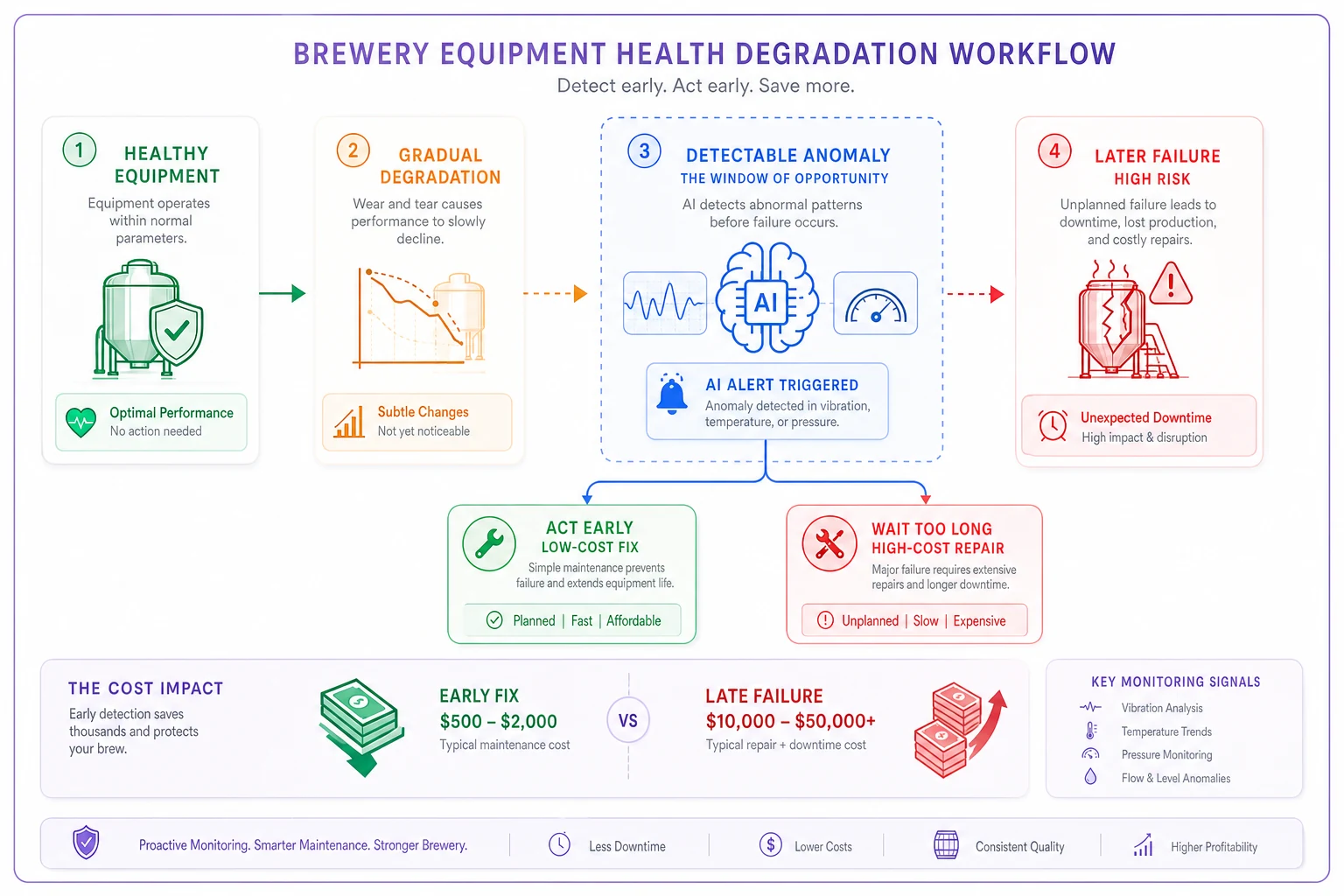
This is where modern operational software starts to actually change things for small breweries. AI-powered platforms can track patterns across all your equipment, automatically identify degradation trends, and alert operators before failures occur — without requiring a dedicated maintenance engineer on staff.
Instead of manually logging every maintenance task, sensors and automated systems capture equipment performance continuously. When pump vibration increases or motor temperature climbs beyond normal patterns, the system flags it for inspection. You catch problems while they're still $50 fixes, not $5,000 emergencies.
GRAPH: Equipment health degradation curve showing the cost difference between catching a problem at the "detectable anomaly" stage versus the "failure" stage — illustrating the value window where AI-flagged alerts create the most savings.
The real benefit isn't just tracking — it's pattern recognition across your entire operation. AI automation can correlate things that seem unrelated: a slight pressure drop in your glycol system, increased runtime on compressors, minor temperature fluctuations in specific tanks. Individually, these look normal. Together, they can indicate a developing leak that manual tracking would miss entirely.
These platforms also reduce the administrative burden that kills most preventive maintenance programs. Automatic work order generation, parts ordering when inventory hits minimum levels, maintenance scheduling that adapts to production demands — your team focuses on actually maintaining equipment, not managing spreadsheets.
For resource-constrained breweries, this kind of tooling levels the playing field. You get solid reliability management without needing an enterprise-level maintenance department.
Making reliability your competitive advantage
The breweries that last aren't necessarily the ones with the best recipes or the most Instagram followers. They're the ones that can consistently produce and deliver quality beer without constant equipment drama. A solid brewery preventive maintenance program isn't about perfection — it's about predictability.
When your glycol chiller dies at 2 AM on that Saturday, you won't panic. You'll swap in the rebuilt compressor you've had on the shelf for six months, because your MTBF tracking told you this failure was statistically likely. Your production schedule already had buffer time built in. Your team knows exactly what to do.
More importantly, those 2 AM emergencies become increasingly rare. Not because your equipment is newer or better than your competitors', but because you've built systems that catch problems early, schedule maintenance strategically, and turn equipment reliability from a hope into something you can actually plan around.
The framework here — criticality tiers, operator-integrated checklists, practical MTBF/MTTR tracking, strategic spare parts, and schedule buffers — takes roughly 4–6 hours per week to manage once it's set up. That time investment pays for itself the first time you prevent a tank dump or avoid a weekend emergency repair.
Start with one system. Pick your most critical, most problematic equipment. Track every failure for three months. Build simple checklists that operators will actually complete. Stock the parts that have already burned you. Create small schedule buffers. Then expand the program as you see results.
Your competition is hoping their equipment holds together through the next production run. You'll know when each piece of equipment needs attention, have the parts ready, and the time scheduled. That's the difference between a brewery that's always putting out fires and one that actually scales.
Ready to elevate your brewery operations?
Join 500+ craft breweries using Beeryly to increase production efficiency, reduce waste, and grow sales.