

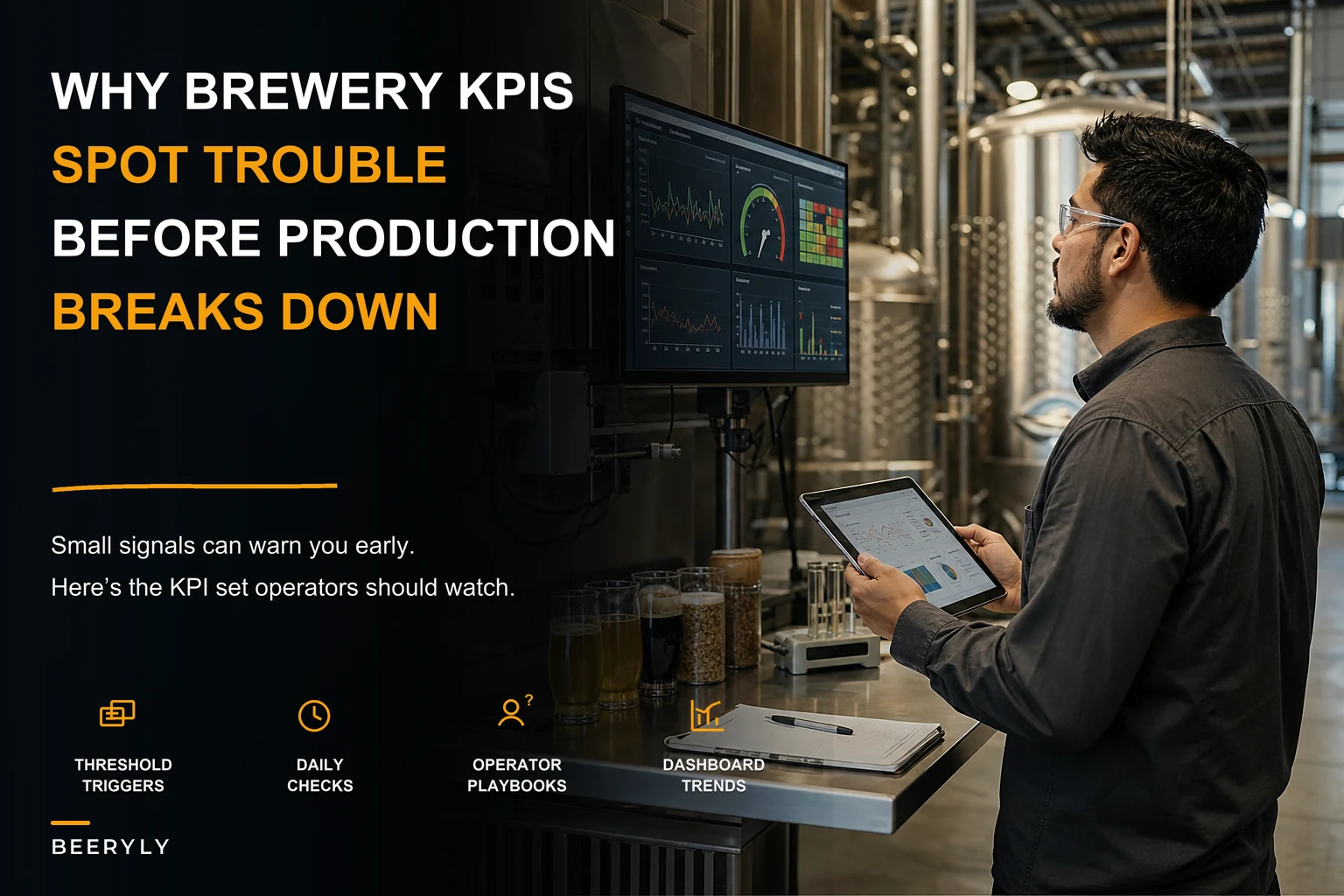

Running a brewery means running three businesses at once—a factory, a chemistry lab, and a hospitality venue. Most brewery owners track revenue and check tank turns monthly, but the operations that prevent costly disasters live in a handful of KPIs that almost nobody monitors correctly.
Building operational software for dozens of craft breweries showed me the same pattern: production problems appear in the numbers weeks before they become expensive emergencies. The difference between breweries that catch issues early and those that don't is tracking the right KPIs with trigger thresholds and having clear playbooks when those numbers shift.
Units & glossary (quick reference)
-
SG = Specific Gravity (unitless). Gravity points = (SG − 1.000) × 1000 (example
1.050 → 50 points).
-
°P = degrees Plato. Conversion example
1.050 → 50 points ≈ 12.4 °P.
-
ppb/ppm = parts per billion / parts per million (1 ppm = 1000 ppb).
-
cells/mL = viable yeast cells per millilitre; report concentration and viability separately.
-
days/hours = calendar days or elapsed hours; always state which when sampling.
-
Control-chart baseline
collect 4–8 weeks of routine data before making final thresholds.
For QC sampling details and sample-point lists, see the QC sampling plan.
Why standard brewery metrics miss operational problems
Most brewery dashboards show vanity metrics: total barrels produced, monthly revenue, and a few cost percentages. Those tell you what already happened, not what's about to break.
Take control of your brewery’s workflow.
Beeryly helps you schedule batches, track inventory, and monitor sales with ease.
- Production timeline management
- Inventory tracking & alerts
- Sales & distribution monitoring
No credit card required
Real production problems hide in the relationships between systems. A small uptick in dissolved oxygen combined with slower tank turns can predict batch failures weeks ahead. Individual metrics often look fine until paired with related KPIs.
The real issue is data in silos: brewing software tracks tank temps, lab systems record tests, and spreadsheets hold inventory. When those systems don't connect, patterns get missed and problems escalate.
The core KPI framework that catches problems early
Track operational relationships, not isolated numbers. Build dashboards that connect quality control, production schedules, and inventory turnover so small correlated shifts trigger playbooks before problems scale.
Tank utilization efficiency
Formula:
Occupiedtankdays / Availabletankdays × 100
Definitions: Occupiedtankdays = sum of calendar days each tank is filled (primary + secondary + bright) during the period. Availabletankdays = (numberoftanks × calendardaysinperiod) − plannedoutofservice_days.
Cadence: compute weekly per tank; trigger a daily projection review when weekly projection >80% or movement is ±5% week‑over‑week. Track weekly per tank and monthly as an aggregate.
Dashboard visualization: Heat map showing each tank's utilization over 30 days, with red zones above 85% and below 60%.
-
Below 60%
capacity waste and scheduling problems.
-
Above 85%
bottleneck forming and quality risk.
-
Variance >15% between tanks
flow imbalance.
Action playbook when below 60%:
-
Map the next 6 weeks of production and identify opportunities to double-batch or brew ahead for seasonal releases.
-
Review CIP scheduling and align cleaning cycles with brew days to reduce idle tank time.
-
Adjust brew sequencing to group similar styles and minimize tank changeover.
Action playbook when above 85%:
-
Identify beers that can transfer earlier (lower ABV, force-carbonation candidates).
-
Coordinate with distributors to advance deliveries when possible.
-
Consider adding unitanks or bright tanks before investing in extra fermenters.
Dissolved oxygen variance
Formula:
(Max DO reading - Min DO reading) / Average DO × 100
Measure at three points: post-filtration, at packaging, and 24 hours post-package.
Dashboard visualization: Line graph showing DO levels at each measurement point across batches, with control limits at ±20% from target.
-
Variance >25%
equipment calibration issues.
-
Upward trend over 5 batches
seal degradation.
-
Spike at a single measurement point
process breakdown.
Action playbook for variance >25%:
-
Calibrate DO meter and inspect/replace the membrane.
-
Audit a full transfer from fermentation to packaging and watch for foam, turbulence, or leaks.
-
Review purge procedures and verify CO2 purge volumes of 3–5 tank volumes.
Yeast generation tracking
Formula:
Viablecellspitched = cellconcentration (cells/mL) × viabilityfraction × pitchedvolume (mL) Yeastgenerationhealth (%) = (Viablecellspitchedcurrent / Viablecellspitched_original) × 100
Units: cells/mL, viabilityfraction (for example 0.95 for 95%), pitchedvolume in mL. Cadence: measure viability & concentration at harvest and immediately prior to pitch; track generation health weekly per strain and move to daily monitoring if health enters the warning band.
Dashboard visualization: Genealogy tree showing each generation's performance metrics with color coding for viability drops.
-
Generation health <85%
re-pitch decision point.
-
Viability drop >10% between generations
contamination risk.
-
Attenuation variance >5%
possible mutation concerns.
Action playbook for generation health <85%:
-
Stop using that generation for flagship beers and order fresh yeast.
-
Run contamination checks, including forced fermentation tests on a sample.
-
Review harvesting timing; aim for 12–24 hours after fermentation completes to avoid trub or dead cells.
Production schedule variance
Formula:
(Actual brew completion time - Scheduled completion time) / Scheduled time × 100
Calculate this for each major production step. Dashboard visualization: Gantt chart showing scheduled vs actual times with variance percentages and cascading delay impacts.
-
Single batch >20% over time
process problem.
-
Average variance >10%
systemic scheduling issues.
-
Increasing trend
capacity planning needed.
Action playbook for average variance >10%:
-
Track where delays happen and look for patterns by tank, day, or employee.
-
Build buffer time into schedules; add ~15% buffer between major operations.
-
Create a delay log and review monthly to identify recurring issues.
Quality control KPIs that prevent batch disasters
Quality KPIs should trigger holds and investigations early. Below are sensory and microbiological metrics that predict costly failures.
Sensory panel consensus score
Formula:
(Number of "pass" ratings / Total panel ratings) × 100
Run panels on every 10th batch minimum, and every batch for new recipes. Dashboard visualization: Control chart showing consensus scores over time with control limits based on historical data.
-
Score <75%
hold for investigation.
-
Downward trend over 3 batches
process drift.
-
Sudden drop >15%
contamination or equipment failure.
Action playbook for score <75%:
-
Hold the batch and re-test samples from multiple tank points.
-
Consider blending, limited release, or dumping based on re-tests and cost.
-
Check raw materials and process logs for temperature excursions or extended transfer times.
Microbiological trending
Formula:
Weeklypositiverate = positivesthisweek / totalsamplesthisweek Rollingbaselinerate = (sumpositiveslast4weeks) / (sumsampleslast4weeks) Microtrendratio = Weeklypositiverate / Rollingbaseline_rate
Define a "positive" per your lab method and always record test method and detection limits. Baseline requires weekly sampling for 4–8 weeks. Any packaging positive = immediate hold and confirmatory retest the same day.
Recommended sample points: incoming water, post‑boil, post‑fermentation, packaging, and random environmental swabs. Dashboard visualization: Multi-line trend showing each test point's contamination rate with alert zones above historical baselines.
-
Any packaging positive
stop production and confirm.
-
Environmental rate >2× average
schedule deep cleaning.
-
Pattern at a specific point
investigate and repair equipment.
Action playbook for environmental rate >2x average:
-
Schedule a full brewery shutdown for deep cleaning within 48 hours.
-
Test and replace cleaning chemical drums; verify caustic and sanitizer concentrations.
-
Check air handling to ensure positive pressure and proper make-up air.
Inventory and financial KPIs that reveal hidden problems
Financial KPIs expose hidden operational issues like overproduction, mispriced formats, and cash-flow stress. Track these monthly with trend analysis.
Working capital cycle time
Formula:
(Raw material days + WIP days + Finished goods days) - Payables days
Calculate monthly with trending. Dashboard visualization: Waterfall chart showing each component's contribution and period-over-period changes.
-
Cycle >45 days
cash flow risk.
-
Increase >7 days month-over-month
investigate immediately.
-
Component imbalance indicates operational inefficiency.
Action playbook for cycle >45 days:
-
Prioritize collections; call anyone over 30 days past due today.
-
Negotiate extended payment terms with suppliers where possible.
-
Reduce finished goods inventory by matching batch sizes to sales velocity.
Package mix profitability
Formula:
(Gross margin per package type × Volume) / Total packaged volume
Track kegs, cans, bottles, and crowlers separately. Dashboard visualization: Stacked bar chart showing margin contribution by package type with volume overlay.
-
Any format <20% margin
pricing problem.
-
Mix shift >10% to lower-margin formats
strategy review needed.
-
Declining trend in any format
investigate costs.
Action playbook for format <20% margin:
-
Stop producing the low-margin format for distribution; consider keeping it for taproom sales.
-
Recalculate true packaging costs including labor, materials, and equipment depreciation.
-
Consider co-packing or mobile canning to avoid fixed equipment and labor costs.
The cascade effect: how KPI relationships predict failures
KPIs rarely move alone. Rising tank utilization often precedes DO variance; high yeast generations correlate with sensory drops. Tracking relationships lets you prevent problems rather than merely react.
Example: a 7-barrel brewery saw utilization hit 82%. Rather than celebrate, they checked correlated KPIs, found DO variance rising and yeast generation high, ordered fresh yeast, scheduled maintenance, and adjusted schedules—preventing multiple contaminated batches.
Operationalize these relationships: when tank utilization >80%, automatically flag DO and yeast for daily monitoring. When sensory scores drop, immediately check micro counts and DO variance.
Building your monitoring system without drowning in data
Start small and iterate. Pick the KPIs that have cost you money in the last year and instrument them with clear thresholds and playbooks.
-
Pick up to five KPIs focused on your biggest risks.
-
Create a simple daily dashboard and check it each morning.
-
When a KPI hits a threshold, execute the playbook immediately.
-
Weekly
review KPI relationships and plot metrics together for patterns.
-
Monthly
adjust thresholds based on actual performance data.
Avoid dashboard paralysis by not tracking everything at once. Start with one KPI this week: calculate it, set a threshold, and write a playbook. Add more KPIs gradually.
Software automation for proactive monitoring
Automation pulls data from brewing and lab systems, identifies patterns, and triggers playbooks. The value lies in pattern recognition and automatic alerting, not merely data collection.
AI can surface relationships you miss manually, such as an employee's transfer technique correlating with DO spikes or certain grain lots linking to sensory drops. The best systems also assign tasks and execute routine responses automatically.
Use automation to handle routine monitoring and alerts, freeing your team to focus on problem-solving and process improvement. It should augment human judgment, not replace it.
The difference between surviving and scaling
Breweries that scale treat KPIs like a nervous system—sensing, responding, and learning quickly. They measure relationships, set clear triggers, and maintain specific playbooks.
Most production disasters are visible in the data weeks before they explode. The gap between catching and suffering comes down to knowing which numbers matter and executing playbooks immediately.
Start with one KPI this week: calculate it, set a threshold, and write a playbook. Within three months you can prevent problems that would have cost thousands and build an early warning system that actually works.
Measure relationships, not just numbers. Set clear triggers and playbooks, check your dashboard every morning, and iterate thresholds based on real data. Doing so shifts your brewery from surviving to scaling.
Ready to elevate your brewery operations?
Join 500+ craft breweries using Beeryly to increase production efficiency, reduce waste, and grow sales.