



Running a brewery without a real production schedule is like trying to navigate rush hour traffic blindfolded. You might get lucky for a while, but eventually you're going to crash into something expensive.
Most breweries start with a whiteboard and good intentions. Monday's for pale ales, Wednesday's for IPAs, Friday's for packaging. Works great when you're making three beers and selling everything to the taproom. Then you add distribution accounts, seasonal releases multiply, tank space gets tight, and suddenly your head brewer is texting at 11pm about running out of Centennial hops for tomorrow's brew.
The scheduling problems that sink brewery operations aren't dramatic. They're the quiet accumulation of small miscalculations—a fermenter tied up three days longer than planned, canning line down when you need it most, realizing too late that your biggest account needs 40 cases of flagship lager by Thursday and you haven't even started brewing it.
Why brewery scheduling breaks differently than other manufacturing
Brewery production has this nasty combination of constraints that makes scheduling harder than most manufacturing. Your product takes 2-6 weeks to make, you can't speed it up without ruining quality, and every tank has different capabilities. A 30-barrel fermenter can't magically become a 60-barrel one when demand spikes.
The real killer is how these constraints compound. Say your wheat beer ferments faster than expected—sounds good, right? Except now you need to transfer it somewhere, but your bright tanks are full because packaging got pushed back due to a canning line issue. So the wheat sits on the yeast longer than it should, picking up off-flavors.
Meanwhile, you can't start your next IPA batch because that fermenter's occupied, which means you'll miss delivery for three accounts next week. Traditional manufacturing can often throw more labor or machines at bottlenecks. Breweries can't. Fermentation takes what it takes. You can't hire temporary yeast to work overtime.
Then there's the packaging puzzle. Small breweries might run cans two days a week, kegs one day. Miss your canning window because a beer isn't ready, and you're looking at a week delay minimum. Regional breweries with dedicated packaging lines face different headaches—changeover times between SKUs, minimum run quantities that don't match order patterns, deciding whether to package that partial tank or wait for tomorrow's matching batch.
Yeast management adds another wrinkle. You can't just decide to brew five batches of lager next week if you only have two generations of healthy lager yeast. Most breweries run 4-6 generations before repitching gets risky. Plan poorly, and you're either buying expensive yeast on rush delivery or waiting three days for a starter to grow.
Building operational rules that actually work
Good brewery scheduling starts with understanding your actual capacity, not your theoretical capacity. That 7-barrel system that supposedly does 14 barrels a day? Track your real throughput for a month. You'll probably find it's closer to 10-11 barrels after accounting for cleaning, transfers, and the inevitable Monday-morning equipment surprise.
Take control of your brewery’s workflow.
Beeryly helps you schedule batches, track inventory, and monitor sales with ease.
- Production timeline management
- Inventory tracking & alerts
- Sales & distribution monitoring
No credit card required
The first rule: protect your core SKUs. These are the beers that pay rent and salaries. A microbrewery might have 2-3 core beers representing 60-70% of volume. Regional breweries often run 4-6 core SKUs making up about half their volume. Everything else—seasonals, limited releases, collaboration brews—gets scheduled around these anchors.
Here's a practical capacity framework that's worked for dozens of breweries:
-
Core beers
50-60% of tank space
-
Seasonal/rotating
25-30%
-
Limited/experimental
10-15%
-
Buffer/cleaning
5-10%
Never schedule yourself above 90% fermentation capacity. That last 10% isn't inefficiency—it's insurance against the fermenter that takes three extra days, the tank that needs deep cleaning, or the surprise 200-case order from your biggest account.
Brite tank scheduling needs different math. These tanks turn faster but become bottlenecks during packaging runs. Map your actual packaging schedule first, then work backwards to determine when beers need to be in brite tanks. A typical microbrewery might turn brite tanks every 3-4 days. Regional operations often achieve 2-3 day turns with coordinated packaging schedules.
Tank cleaning can't be an afterthought. CIP (clean-in-place) cycles take 3-6 hours depending on soil level. Deep cleans for contamination risk or beer style changes need 8-12 hours. Account for this upfront, or you'll find yourself brewing into dirty tanks because the cleaning schedule fell apart.
SKU prioritization that prevents stockouts
Every brewery eventually faces this choice: brew the IPA that sells steadily or the seasonal that commands higher margins but moves slower? Without clear prioritization rules, these decisions become daily arguments between sales and production.
Start with a simple scoring matrix:
| SKU Category | Weekly Volume | Margin | Lead Time | Priority Score |
|---|---|---|---|---|
| Flagship Lager | 40 BBL | $180/BBL | 21 days | Critical (9-10) |
| Core IPA | 25 BBL | $220/BBL | 14 days | Critical (9-10) |
| Seasonal Wheat | 10 BBL | $240/BBL | 12 days | Standard (6-8) |
| Limited Sour | 3 BBL | $320/BBL | 45 days | Planned (4-6) |
| Collaboration | 5 BBL | $260/BBL | 14 days | Flexible (2-4) |
Critical SKUs get scheduled first, always. These typically include your top 3-4 sellers by volume. Standard SKUs fill regular rotation slots. Planned SKUs get brewed when capacity allows but on a predictable schedule—maybe that sour program runs quarterly. Flexible SKUs only happen when you have genuine excess capacity.
The trap many breweries fall into: treating all beers as equally important. Your raspberry wheat might have great margins, but if it ties up a fermenter for three weeks while your flagship lager runs out, you've lost money. Volume times margin times velocity—that's the real profitability equation.
Set trigger points for each SKU category. Critical beers might trigger production when inventory drops below two weeks of average sales. Standard beers get three weeks. This seems like excess inventory until you remember fermentation time. If your lager takes 21 days grain-to-glass, a two-week inventory trigger means brewing more when you're down to 35 days of supply. That's not excessive—that's barely adequate.
Understanding your sales patterns changes everything. Maybe your IPA does 30 cases per week average, but 45 cases the first week of each month when paychecks hit. Brewing to the average means stockouts. Smart scheduling accounts for these patterns.
Sample production schedule for a 7-BBL microbrewery
What a functional week looks like for a microbrewery with real constraints: one 7-BBL brewhouse, four 7-BBL fermenters, two 7-BBL brite tanks, canning twice weekly, kegging once.
Week Overview:
-
Monday
Brew IPA (Fermenter 1), Clean/CIP
-
Tuesday
Transfer Wheat to Brite 1, Keg from Brite 2
-
Wednesday
Brew Lager (Fermenter 2), Can from Brite 1
-
Thursday
Admin/Maintenance/Cellar work
-
Friday
Brew Pale Ale (Fermenter 3), Can from Brite 2
-
Saturday
Transfer IPA to Brite 2, Taproom focus
This schedule assumes roughly 10-14 day fermentation for ales, 21 days for lagers. The key is the Thursday buffer day. Every brewery needs scheduled downtime for maintenance, cleaning, and catching up on cellar work. Trying to brew five days straight in a 7-BBL system usually means something breaks by Wednesday.
Notice how transfers align with packaging. Wheat transfers Tuesday morning, gets canned Wednesday. This minimizes brite tank residence time, critical when you only have two tanks. The Saturday transfer sets up next week's Tuesday kegging run.
For inventory planning, this schedule produces roughly 21 BBL/week capacity (three brew days), 10-12 BBL packaged weekly, 14-day ale pipeline, and 21-day lager pipeline. The math gets tight. Missing one brew day creates shortages two weeks later. That Thursday buffer isn't downtime—it's schedule insurance.
Tank utilization tracking shows the real picture. Fermenter 1 might run IPA→Pale Ale→IPA on a two-week rotation. Fermenter 2 stays dedicated to lagers due to yeast concerns. This reduces theoretical capacity but eliminates cross-contamination risk.
Regional brewery scheduling with multiple packaging lines
A 30-BBL regional brewery operates on completely different physics. You might have six 60-BBL fermenters, four 60-BBL brite tanks, dedicated canning and bottling lines, plus a keg line. The complexity isn't just scale—it's coordination.
A typical week for a brewery producing around 8,000 BBL annually:
-
Monday
AM: Brew Double IPA (60 BBL to F1) PM: Brew Flagship Lager batch 1 (30 BBL to F2) Packaging: Cans - Pale Ale (300 cases)
-
Tuesday
AM: Brew Flagship Lager batch 2 (30 BBL to F2) PM: Clean/CIP Packaging: Bottles - Seasonal Porter (200 cases)
-
Wednesday
AM: Brew Wheat (60 BBL to F3) PM: Yeast management/Cell counts Packaging: Kegs - IPA (40 half-barrels)
-
Thursday
AM: Brew Pale Ale (60 BBL to F4) PM: Transfer Lager to Brite 1 Packaging: Cans - Flagship Lager (500 cases)
-
Friday
AM: Brew Session IPA (60 BBL to F5) PM: Maintenance/Deep clean Packaging: Cans - Double IPA (250 cases)
This produces roughly 300 BBL weekly. But the real scheduling challenge is packaging coordination. Notice how high-volume SKUs (Flagship Lager) get longer packaging runs to minimize changeovers. Lower-volume specialty beers get grouped on specific days.
Changeover time between SKUs kills efficiency in regional operations. Going from a light lager to an IPA might take 45 minutes of cleaning and line adjustment. Smart scheduling groups similar beers—run all your hop-forward beers consecutively, then clean thoroughly before switching to lighter styles. This might mean holding a beer in brite an extra day, but you save 2-3 hours of changeover time weekly.
Line efficiency tracking reveals patterns. Your canning line might run 60 cases/hour on 12oz cans but only 40 cases/hour on 16oz. Factor these differences into scheduling, or you'll consistently run over time estimates.
Dealing with the reality of finite capacity
Every brewery hits the ceiling eventually. You're running three shifts, fermenters are full, and sales wants to add two new seasonal releases. Finite capacity modeling saves you from promising impossible things.
Start by mapping your absolute constraints. Brewhouse maximum batches per week (accounting for CIP), total BBL-days of fermentation capacity, brite tank turnover rate and packaging alignment, packaging volume per day by line.
A 7-BBL brewery might max out at 21 BBL weekly brewhouse capacity, but only have 28 BBL of fermentation space. With 14-day average fermentation, that's 56 BBL of monthly brewing capacity—except you also need cleaning time, transfer days, and the occasional tank that needs repair. Real capacity is probably 85% of theoretical, so maybe 48 BBL monthly.
For the regional brewery with six 60-BBL fermenters, you're looking at 360 BBL of fermentation space. With 18-day average residence time, that's about 600 BBL monthly capacity if everything runs perfectly. Account for cleaning, transfers, and reality, and you're probably looking at 500-520 BBL of sustainable monthly capacity.
The brutal truth about capacity: you can temporarily surge above these limits by cutting corners. Shorter conditioning, skipping deep cleans, running packaging on Saturdays. Do this for more than a few weeks and quality problems start accumulating. Dissolved oxygen creeps up, microbiological issues emerge, and staff burnout leads to expensive mistakes.
Capacity planning needs seasonality factors too. Summer might see 40% higher demand for wheat beers and lagers. Winter could shift heavily toward porters and stouts. Your annual capacity is meaningless if you can't meet peak seasonal demand.
Connecting scheduling to inventory and sales
Production scheduling can't exist in isolation. You need visibility into finished goods inventory, sales velocity, and upcoming orders. Most breweries learn this after their first major stockout.
Build simple feedback loops. Weekly sales reports showing velocity by SKU. Daily inventory counts of finished goods. Forward order visibility for the next 30 days. Production schedules published two weeks ahead.
The forward order visibility is crucial but often missing. Sales knows that distributor takes 500 cases monthly, but does production know it's usually 350 cases in week one and 150 spread across the month? These ordering patterns matter for scheduling.
Track velocity changes religiously. If IPA sales jump 30% in March (hello, spring weather), you need to adjust production immediately. With a two-week fermentation cycle, waiting until you see inventory drop means stockouts are inevitable.
Some breweries try to solve this with excessive safety stock—keeping 4-6 weeks of finished inventory. This ties up massive working capital and creates quality issues. Beer is perishable. A pale ale sitting warm for six weeks tastes noticeably different than one packaged last week. Better to tighten the production-sales feedback loop than to buffer with inventory.
Distributor communication can make or break your schedule. That 500-case monthly account probably has preferences—they might want 250 cases the first week to capitalize on month-start promotions. Know these patterns upfront.
Software-assisted scheduling without losing flexibility
This is where thoughtful automation changes everything. Not some rigid system that treats brewing like making widgets, but AI-powered operational software that understands the unique constraints of beer production.
The best brewery scheduling platforms track your actual capacity—not theoretical numbers, but real throughput based on your historical data. They know your Centennial-hopped IPA typically takes 12 days in fermenter but your imperial stout needs 21. They factor in your packaging schedule, account for cleaning time, and alert you before problems cascade.
What makes modern scheduling software valuable isn't just the calendar view. It's the ability to model scenarios quickly. What happens if you add a third canning day? Should you brew double batches of your wheat beer or keep them separate for tank flexibility? How much could you increase production before hitting packaging bottlenecks?
AI automation helps by pattern-matching your historical scheduling decisions. It learns that you typically run lagers on Wednesdays because your lager yeast arrives Tuesday afternoon. It notices you avoid scheduling dark beers before wheat beers due to cleaning requirements. Over time, it suggests schedules that match your operational reality, not some generic template.
The coordination piece matters even more. When sales enters a large order, production immediately sees the impact on next week's schedule. When a fermenter shows slower-than-expected gravity drop, the system adjusts downstream packaging automatically. This isn't replacing your brewers' judgment—it's eliminating the Thursday afternoon scramble when three departments realize they have conflicting plans.
Integration with existing tools saves enormous time. Pull sales data from your POS, inventory levels from your warehouse system, production metrics from fermentation monitoring. When information flows automatically between systems, decisions get made with complete data instead of best guesses.
Here's a visual of how an AI-assisted scheduling workflow ties these pieces together.
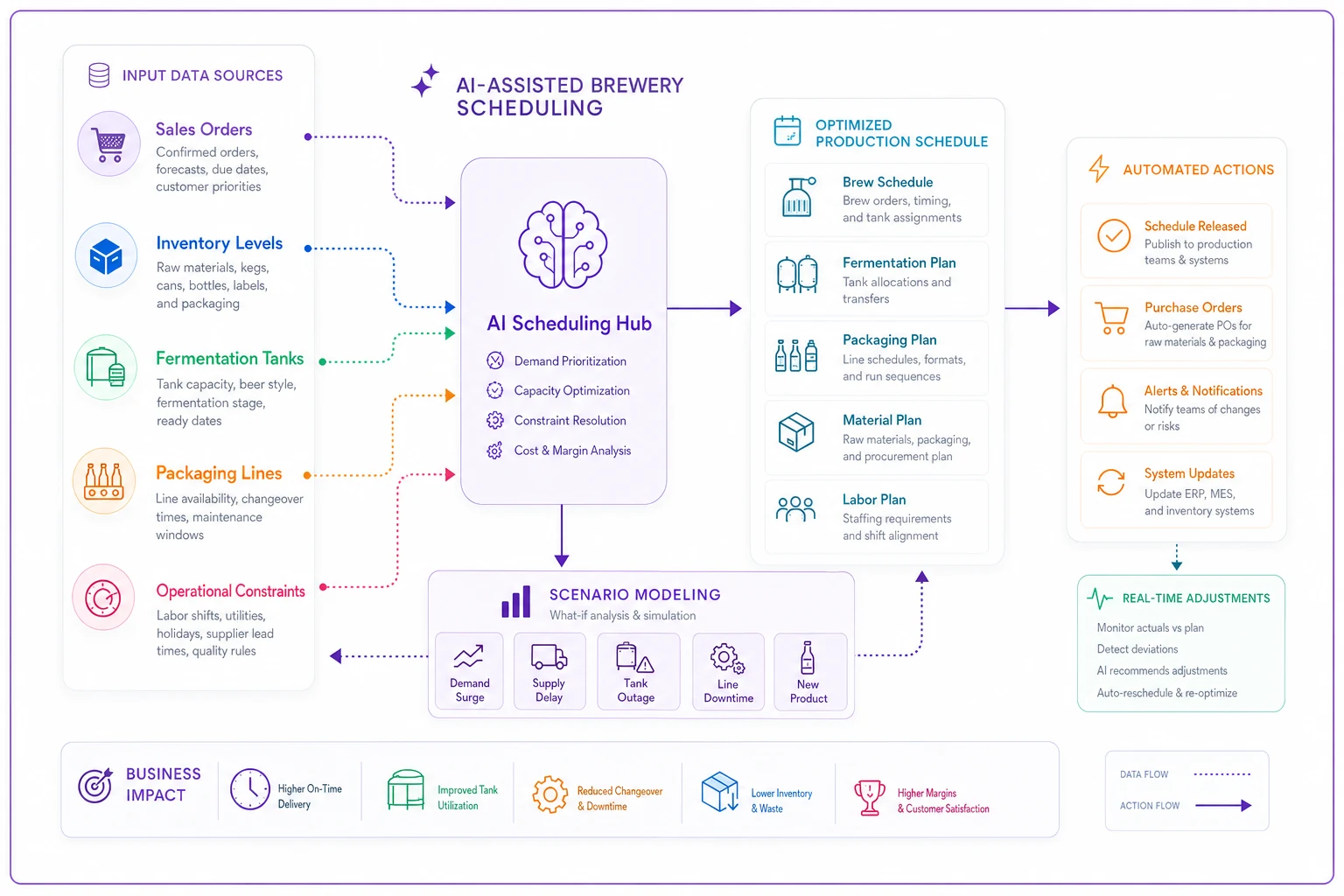
This diagram shows the flow from sales and inventory into production planning and how scenario modeling updates the schedule when constraints or orders change.
The key is that software doesn't remove flexibility—it codifies the decision rules and provides fast, data-backed options when you need to bend the schedule.
Building schedules that bend but don't break
The best brewery schedules have structured flexibility. Core production runs like clockwork—same days, same tanks, same packaging slots. This predictability lets your team optimize their work and helps sales make realistic promises. But you also need predetermined flex points for the inevitable surprises.
Maybe Thursday afternoon is always held for opportunistic batches. If nothing urgent comes up, you brew a seasonal. If sales lands a big new account, that's when you brew the extra IPA. Having the flexibility predetermined means it doesn't feel like a crisis every time you need to adjust.
Build in cascade planning for common problems. If canning line breaks, what gets kegged instead? If fermentation runs long, which tank becomes the overflow? If ingredient delivery delays, what's the substitute recipe?
Document these contingencies before you need them. The middle of a production crisis isn't when you want to figure out whether you can substitute Cascade for Centennial in your pale ale.
Emergency protocols should cover equipment failure scenarios. Your main fermenter develops a leak on Wednesday morning—which scheduled batches get priority for the backup tanks? Which ones can wait until repairs finish? Having these decisions pre-made eliminates panic and prevents quality compromises.
Making scheduling sustainable as you grow
The scheduling system that works at 500 BBL annually falls apart at 5,000 BBL. But you can't completely redesign operations every time you add a fermenter. Build systems that scale gradually.
Start with time-based scheduling (Monday is brew day) and evolve toward capacity-based scheduling (we brew when fermenters are 70% full). This transition usually happens around 2,
Start with time-based scheduling (Monday is brew day) and evolve toward capacity-based scheduling (we brew when fermenters are 70% full). This transition usually happens around 2,
Ready to elevate your brewery operations?
Join 500+ craft breweries using Beeryly to increase production efficiency, reduce waste, and grow sales.