

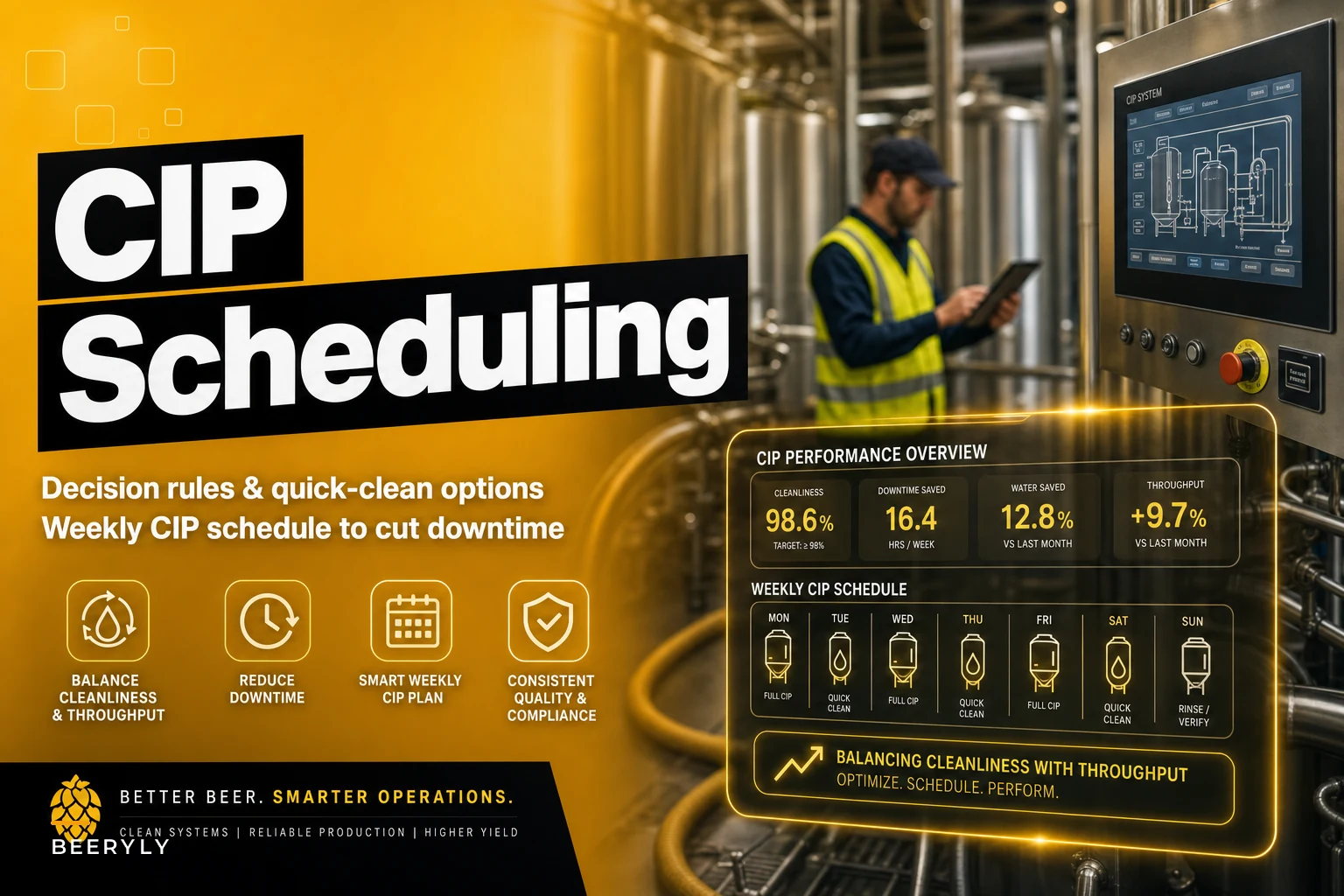

Running a Clean-In-Place cycle after every single tank turn feels safe until you're burning 4-6 hours of production time that didn't need burning. Most breweries operate like every beer carries the same contamination risk—full caustic cycles after a light lager, treating a dry-hopped IPA the same as a fruited sour. The operational cost adds up.
A 15-barrel brewhouse running 8 batches weekly loses roughly 32-48 hours monthly to CIP when half those cycles could be quick rinses or abbreviated runs. That's basically giving up an entire production day every month for cleaning that doesn't match the actual risk.
The fundamental mistake: all CIPs are not created equal
Your CIP scheduling probably looks like a checkbox system. Tank empty? Run CIP. Next beer ready? Fill tank. This ignores the massive operational differences between product types and how contamination risk actually works.
What happens after different beer styles matters. A clean pilsner leaves minimal protein residue and virtually no hop oils. Following it with another light beer? You probably need a rinse and sanitize, not a full caustic cycle. But that triple dry-hopped hazy IPA coating your tank walls with hop matter? Different story entirely.
Smart breweries track three risk categories for every product:
-
Microbial risk
Sours, fruit additions, brett beers, anything with wild yeast
-
Residue risk
Heavy dry hops, lactose additions, fruit purees, spices
-
Flavor carryover risk
Heavily roasted malts, smoke beers, anything with distinct flavor compounds
Each category drives different cleaning requirements. A low-risk to low-risk transition might need 45 minutes. High-risk to anything else demands the full 4-hour treatment.
Building decision rules that actually work
Category 1: Low-risk runs (most lagers, light ales, standard IPAs)
Take control of your brewery’s workflow.
Beeryly helps you schedule batches, track inventory, and monitor sales with ease.
- Production timeline management
- Inventory tracking & alerts
- Sales & distribution monitoring
No credit card required
Following another low-risk beer:
-
Rinse at 140°F for 15 minutes
-
Visual inspection through sight glass
-
ATP test if switching yeast strains
-
Sanitize and fill
Following a medium-risk beer:
-
Hot water rinse at 160°F for 20 minutes
-
Abbreviated caustic cycle (1.5% concentration, 20 minutes)
-
Final rinse and sanitize
Following a high-risk beer:
-
Full CIP required
Category 2: Medium-risk runs (heavily hopped beers, wheat beers, milk stouts)
Following a low-risk beer:
-
Standard rinse cycle
-
Light caustic if visible residue
-
Sanitize
Following another medium-risk beer (same style family):
-
Hot rinse, inspect, sanitize
-
Full CIP every third turn
Following a high-risk beer:
-
Full CIP, extended caustic time
Category 3: High-risk runs (sours, brett, fruit beers, specialty additions)
Always require full CIP before and after. No exceptions. These beers can contaminate an entire tank farm if you get lazy.
This diagram shows the CIP decision ladder in practice.
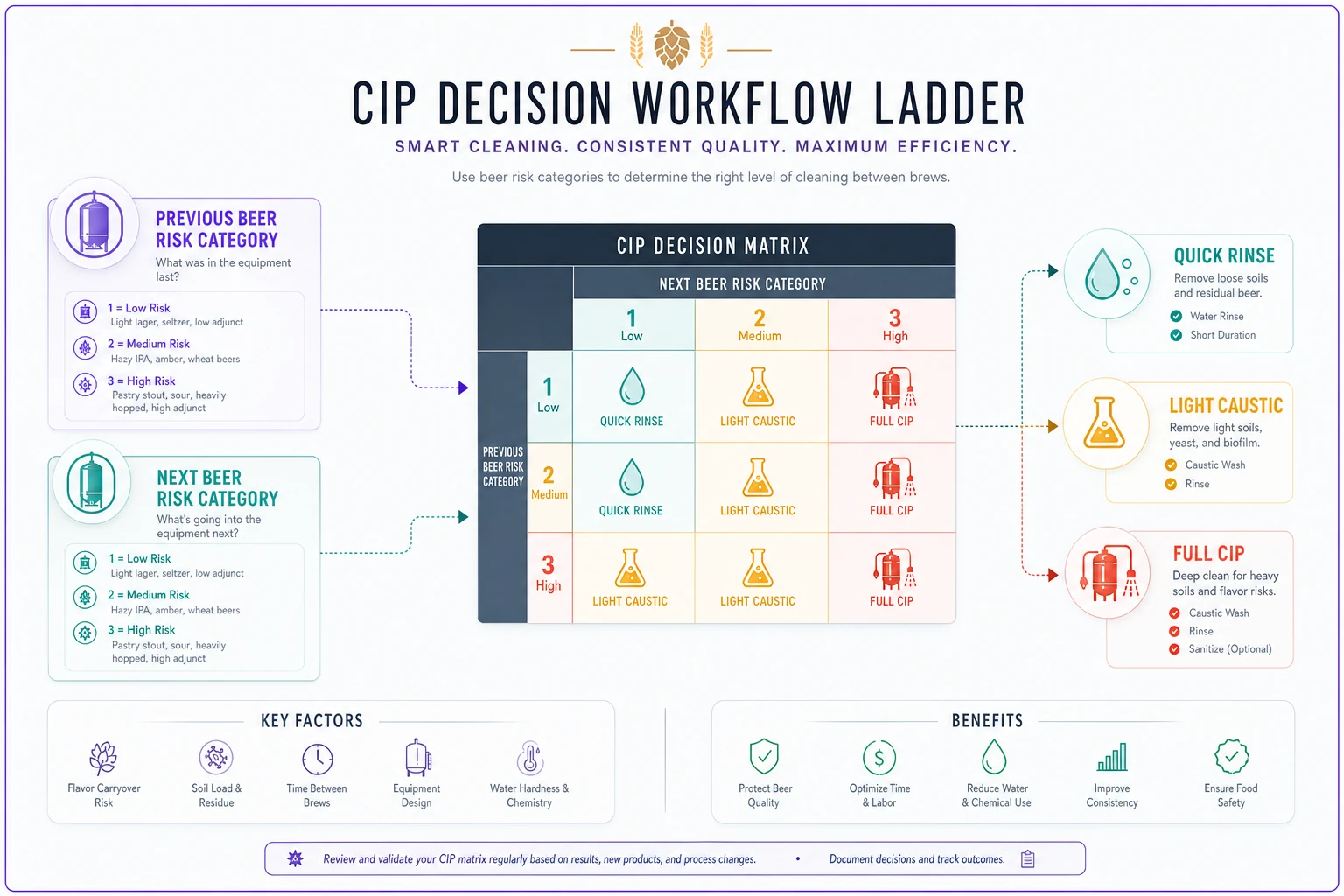
Always document the chosen path so you can audit your decisions later.
The quick-clean protocol that changed everything
About 18 months ago, I worked with a 30-barrel brewhouse in Colorado to restructure their CIP approach after watching them lose nearly 60 hours monthly to unnecessary cleaning cycles. Their head brewer was paranoid about contamination after a bad Brett incident, so everything got the nuclear treatment.
We implemented what they now call the "ladder system"—cleaning intensity ladders up or down based on the previous and next beer. The results were striking:
Week 1 (old system):
-
Monday
Pilsner → Full CIP → Wheat beer
-
Tuesday
Wheat → Full CIP → IPA
-
Thursday
IPA → Full CIP → Pilsner
-
Friday
Pilsner → Full CIP → Stout
Week 1 (ladder system):
-
Monday
Pilsner → Quick rinse → Wheat beer
-
Tuesday
Wheat → Light caustic → IPA
-
Thursday
IPA → Quick rinse → Pilsner
-
Friday
Pilsner → Light caustic → Stout
They gained back an entire brew day every week without a single contamination issue in 18 months.
Sample weekly CIP schedule that minimizes downtime
Here's a real schedule from a 20-barrel system producing 12 different beers weekly:
| Day | Tank | Previous Beer | Next Beer | CIP Decision | Time Required |
|---|---|---|---|---|---|
| Monday AM | FV1 | Blonde Ale | Pilsner | Quick rinse + sanitize | 45 min |
| Monday PM | FV2 | Hazy IPA | West Coast IPA | Light caustic | 90 min |
| Tuesday AM | FV3 | Stout | Sour | Full CIP + extra sanitize | 4.5 hours |
| Tuesday PM | FV4 | Pilsner | Blonde Ale | Rinse only | 30 min |
| Wednesday AM | BBT1 | Mixed ferm | Lager | Full CIP + acid cycle | 5 hours |
| Thursday AM | FV1 | Pilsner | Hazy IPA | Standard caustic | 2 hours |
| Thursday PM | FV2 | West Coast IPA | Hazy IPA | Quick rinse | 45 min |
| Friday AM | FV3 | Sour | Full CIP before fill | Full CIP | 4 hours |
Total weekly CIP time: 18.5 hours vs. potential 32 hours with full cycles
The key insight: matching cleaning intensity to actual risk instead of treating every transition identically. Notice how the sour beer commands full cycles on both sides, while the pilsner-to-blonde transition barely needs attention.
When to break your own rules
Sometimes the smart move is ignoring your risk categories entirely. These situations demand full CIP regardless of beer styles:
Time-based triggers:
-
Any tank idle more than 72 hours
-
Visible biofilm formation
-
Failed ATP test
-
Any off-flavor detected in previous batch
-
Monthly deep clean regardless of use
Audit preparation:
Your risk-based system works great until an inspector shows up. Three weeks before any audit, switch to full CIP protocols. The efficiency loss hurts, but not as much as failing an inspection because someone questions your abbreviated cleaning.
Yeast changes:
Switching yeast strains within the same tank always requires full CIP, even between two identical blonde ales. Cross-contamination between house strains causes more quality issues than most brewers realize.
The hidden costs of over-cleaning
Beyond lost production time, excessive CIP creates problems most breweries don't track.
Chemical costs balloon when you're running unnecessary caustic cycles. A 15-barrel system burns through roughly $180 in chemicals per full CIP. Cut out 8 unnecessary cycles monthly and you're saving $1,400+ that could fund better quality testing.
Water usage becomes a production bottleneck. Many municipal breweries operate under water-use restrictions or pay escalating rates above certain thresholds. Every skipped CIP cycle saves 200-400 gallons depending on your system.
Equipment wear accelerates with constant chemical exposure. Gaskets fail faster, pumps wear prematurely, and tank surfaces develop pitting when exposed to caustic more than necessary. One brewery tracked a 30% reduction in gasket replacements after implementing risk-based cleaning.
Creating SOPs your team will actually follow
The best CIP protocol means nothing if your cellar team ignores it. Build a simple decision tree and laminate it. Post copies at every CIP station. The flow should take 10 seconds to read:
-
Check previous beer category (Low/Medium/High)
-
Check next beer category
-
Find intersection on chart
-
Run specified protocol
Track violations and wins equally. When someone makes a good call to run full CIP despite the protocol saying quick rinse, document why. When someone successfully quick-cleans between compatible beers, note the time saved. This data refines your rules over time.
Require sign-offs but keep them simple. A basic log showing:
-
- Date/time
-
- Tank number
-
- Previous/next beer
-
- Protocol used
-
- Operator initials
-
- ATP reading if taken
Laminate a one-page decision tree and place it at each CIP station for quick reference.
When someone makes a good call to run full CIP despite the protocol saying quick rinse, document why.
The automation angle that makes this manageable
Managing a risk-based CIP schedule manually means constant decision-making and perfect communication between shifts. This is where operational software actually earns its keep—not by making decisions for you, but by surfacing the right information at the right time.
A good brewery management platform tracks your beer categories automatically, flags when full CIP is required, and alerts operators to upcoming cleaning windows. Instead of checking three different logs to figure out what was in a tank and what's going in next, everything lives in one place.
The real value comes from pattern recognition. After a few months, the system identifies which transitions consistently pass ATP tests with quick cleans and which ones trend toward problems. You're not guessing anymore—you're operating on actual data from your specific facility.
Some breweries link their CIP decisions directly to production scheduling, automatically adding appropriate cleaning time between batches based on the risk matrix. This prevents the classic Thursday afternoon scramble when someone realizes the tank wasn't cleaned and the next batch is ready to transfer.
Making peace with "good enough" cleaning
The hardest part about implementing risk-based CIP isn't technical—it's psychological. Every brewer remembers their worst contamination event. That memory drives over-cleaning behavior that feels safe but devastates operations.
Start small if you're nervous. Pick your two most compatible beers and test quick-clean protocols between them for a month. Run ATP tests, check micro results, taste everything. Build confidence in the process before expanding.
Document everything obsessively at first. When you can show six months of clean micro reports despite cutting CIP time by 40%, even the most paranoid brewer starts believing the system works.
Remember that "audit-ready" doesn't mean "over-cleaned." It means having documented processes, consistent execution, and data showing your decisions make sense. A risk-based system with good records actually looks more professional than blindly running full CIP on everything.
The bottom line on balanced CIP scheduling
Your CIP scheduling shouldn't treat a pilsner like a passion fruit sour. The contamination risk isn't the same, the residue isn't the same, and the cleaning requirements aren't the same. Building decision rules based on actual risk rather than fear transforms CIP from a production bottleneck into a manageable process.
Most 10-20 barrel brewhouses can reclaim 40-60 hours monthly by matching cleaning intensity to product risk. That's what happens when you stop treating every beer like it might destroy your entire operation.
The framework is straightforward: categorize your beers by risk, build transition rules between categories, and stick to the process. Add quick-clean protocols for compatible transitions. Reserve full CIP for actual high-risk situations. Track everything so you can prove the system works when someone inevitably questions it.
Smart CIP scheduling isn't about cutting corners or gambling with contamination. It's about recognizing that operational efficiency and product safety aren't opposing forces—they're complementary when you understand the actual risks involved.
Your CIP scheduling shouldn't treat a pilsner like a passion fruit sour. The contamination risk isn't the same, the residue isn't the same, and the cleaning requirements aren't the same. Building decision rules based on actual risk rather than fear transforms CIP from a production bottleneck into a manageable process.
Most 10-20 barrel brewhouses can reclaim 40-60 hours monthly by matching cleaning intensity to product risk. That's what happens when you stop treating every beer like it might destroy your entire operation.
Ready to elevate your brewery operations?
Join 500+ craft breweries using Beeryly to increase production efficiency, reduce waste, and grow sales.