

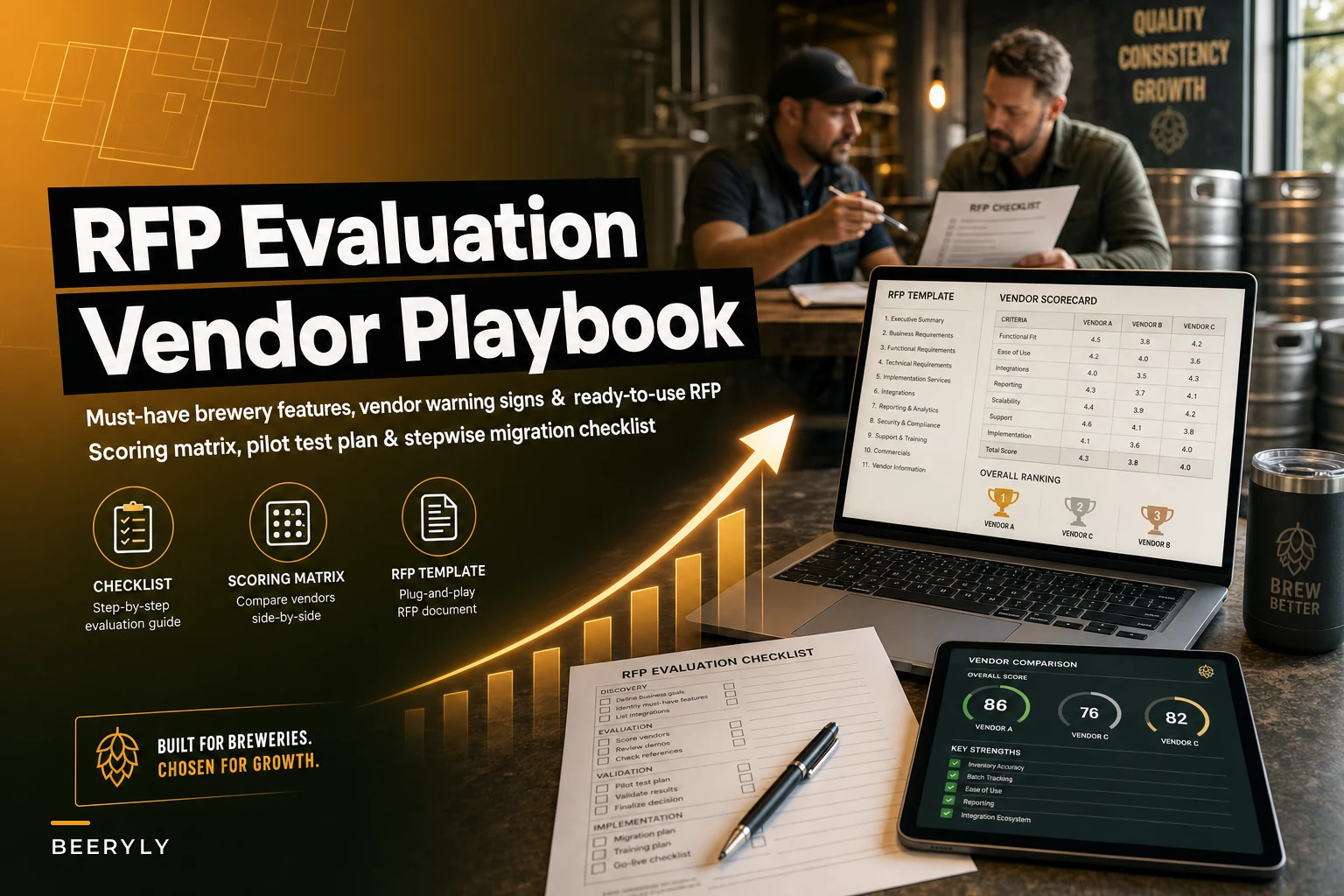

Most brewery software buying decisions fall apart for a pretty mundane reason: nobody wrote down what "good" actually looked like before the demos started. You sit through five polished walkthroughs, every vendor nods enthusiastically when you mention keg tracking, and three weeks later you're staring at two quotes that don't compare to each other at all. One prices by user seat, one by barrel volume, and neither clearly answers whether it can handle a split batch across two fermenters with different packaging dates.
This guide is for the brewery that's past the "should we buy software" question and is now in the harder part—running an evaluation that doesn't collapse into vibes and sales charm. If you're still figuring out whether you're even ready, the earlier buyer's checklist and implementation roadmap covers readiness questions. Here we're focused narrowly on procurement: how to write the RFP, how to score vendors without fooling yourself, how to pilot before you commit, and how to migrate without losing a month of production history.
Why Brewery Software Evaluations Go Sideways
The core problem is that "inventory management software" is a category that includes tools built for distributors, restaurants, light manufacturers, and generic warehouses. A lot of them technically track inventory. Very few understand that a batch of beer changes volume as it moves, that a keg is both an asset and a container, or that your raw material lot numbers need to survive all the way into a finished-goods recall trace.
What tends to happen: a brewery buys something that demos beautifully for finished-case inventory, then discovers six weeks in that it can't model yield loss through the brewhouse, can't tie a specific malt lot to a specific batch, and treats kegs like consumable packaging. Now you're maintaining a spreadsheet alongside the software you just paid for—which is exactly the situation you were trying to escape.
The second failure mode is scoring. Without a structured matrix, the loudest requirement wins. Someone on the team really cares about the mobile app, so it becomes the deciding factor—while lot traceability, which is the thing that actually matters during a recall, gets a passing nod. A good RFP process forces you to weight requirements before emotion enters the room.
The Brewery-Specific Features That Actually Matter
Before you write a single RFP question, get clear on the capabilities that are genuinely brewery-specific. Generic inventory features—reorder points, purchase orders, basic reporting—are table stakes. Almost everyone has them. These are the ones that separate real brewery tools from repackaged restaurant software:
Take control of your brewery’s workflow.
Beeryly helps you schedule batches, track inventory, and monitor sales with ease.
- Production timeline management
- Inventory tracking & alerts
- Sales & distribution monitoring
No credit card required
Keg and container lifecycle tracking. Kegs aren't inventory that gets consumed. They cycle out, come back, get cleaned, and carry a deposit. The software needs to treat a keg as a tracked asset with a status: filled, at distributor, empty-returned, in-service, lost. If it can only report "kegs on hand" as a number, it's not built for you.
Batch and lot traceability, end to end. You should be able to pick any finished package and trace backward to every raw material lot that went into it—malt, hops, yeast generation, adjuncts, packaging materials. And go forward too: given a suspect malt lot, which batches and shipped SKUs are affected? This is the backbone of recall readiness.
Lot and expiry handling for perishables. Hops have harvest years. Yeast has viability windows. Finished beer has freshness dates that matter to accounts. The system needs FIFO/FEFO logic, not just a single average quantity on hand.
Bills of material and recipe scaling. Your recipe is a BOM. A good system lets you define it once, scale it to batch size, and automatically deduct raw materials when a batch is brewed—then flag variances between expected and actual consumption.
Yield and loss tracking at each stage. Brewhouse yield, fermentation loss, filtration loss, packaging loss. If the software can't record actual volume at transfer points and compute loss against expectation, you're flying blind on where your beer is disappearing.
POS and wholesale integrations. Taproom POS, distributor ordering portals, and accounting all need to talk to inventory. Depletion data from wholesale, sales from the taproom, and finished-goods counts should reconcile without manual re-keying. This is also where seasonal demand and taproom event planning data lives or dies.
Here's a quick way to classify any feature a vendor pitches:
| Feature | Table Stakes | Brewery-Specific (Score Heavily) | Nice-to-Have |
|---|---|---|---|
| Purchase orders & receiving | ✓ | ||
| Reorder point alerts | ✓ | ||
| Keg lifecycle & deposit tracking | ✓ | ||
| Batch-to-lot forward/backward trace | ✓ | ||
| Recipe BOM with auto-deduction | ✓ | ||
| Stage-by-stage yield/loss capture | ✓ | ||
| FEFO for hops/yeast/finished beer | ✓ | ||
| POS + distributor depletion sync | ✓ | ||
| Mobile scanning | ✓ | ||
| Customizable dashboards | ✓ |
One mistake that keeps coming up: breweries over-index on the right column during demos because dashboards are visually impressive, and under-test the middle column because it's harder to evaluate in a 45-minute call. That imbalance has ended more than a few purchases badly.
Writing an RFP That Gets Comparable Answers
A good RFP does one job: it forces every vendor to answer the same questions in the same format, so capability claims and quotes can sit side by side. Vague questions get vague answers. "Do you support traceability?" gets a yes from everyone. "Walk me through tracing a specific hop lot from receiving to a shipped keg, including the exact steps" gets you the truth.
Ready-to-Use RFP Template
Copy this, fill in the brackets, and send it to every shortlisted vendor. Require them to answer inline.
Section 1 — Company & Support
-
Years operating specifically with breweries; number of brewery customers in [your size range, e.g., 2,000–15,000 BBL/yr]
-
Support hours and channels; guaranteed response time for critical issues
-
Where is customer data hosted, and what is your backup/recovery process?
Section 2 — Core Brewery Functionality (require a written answer, not yes/no)
-
Describe how a recipe/BOM is created and how raw materials auto-deduct at brew time.
-
Describe the full keg lifecycle you track, including deposit accounting and lost-keg handling.
-
Describe a backward trace
starting from a shipped finished SKU, what steps reveal every input lot?
-
Describe a forward trace
starting from a suspect malt lot, how do we identify affected batches and shipments?
-
How is yield/loss captured at brewhouse, fermentation, and packaging?
-
How do you handle split batches, blends, and re-fermentation?
Section 3 — Integrations
-
List native integrations for
[your POS], [your accounting system], [your distributor portals].
-
Is there an open API? Rate limits? Documentation link?
Section 4 — Implementation & Data Migration
-
Typical implementation timeline for a brewery our size.
-
What data do you migrate, and what's our responsibility vs. yours?
-
Who is assigned to our onboarding, and for how long?
Section 5 — Pricing (require a fully loaded number)
-
Pricing model (per seat, per BBL, flat tier) with our specific volume plugged in.
-
One-time implementation/migration cost.
-
Cost of additional users, locations, or integrations.
-
Annual increase policy.
The pricing section matters more than most people expect. Require every vendor to quote using your actual numbers—your barrel volume, your user count, your integration list—so you get one total annual figure, not a starting price that triples once you add what you actually need.
Scoring Vendors Without Fooling Yourself
Weight your criteria before the demos. This is probably the single most important discipline in the whole process, because it blocks the recency effect—where whoever demoed last feels best.
Vendor Scoring Matrix
Score each vendor 1–5 on every criterion, multiply by the weight, and total it. Set the weights as a team before anyone watches a demo.
| Criterion | Weight | Vendor A | Vendor B | Vendor C |
|---|---|---|---|---|
| Batch & lot traceability | 20% | |||
| Keg lifecycle & deposits | 15% | |||
| Yield/loss tracking | 15% | |||
| BOM & recipe handling | 10% | |||
| POS/wholesale integration | 15% | |||
| Ease of daily use (floor staff) | 10% | |||
| Implementation & migration support | 10% | |||
| Total cost of ownership | 5% | |||
| Weighted Total | 100% |
Traceability sits at the top for a reason. During a recall or an audit, nobody cares how pretty the dashboard was. Adjust the percentages to match your operation—if you're keg-heavy and self-distributing, push keg lifecycle up; if you're 90% taproom, POS integration should climb.
One thing worth calling out: don't let a single person fill out the whole matrix. Have the production manager score the production features and a taproom lead score ease-of-use and POS. The person scoring a feature should be the one who'll live with it every day.
Run a Pilot Before You Sign
Never buy on the demo alone. A demo shows you the software working on the vendor's clean sample data. A pilot shows you whether it survives your data and your staff.
Most serious vendors will agree to a paid or time-boxed pilot if you ask. A vendor who refuses any form of trial is telling you something worth hearing.
Sample 2-Week Pilot Test Plan
Goal: Prove the system handles one full batch cycle and one keg cycle with real data.
-
Day 1–2
Setup.
Load 3–5 real recipes as BOMs. Enter current raw material lots for malt, hops, and yeast with real lot numbers and quantities. -
Day 3–4
Brew a batch in the system.
Run an actual (or recent) brew. Confirm raw materials deduct correctly and the batch gets a traceable ID. -
Day 5–8
Move the batch.
Record transfers and log actual volumes. Confirm the system computes fermentation and packaging loss. -
Day 9–10
Package and keg.
Fill kegs in the system, assign deposits, mark some as shipped to a test "account." -
Day 11
Run both traces.
Backward trace from a shipped keg to its hop lot. Forward trace from a malt lot to affected packages. Time how long each takes and whether the data is actually right. -
Day 12
Integration check.
Push a test sale through POS and confirm finished-goods inventory updates. -
Day 13–14
Floor-staff test.
Have the people who'll actually use it daily enter a receiving and a transfer unsupervised. Note every point of confusion.
The traces in step 5 are the whole ballgame. If a backward trace takes twenty minutes and requires exporting to a spreadsheet, the traceability claim was marketing, not a feature. That alone should eliminate a vendor from contention.
Below is a rough picture of how the full batch lifecycle flows through the system during the pilot—from receiving raw materials through to a shipped keg with a traceable ID:
[Raw Material Receiving + Lot Assignment] ↓ [Recipe BOM Loaded → Brew Session Opened] ↓ [Brewhouse Transfer → Volume + Loss Recorded] ↓ [Fermentation → Transfer → Packaging] ↓ [Keg Filled → Deposit Assigned → Status: At Distributor] ↓ [Backward Trace: Shipped Keg → Hop Lot] [Forward Trace: Malt Lot → Affected SKUs]
Here's a simple workflow diagram you can use to visualize the pilot steps.
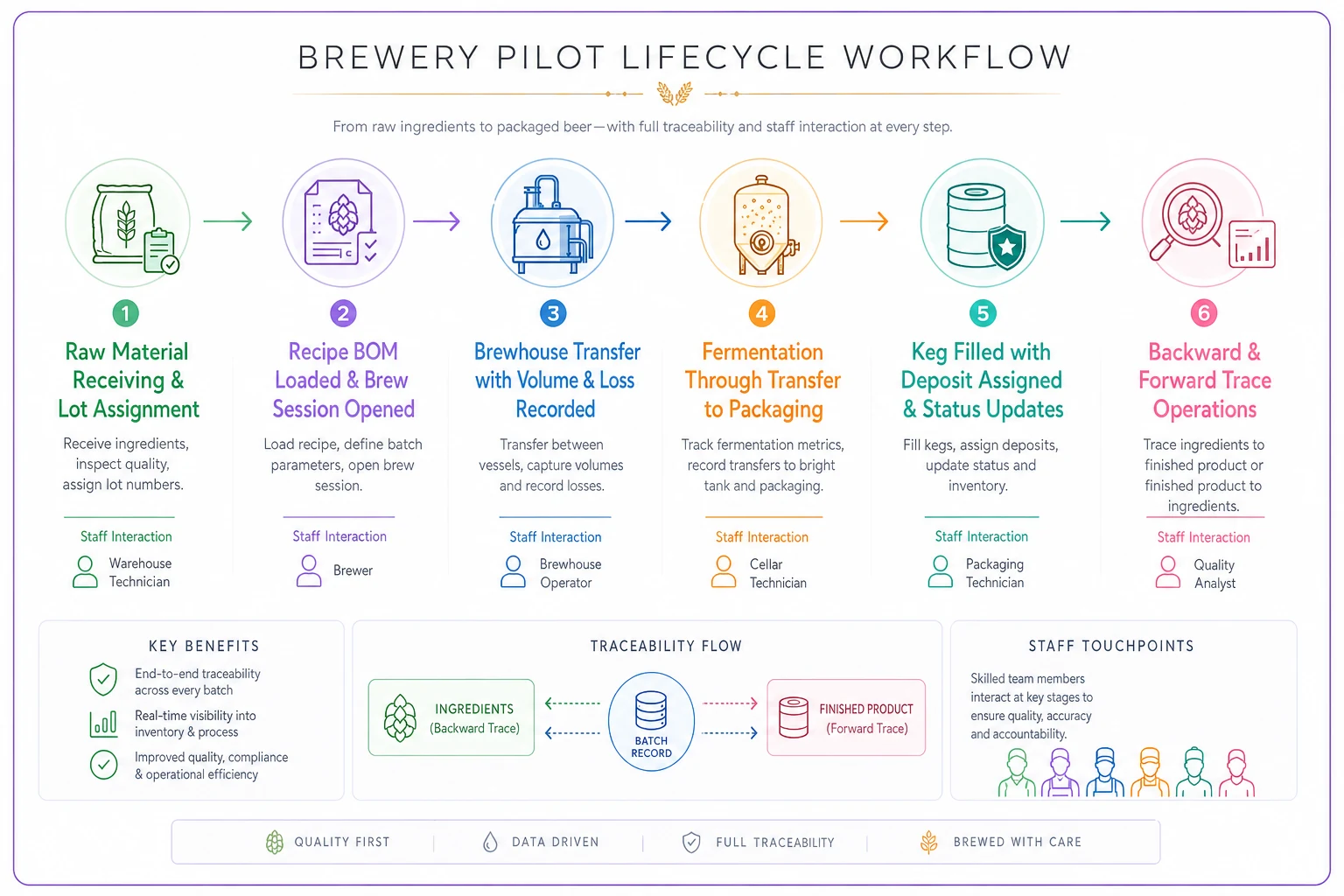
If the system breaks down anywhere in that chain during the pilot, you've learned something that wouldn't have shown up in any demo.
The Migration Checklist That Prevents Data Loss
The migration is where good purchases turn into bad launches. Breweries that rush the cutover end up with half their lot history stranded in the old system and no clean starting inventory count in the new one.
-
Lock a cutover date that falls after a packaging run and before your next raw material delivery—a natural low-activity window.
-
Do a full physical count of raw materials, WIP, and finished goods the day before go-live. Your opening balances need to be real, not carried from a stale spreadsheet.
-
Export and archive all historical lot and batch records from the old system, even if you don't import all of them. You may need them for a trace later.
-
Validate the first 10 records by hand—compare a few recipes, lots, and keg counts between old and new. Catch mapping errors before they compound.
-
Run parallel for one cycle if you can afford it. Enter data in both systems for one brew-to-package cycle to confirm the new one matches reality.
-
Assign one data owner during migration who signs off that each data type (materials, recipes, kegs, finished goods) is loaded and verified.
For the detailed day-by-day version of the rollout itself, the 30/60/90 implementation framework goes deeper than there's room for here. The point for procurement purposes: build the migration cost and timeline into your decision from day one, because a cheaper tool with a brutal migration can easily cost more overall than a pricier tool with hands-on onboarding support.
Quantifying ROI So the Decision Holds Up
You'll need to justify this spend, and "it's more organized" won't survive a budget conversation. Tie it to things you can actually measure before and after.
A realistic example: a brewery around 4,000 BBL/yr running on spreadsheets and a basic POS was losing roughly 60–80 kegs a year to untracked field losses, each worth about $120 in replacement plus a lost deposit. That's somewhere in the $8k–$12k range annually, just gone. They were also writing off hops to spoilage because older lots kept getting buried under new deliveries—another few thousand. And their monthly count took two people most of a Saturday.
After running on brewery-specific software for a full cycle, keg losses dropped to the low twenties because every keg had a status and a last-known account. Hop spoilage nearly disappeared once FEFO alerts started surfacing older lots first. The monthly count shrank to a couple of hours because the system was already close to reality. None of those numbers are dramatic on their own—together they covered the software cost inside the first year and freed up real labor hours.
-
Shrinkage recovered (keg losses, spoilage write-offs avoided)
-
Labor hours saved (counts, reconciliation, manual re-keying between POS and inventory)
-
Avoided-cost insurance (recall readiness—hard to price until you need it, catastrophic when you don't have it)
These aren't hypothetical line items. They're the actual levers that move in year one when you switch from spreadsheets to something built for how a brewery actually operates.
When This Process Is Overkill—and When It's Essential
A full RFP-and-pilot process makes sense when you're committing to a multi-year platform, spending real money, and the switching cost of getting it wrong is high. If you're over roughly 2,000–3,000 BBL, self-distributing, or managing kegs across many accounts, the rigor pays for itself.
When it's overkill: a small taproom-only operation doing a few hundred barrels with one SKU line and no wholesale footprint probably doesn't need a formal RFP. A structured feature checklist and a single good pilot is plenty. Writing a five-section RFP for a $200/month tool is process for its own sake.
Who should slow down: any brewery mid-expansion. If you're adding tanks or a packaging line in the next six months, your volume and complexity are about to change—score vendors against where you'll be, not where you are now. And if you're heading into a season where shipping and inventory pressure spikes, like the dynamics covered in 2026 peak-season surcharge planning, make sure the tool handles your busiest month, not your average one.
That last point matters more than it sounds. A system that works fine at average volume but falls apart during a busy release weekend or a large distributor push isn't really a production system—it's a fair-weather one.
A Short Real Scenario
A regional brewery around 6,000 BBL ran a formal evaluation after two failed informal software attempts. The first time, they bought on a demo and found out the tool couldn't trace lots backward—dead end within two months. The second tool couldn't sync with their distributor portal, so depletion data stayed manual anyway.
The third time, they wrote the RFP, weighted traceability and POS integration heaviest, and ran the two-week pilot. One of the two finalists failed it outright—the backward trace required a spreadsheet export, exactly the thing the salesperson had waved off during the demo. They went with the other vendor. Migration took about three weeks with a parallel cycle, and the first clean monthly count came in within a few cases of what the system showed.
The difference between attempt three and the first two wasn't the software market—it was having a process that tested the claims instead of trusting them.
Bringing It Together
Choosing brewery inventory management software is a procurement problem before it's a technology problem. The breweries that get it right aren't the ones who watch the most demos—they're the ones who decide what matters, write it down, make every vendor answer the same questions, and insist on proving the hard features with real data before signing anything.
Weight traceability and yield tracking heavily, because those are the capabilities that are genuinely difficult to retrofit and genuinely painful to lack. Run the pilot. Make sure the backward trace works in minutes, not spreadsheets. Build the migration into your cost and timeline from day one. Do that, and the decision will hold up—both to your team on the floor and to whoever signs the check.
Ready to elevate your brewery operations?
Join 500+ craft breweries using Beeryly to increase production efficiency, reduce waste, and grow sales.


