
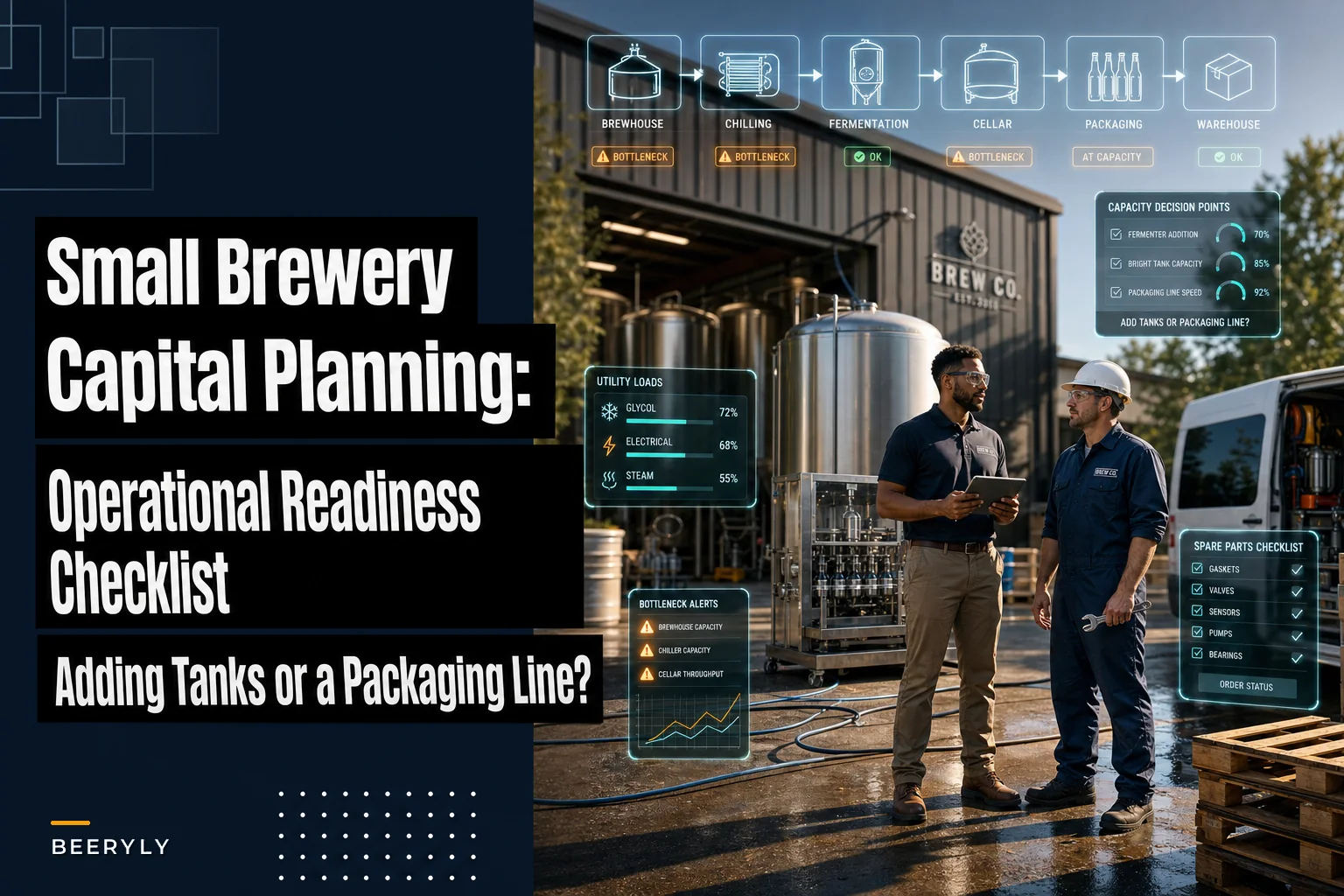

The most expensive mistake in small-brewery capital planning isn't overpaying for equipment. It's buying a new fermenter or canning line that your utilities, staffing, and warehouse can't support — then spending the next six months paying for that gap in overtime, spoilage, and half-used capacity.
A new 60bbl unitank looks like more beer. On a spreadsheet it's clean: more fermentation volume, more batches, more revenue. In the cellar it's a chain reaction. That tank pulls more glycol, needs more CIP cycles, produces more wort that has to be brewed, cooled, and packaged, and eventually shows up as pallets that need somewhere to live. If any link in that chain is already running near its limit, you don't get more beer. You get a bottleneck that moved somewhere you weren't watching.
This checklist is built around that reality. Not "should you expand," but "can the rest of your operation absorb what you're about to buy." Work through it before the deposit, not after the install crew leaves.
Start with throughput, not tank volume
The number that matters isn't fermentation capacity. It's the throughput of your slowest downstream step once the new equipment is actually running.
Here's the pattern that burns people. A brewery adds two 30bbl fermenters to relieve a tank crunch. Fermentation was the visible constraint, so that felt right. But the brewhouse is a 15bbl system doing one, maybe two turns a day. To fill those new tanks, they'd need to brew four to six times as often — and the mash tun physically can't turn that fast. The tanks sit half-used. Meanwhile the actual limit — brewhouse turns, hot/cold liquor capacity — never moved.
| Stage | Question to answer | Common hidden limit |
|---|---|---|
| Brewhouse | How many turns/day can you realistically sustain? | Hot liquor tank recovery, single mash tun |
| Knockout / chilling | Can the heat exchanger + glycol cool a batch fast enough between brews? | Glycol reserve, wort chiller capacity |
| Fermentation | Do you have tank days, or just tank count? | Conditioning overlap, not raw volume |
| Cellar labor | Who transfers, dry-hops, harvests yeast on the extra batches? | Same crew, more tasks |
| Packaging | Can the line move the added volume without a second shift? | Changeovers, not runtime |
| Warehouse | Where do the extra finished pallets go? | Cold storage, floor space |
If your honest answer at the brewhouse is "we're already brewing back-to-back," more fermenters won't help. You need brewhouse capacity or another brew day first. Tank overlap deserves its own hard look too — if conditioning times are already colliding, adding tanks can mask a scheduling problem instead of fixing it.
This simple workflow shows the path from brewhouse to warehouse to check for bottlenecks.
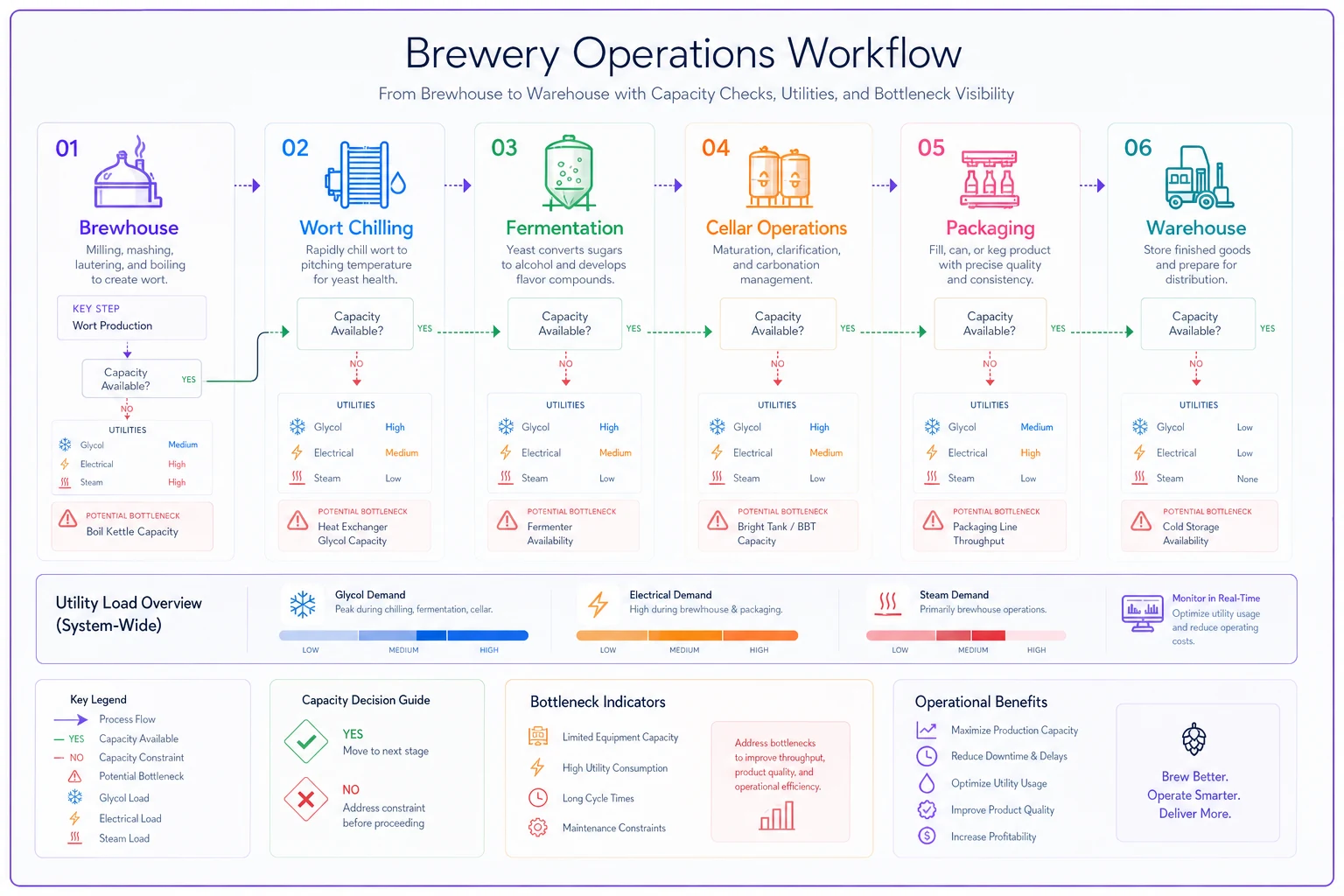
Fermentation capacity is usually the symptom, not the constraint. Tanks feel full because beer sits in them too long, not because you lack volume. Fix conditioning schedules before you fix them with steel.
Site utilities: the silent budget-killer
This is where readiness checklists fall apart in the real world, because utilities don't announce themselves until the equipment is already bolted down.
Take control of your brewery’s workflow.
Beeryly helps you schedule batches, track inventory, and monitor sales with ease.
- Production timeline management
- Inventory tracking & alerts
- Sales & distribution monitoring
No credit card required
Glycol and cooling. Every new jacketed vessel and every stretch of the packaging line's cold side pulls from the same chiller. Add a 60bbl fermenter to a system already sized tight, and crash-cool times stretch. Two tanks fight for cooling and neither hits temp on schedule. A common scenario: a brewery adds fermentation, crash times slip from overnight to a day and a half, and suddenly the tank-turn math they built the whole expansion on doesn't hold. Get your chiller's actual tonnage and reserve capacity checked before purchase, not after.
Electrical. A packaging line — filler, seamer, conveyors, labeler, depalletizer — can pull serious amperage. Plenty of small breweries discover their panel is maxed and the expansion now includes a service upgrade, plus utility-side work with a lead time measured in months. That's a five-figure surprise that should have been a line item from the start.
Steam and hot water. More brews means more hot liquor. If your water heater or steam capacity is already the reason you can't run a second brew day, adding tanks downstream changes nothing.
Drainage and floor. More volume means more CIP, more rinse water, more trench-drain load. Floors that handle today's flow can back up under a heavier packaging schedule.
Walk the site with your equipment vendor and an electrician or mechanical contractor before signing. The question isn't "does it fit through the door." It's "what does this pull, and do we have the headroom." Utilities is also where a lot of ongoing cost hides — worth revisiting your cost-per-barrel assumptions once the new load is real.
Budget for spare parts and consumables, not just the machine
Every capital quote covers the equipment. Almost none of them cover the parts you'll be replacing at 2 a.m. six weeks after go-live.
-
Critical spares (a broken one stops the line)
stock at least one of each on-site from day one
-
Wear parts (predictable replacement)
stock 2–3 cycles' worth
-
Change parts (per format you actually run)
buy with the machine, don't defer
Keep at least one critical spare on-site to avoid line-stopping outages.
Budget somewhere in the range of 5–10% of the equipment cost as an initial spares and consumables reserve. It feels like padding until the first failure, at which point it's the difference between a 20-minute swap and a scrapped production day.
Tie this into your existing maintenance program rather than treating it as a separate afterthought. If you've already built a preventive maintenance and reliability framework, the new equipment's spares list, lubrication schedule, and inspection points should slot into it before the machine ever runs a batch.
Staffing and training: the gap nobody quotes
New equipment doesn't run itself, and the assumption that the current crew will "just absorb it" is where a lot of expansions quietly fail.
-
Do you have enough hands for the added volume? More batches mean more transfers, more CIP, more dry-hop additions, more QC pulls, more packaging runs. If the cellar crew is already stretched, the new tanks add tasks to people who are maxed. What tends to happen with small producers: the expansion "works" for a month on adrenaline and overtime, then quality slips because tired people start cutting corners on cleaning and handoffs.
-
Is anyone actually trained on the new gear? A new canning line is a different skill than the old bottler. Seamer setup, dissolved oxygen control, seam inspection — these are learned, not intuited. Budget for the vendor's commissioning and operator training, and budget time for the crew to be genuinely slow at first.
A practical staffing check before purchase:
-
Map the added weekly labor hours the new equipment creates (brew, cellar, package, QC, clean)
-
Compare against current crew's actual available hours, not their scheduled ones
-
Decide now
hire before, hire after, or run overtime — and put a number on each option
-
Identify who owns seam inspection and DO checks, get them trained during commissioning
-
Plan for a productivity dip of several weeks; don't schedule a major account launch into week one
Treating training as a one-day vendor visit is a mistake. Real competence on a new line takes weeks of supervised runs. Plan production around that ramp instead of pretending it doesn't exist.
A go-live playbook that prevents scope creep
Scope creep after purchase is the part that quietly wrecks ROI. The install is going in anyway, so someone says "while we're at it, let's re-plumb the glycol loop, add a second CIP station, and move the brite tanks." Each add-on sounds efficient. Together they blow the budget and the timeline, and now you've got three half-finished projects and a line that still isn't running.
Define go-live narrowly. Write down the single measurable outcome. Example: "The new line packages 400 cases of our flagship in a shift, at target seam specs and DO, with the current crew." Not "the line and everything around it is optimized." One outcome. Everything else is a separate project with its own timeline.
Run the sequence in this order:
-
Utilities and infrastructure verified — power, glycol, drainage, and floor confirmed adequate before equipment arrives
-
Install and mechanical commissioning — vendor confirms the machine runs to spec on water/rinse
-
Operator training on real product — supervised runs, seam and DO checks documented
-
Controlled first batches — small, low-stakes SKUs, full QC, ramp volume slowly
-
Sign-off against the one defined outcome — hit the target, then the project is closed
-
Log the "would be nice" list separately — everything deferred goes on a parking lot, revisited next quarter
Protect the go-live with a simple rule: any change proposed after the PO is signed gets written down, priced, and scheduled as its own item — it doesn't get folded into the current install. That single discipline is what keeps a two-week install from becoming a two-month one.
The other thing a clean go-live needs is a production schedule that protects the ramp. Don't drop the new line into your busiest month. If your production scheduling system already flags load and capacity, use it to carve out low-pressure weeks for the first supervised runs, so a slow week one doesn't cascade into late deliveries.
When adding capacity actually makes sense
Not every "we're slammed" moment justifies capital. Expansion pays off when:
-
You're turning away consistent, contracted volume — not a seasonal spike
-
Your actual constraint is the thing you're buying, verified upstream and downstream
-
Utilities have headroom, or the upgrade cost is already in the budget
-
You have or can hire the labor to run the added volume without burning the crew
-
Cold storage and warehouse can hold the finished output
You're turning away consistent, contracted volume — not a seasonal spike
When it's a bad idea
Your tanks feel full because conditioning schedules overlap, not because you lack volume — fix scheduling first, it's free
-
Your tanks feel full because conditioning schedules overlap, not because you lack volume — fix scheduling first, it's free
-
The real constraint is upstream (brewhouse turns, chilling) and the new gear is downstream, or vice versa
-
Demand is soft or uncertain and you're expanding on a hopeful forecast
-
You can't fund the spares float and the training ramp — those aren't optional, and skipping them means the equipment underperforms from day one
You can't fund the spares float and the training ramp — those aren't optional, and skipping them means the equipment underperforms from day one
A short real scenario
A regional brewery running a 20bbl brewhouse was maxed on packaging — an old bottler doing long, slow runs with constant jams. They planned to buy a mid-speed canning line, quoted at roughly the equipment cost alone.
The readiness pass changed the plan. The electrical panel couldn't support the line, which added a service upgrade with a two-month lead time they hadn't scheduled. Glycol had enough headroom, barely. Spares and change parts for their two can formats added close to 8% on top. And nobody on staff had run a seamer, so they built vendor training and a three-week supervised ramp into the timeline instead of promising a distributor rollout on week one.
The go-live was scoped to one thing: package the flagship at target seam and DO with the existing crew. It took about five weeks from install to sign-off — slower than the vendor's optimistic pitch, but with no scrapped batches and no scope creep. The deferred wish-list items (a second depalletizer, glycol re-plumb) went to a parking lot and got revisited the following quarter. Total real cost landed noticeably above the sticker price — but it was budgeted that way, which is the entire point.
Good small-brewery capital planning is less about the equipment and more about the readiness of everything around it. The tank or line is the easy part to buy and the easy part to quote. Utilities headroom, spare parts, trained hands, and a go-live scoped to one measurable outcome are what decide whether that capital turns into beer or into a bottleneck.
Run the whole path before you sign — brewhouse to warehouse — find where it actually slows down, price the utilities and the spares and the training honestly, and write down what "done" looks like before anyone picks up a wrench. Do that, and the expansion delivers the volume you paid for instead of a new set of problems you didn't budget for.
Ready to elevate your brewery operations?
Join 500+ craft breweries using Beeryly to increase production efficiency, reduce waste, and grow sales.