
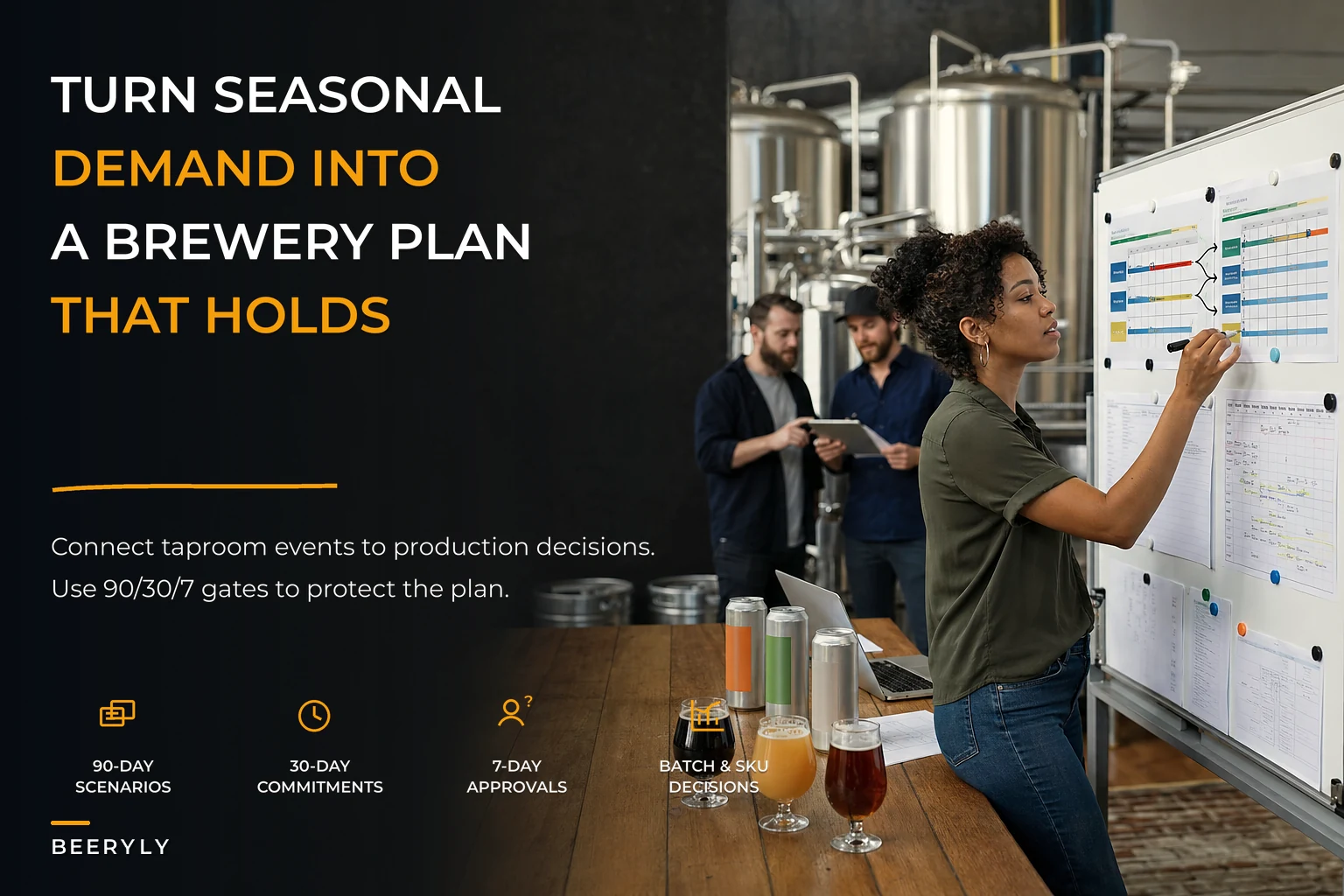

Most breweries don't have a production problem or a sales problem. They have a timing problem. The taproom books a haunted-house event for late October and mentions it in a group chat. Marketing promises a distributor a pumpkin ale allocation before anyone checks whether the tank will be free. The brewhouse finds out about both roughly nine days before they matter, when the calendar's already locked and the malt order's already placed.
That gap — between what commerce is promising and what production can actually deliver — is where margin quietly leaks. Not in dramatic ways. In small, repeated ones. A rushed batch that ties up a fermenter you needed for your flagship. A promo that sells out in three days and makes you look out of stock for the next three weeks. A seasonal that lands two weeks late and misses the window entirely.
Fixing this isn't about better forecasting software or a smarter spreadsheet. It's about building a planning cadence with clear decision points, so that a marketing ask can't turn into a production emergency. The framework below — a 90/30/7 horizon system with role-based approval gates — is how small and regional breweries actually get production to commerce alignment without hiring a full-time planner nobody can afford.
The real shape of the problem
Here's the pattern that shows up again and again in breweries doing somewhere between 2,000 and 15,000 barrels a year. The brewhouse plans on one horizon. Marketing plans on a completely different one. Nobody has agreed on when a "maybe" becomes a "yes."
Production naturally thinks in long horizons because tanks, yeast, and raw materials force it to. A lager needs its weeks. Conditioning doesn't negotiate. Ordering specialty malt or a specific hop varietal has lead time. So the brewhouse is mentally living 60 to 90 days out.
Marketing and the taproom live in the opposite world. Events get booked on short notice. A distributor rep calls Tuesday wanting something for a Saturday festival. A competitor drops a hazy IPA and suddenly there's pressure to respond. The taproom manager sees a slow Thursday and wants a promo this weekend to fix it.
Neither side is wrong. They're just operating on incompatible clocks. And without a shared structure, the collision happens at the worst possible moment — right at execution, when your options have already narrowed to "scramble" or "say no."
What breaks first at scale is coordination, not capacity. A tiny brewery absorbs chaos because one or two people hold the whole picture in their heads. Once you're running multiple SKUs, a handful of distribution accounts, and a taproom doing its own events, that shared mental model disappears. The person who knew the tank schedule wasn't in the room when the promo got promised.
The 90/30/7 horizon: three clocks, one rhythm
The core idea is simple. You plan the same set of decisions at three different distances from execution, and each horizon has a specific job. Nothing skips a horizon. Nothing gets committed later than its gate allows.
Take control of your brewery’s workflow.
Beeryly helps you schedule batches, track inventory, and monitor sales with ease.
- Production timeline management
- Inventory tracking & alerts
- Sales & distribution monitoring
No credit card required
The 90-day horizon is about capacity and commitment. This is where seasonal beers, planned limited releases, and known big events get locked into the tank schedule and the procurement plan. If a pumpkin ale needs to ship in September, the decision to brew it lives here — in June. Raw materials with long lead times get ordered against this horizon. Tank allocation gets blocked out. This is the layer that protects your flagship from getting elbowed aside by a last-minute idea.
The 30-day horizon is about refinement and reality-checking. By now you know more. The forecast for the seasonal has firmed up. You've got an early read on how a similar release performed. Taproom events that were "probably happening" are now confirmed with dates. At 30 days, you adjust batch sizes, confirm packaging runs, and reconcile what you committed at 90 days against what the market's actually telling you. This is also where most conflicts should surface — while you still have room to move.
The 7-day horizon is about execution and small moves only. At one week out, the schedule is essentially frozen for anything requiring a brew. What's still allowed here: pulling forward a promo using inventory you already have, adjusting a taproom-only pour, tweaking allocation between accounts. What's not allowed: adding a new brew, changing a batch size that affects tank timing, or promising a distributor something that isn't already in a tank.
The discipline is in the word "only." The 7-day window is where breweries destroy themselves by treating every marketing ask as urgent. Most aren't. The system's whole purpose is to route each ask to the horizon where it actually belongs.
Here's a simple visual of the 90/30/7 workflow.
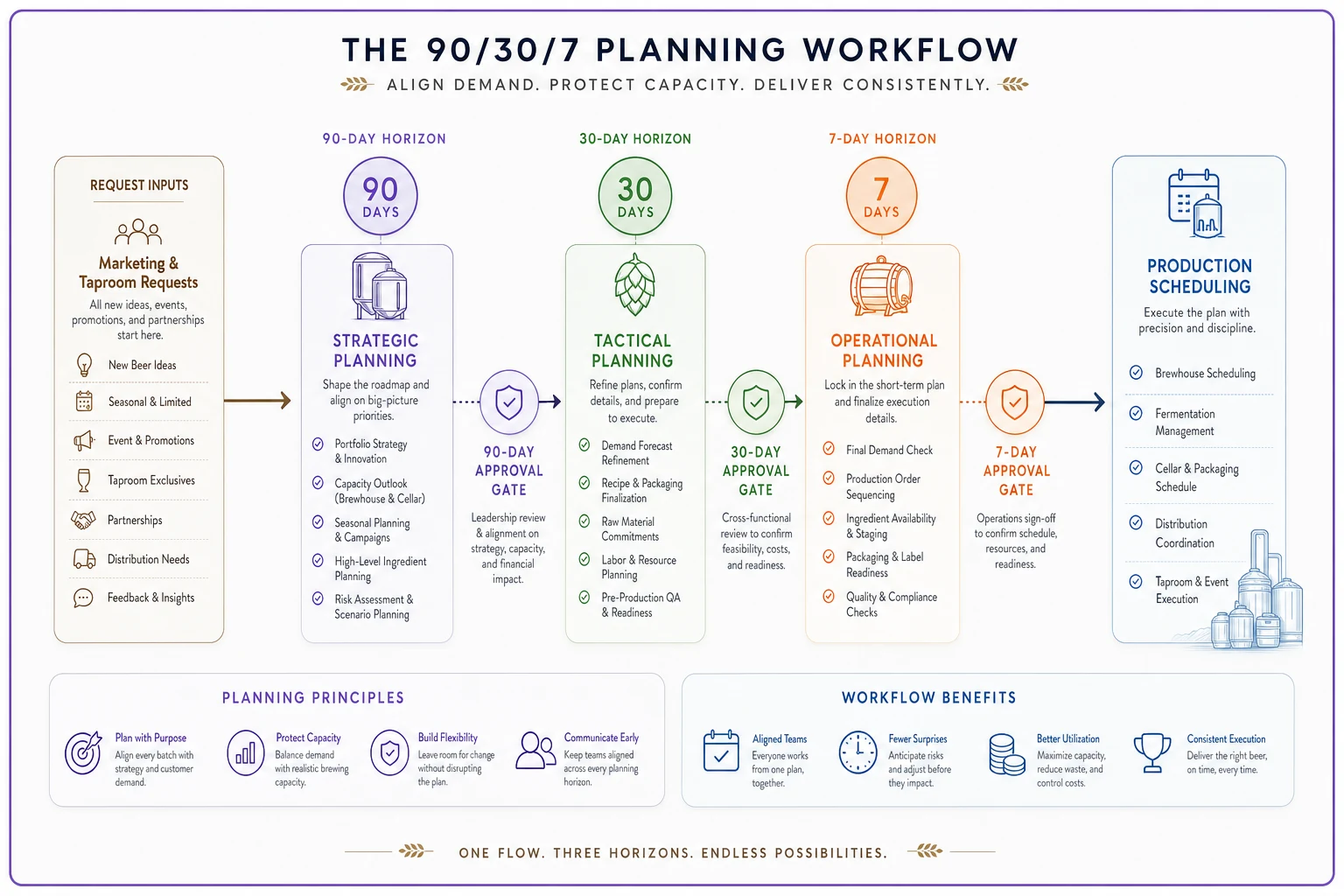
The visual highlights how decisions flow from marketing into production through discrete gates so nothing bypasses the correct horizon.
Role-based approval gates: who can say yes to what
A planning cadence with no gatekeeping is just a nicer-looking chaos. The reason marketing asks turn into production fires is that nobody's clear on who's allowed to commit the brewery to something — and at what point that commitment becomes real.
Approval gates fix this by tying the type of decision to the role that can approve it and the horizon where it's allowed.
| Decision type | Horizon required | Who approves | What they're actually checking |
|---|---|---|---|
| New seasonal / limited release | 90-day | Production manager + owner | Tank availability, raw material lead time, margin |
| Batch-size change on committed beer | 30-day | Production manager | Fermenter timing, packaging capacity |
| Distributor allocation promise | 30-day | Sales lead + production sign-off | Existing inventory + scheduled production |
| Taproom event tied to specific beer | 30-day | Taproom manager + production check | Whether the beer will exist in time |
| Promo using existing inventory | 7-day | Taproom/sales manager | Stock on hand only, no production impact |
| New brew inside 7 days | Not allowed | — | (Escalates to owner as exception) |
The key insight buried in that table: a distributor allocation promise is a 30-day decision, not a same-week one. This is where a lot of breweries get burned. Sales says yes to a number on the phone, and only later does anyone check whether the beer to fulfill it exists or is even scheduled. The gate forces a production sign-off before the promise leaves the building.
A practical way to think about gates: each one is a checkpoint asking a single question — "does saying yes to this break something we've already committed to?" If the person approving can't answer that, they don't have the authority to approve it. That's not bureaucracy. That's the difference between a plan and a wish.
When gates make sense — and when they slow you down
Gates work when you have enough SKUs and channels that no single person holds the full picture. If you're a two-person operation where the brewer is the sales lead, formal gates are overhead you don't need — a quick conversation covers it.
The threshold where gates start earning their keep is usually around the point you have a dedicated taproom manager booking events independently, plus at least a handful of active distribution accounts. That's when the "maybe" living in someone's head starts causing real collisions.
They become a bad idea when you turn them into approval theater — three signatures for a decision one person could safely make. The point is to gate the few decisions that genuinely commit shared resources, not every choice on the calendar.
Scenario templates: pre-deciding the last-minute promo
The hardest thing to handle in this whole system is the genuinely last-minute opportunity. A festival slot opens up. A local sports team makes a surprise playoff run and suddenly there's demand for a themed release. These aren't failures of planning — they're the reality of a market that moves faster than a fermenter.
The fix isn't to say no to all of them. It's to pre-build a small library of scenario templates so that when the ask comes in, you're not designing a response from scratch under pressure. You're picking one off the shelf.
A useful scenario template covers three things: what inventory it draws on, what production it does (or doesn't) trigger, and what the decision thresholds are for going ahead. A few templates that most breweries can build once and reuse:
-
The "existing-inventory promo." Draws only on stock already packaged. Triggers zero production. Approvable at 7 days. Decision threshold: enough inventory that the promo won't create a stockout on that SKU for at least the following two weeks.
-
The "flex-batch release." A small brew of an existing recipe using materials you keep on hand. Requires 30-day gate because it touches tank timing. Decision threshold: a free fermenter window and a minimum expected sell-through that clears the batch cost.
-
The "co-pack or contract pull." When demand outruns your own capacity. Decision threshold based on volume and lead time — worth exploring if the ask is big enough and far enough out.
Keep an up-to-date quick dashboard of packaged stock by SKU so existing-inventory promos can be approved quickly.
The scenario template turns a chaotic conversation ("can we do something for Saturday?") into a fast, structured one ("that's an existing-inventory promo, we've got the stock, taproom manager can approve it"). It also makes the no faster and less painful, because the template tells you immediately when something doesn't fit.
Decision thresholds that link the marketing ask to batch size and SKU
This is the part most planning systems skip, and it's the part that actually protects your margin. A marketing ask isn't just a yes/no. It implies a batch size and a SKU choice, and those choices should be driven by explicit thresholds — not by whoever's most enthusiastic in the room.
-
Estimate realistic sell-through for the promo or event, using the closest comparable you've run. Not the optimistic number — the median one.
-
Match the batch size to that number, plus a modest buffer, never the maximum the tank can hold. Overbrewing a promo beer is how you end up with a slow-moving SKU eating tank space three months later.
-
Decide the SKU form — draft-only, package, or both — based on channel. Taproom-only events rarely justify a packaging run. A distributor ask almost always does.
-
Check the margin floor. If the batch size that matches demand can't clear your cost-to-serve at a reasonable price, the answer is either a smaller draft-only version or a no.
-
Confirm it against tank and packaging availability in the correct horizon. If it doesn't fit without displacing a committed beer, it escalates.
The biggest promo mistakes aren't saying yes to bad ideas. They're saying yes to good ideas at the wrong batch size. A great limited release brewed at triple the demand becomes a working-capital problem and a tank bottleneck. The threshold system exists to keep the size of the yes proportional to the size of the real opportunity.
Getting this right also depends on a production schedule that's actually trustworthy in the first place. If your base schedule is already unreliable, no amount of planning cadence saves you — which is why a solid production scheduling system that prevents late runs and stockouts is the foundation the 90/30/7 layers sit on top of.
A real scenario
A regional brewery running around 6,000 barrels a year had a recurring fall problem. Their Oktoberfest lager was a genuine seasonal winner, but every year it collided with a wave of taproom event requests and distributor asks that all landed in the same six-week window. The lager needed its tank time. The last-minute asks needed tanks too. Something always lost.
The typical outcome: the seasonal shipped about ten days late two years running, they'd panic-brew a flex release at too large a batch, and they'd finish the season with 40–50 unsold cases of a promo beer nobody wanted in November. Between the late seasonal and the dead inventory, they were bleeding somewhere in the range of $8k–$12k a year on that one window alone — before counting the goodwill cost of telling a distributor "sorry, it's late again."
They didn't buy anything to fix it. They restructured the calendar around 90/30/7. The Oktoberfest went into the 90-day lock in June — tank blocked, malt ordered, no negotiation. Taproom events for the fall got funneled into a 30-day gate that required a production check before any beer got promised. And they built two scenario templates: an existing-inventory promo for the small stuff and a capped flex-batch for anything bigger.
The next fall, the seasonal shipped on time. The flex batches got sized to actual comparable demand instead of hope, and they finished the season with almost no dead promo inventory. The change wasn't dramatic in any single moment — it was the absence of the usual scramble. The owner described it as the first October in years where nobody worked a weekend fixing a problem that a decision three weeks earlier could have prevented.
Where this connects to the rest of the operation
This planning cadence doesn't live in isolation. The 90-day commitment feeds procurement lead times. The 30-day gate feeds packaging scheduling. And the whole thing has to hand off cleanly into fulfillment — because a seasonal that's brewed on time but sits in a warehouse missing its cold-chain window is still a miss. Aligning the production rhythm with how product actually reaches customers is its own discipline, and it's worth treating the production-to-cold-chain-delivery handoff as a deliberate framework rather than something that just happens at the end.
The horizons also create a natural feedback loop. Every promo you run at 7 days, every seasonal you commit at 90 days, generates a comparable you can use next time. Over a year or two, your batch-size thresholds stop being guesses and start being grounded in what your accounts and taproom actually absorb. This is where operational software helps quietly in the background — not by making decisions for you, but by keeping the tank schedule, the event calendar, and the inventory picture in one place so the person at each gate can actually see what they're approving against. The gate is only as good as the information the approver has in front of them.
Who should skip this
If you're brewing under about 1,500 barrels with a single taproom and no distribution, this full system is more structure than you need. Your bottleneck is probably capacity, not coordination, and a shared calendar plus a quick weekly conversation will cover you. Building formal gates before you have the complexity to justify them just adds friction.
The system starts paying off the moment you have multiple people making commitments that consume the same tanks. That's the real trigger — not barrel count, but the number of independent hands that can promise the brewery to something.
The takeaway
The collision between marketing and production isn't a personality conflict or a communication failure you can fix with better emails. It's a structural mismatch between two clocks. The 90/30/7 system works because it stops pretending both sides can operate on the same timeline and instead gives each decision a home — a horizon, a gate, and a threshold that connects the marketing ask directly to the batch size and SKU it implies. Build it once, hold the discipline on the 7-day window, and the seasonal ships on time while the last-minute promos still get their shot — just at the right size, in the right form, approved by the right person, without anyone losing a weekend to a fire that a decision three weeks earlier could have prevented.
Ready to elevate your brewery operations?
Join 500+ craft breweries using Beeryly to increase production efficiency, reduce waste, and grow sales.