

The loading dock at 4:47 AM tells you everything about brewery distribution operations. Cases of IPA sitting in 82-degree heat because the refrigerated truck showed up three hours late. A distributor's driver refusing half the order because your cold chain documentation expired yesterday. Your production team cranking out fresh batches while yesterday's beer still hasn't left the building.
Most brewery distribution operations break down exactly where production meets delivery. Not because brewers make bad beer or distributors can't drive trucks, but because nobody builds the operational bridge between what happens inside the brewery and what needs to happen on the road.
The production-to-dock disconnect costs more than spoiled beer
Every brewery starts with a simple promise: make beer, load trucks, get paid. Then reality kicks in around 400 barrels a month. Your flagship IPA needs 38-degree transport but your wheat beer can handle 45. The grocery chain orders need Monday morning delivery, which means Sunday night loading, but your packaging line doesn't run weekends. Your biggest account wants mixed pallets sorted by store location, but your warehouse crew loads by production date.
The real problem? These aren't separate issues. They're all symptoms of running brewery distribution operations without connecting production schedules to delivery requirements. You end up with a warehouse full of beer nobody can ship and trucks showing up for product that won't be ready until tomorrow.
Production thinks they're doing great because tanks are full and packaging lines are running. Distribution thinks they're organized because routes are planned. Meanwhile, beer ages out in the cooler because nobody aligned tank schedules with delivery windows.
Why route priority becomes your secret production scheduler
Most breweries get this backwards: they schedule production first, then figure out delivery. Works fine when you're selling everything to one distributor. Falls apart when you're juggling self-distribution routes, distributor pickups, and direct-to-retail deliveries.
Take control of your brewery’s workflow.
Beeryly helps you schedule batches, track inventory, and monitor sales with ease.
- Production timeline management
- Inventory tracking & alerts
- Sales & distribution monitoring
No credit card required
Start with your routes instead. Map out which accounts need beer when, then work backwards to production. A typical week might look like:
Monday morning routes:
-
Downtown restaurants (need Friday production/Saturday packaging)
-
Chain grocery stores (Thursday production/Friday packaging)
-
Temperature requirement
35-38°F throughout
Wednesday afternoon routes:
-
Suburban taprooms (Monday production/Tuesday packaging)
-
Specialty bottle shops (flexible timing)
-
Temperature requirement
38-42°F acceptable
Friday distributor pickup:
-
Whatever's ready and within date
-
Temperature requirement
follows their specs
Once you see delivery requirements laid out, production scheduling becomes more obvious. That Belgian tripel that needs 14 days conditioning? Schedule it for the monthly specialty shop run, not the weekly grocery delivery. The session ale that drinks best fresh? Time it for restaurant routes where it'll pour within 72 hours.
This route-first thinking changes how you see tank time too. Instead of asking "when will this be ready?" you start asking "when does this need to ship?" Suddenly that tank holding finished beer for an extra three days isn't efficient storage—it's blocking next week's production.
Building your cold chain handoff matrix (without the MBA nonsense)
Cold chain compliance sounds complicated until you realize it's just tracking temperature at handoff points. Expensive consultants will sell you IoT sensors and blockchain verification. Here's what actually works for brewery distribution operations under 5,000 barrels annually:
Create a simple acceptance matrix for each temperature-critical handoff:
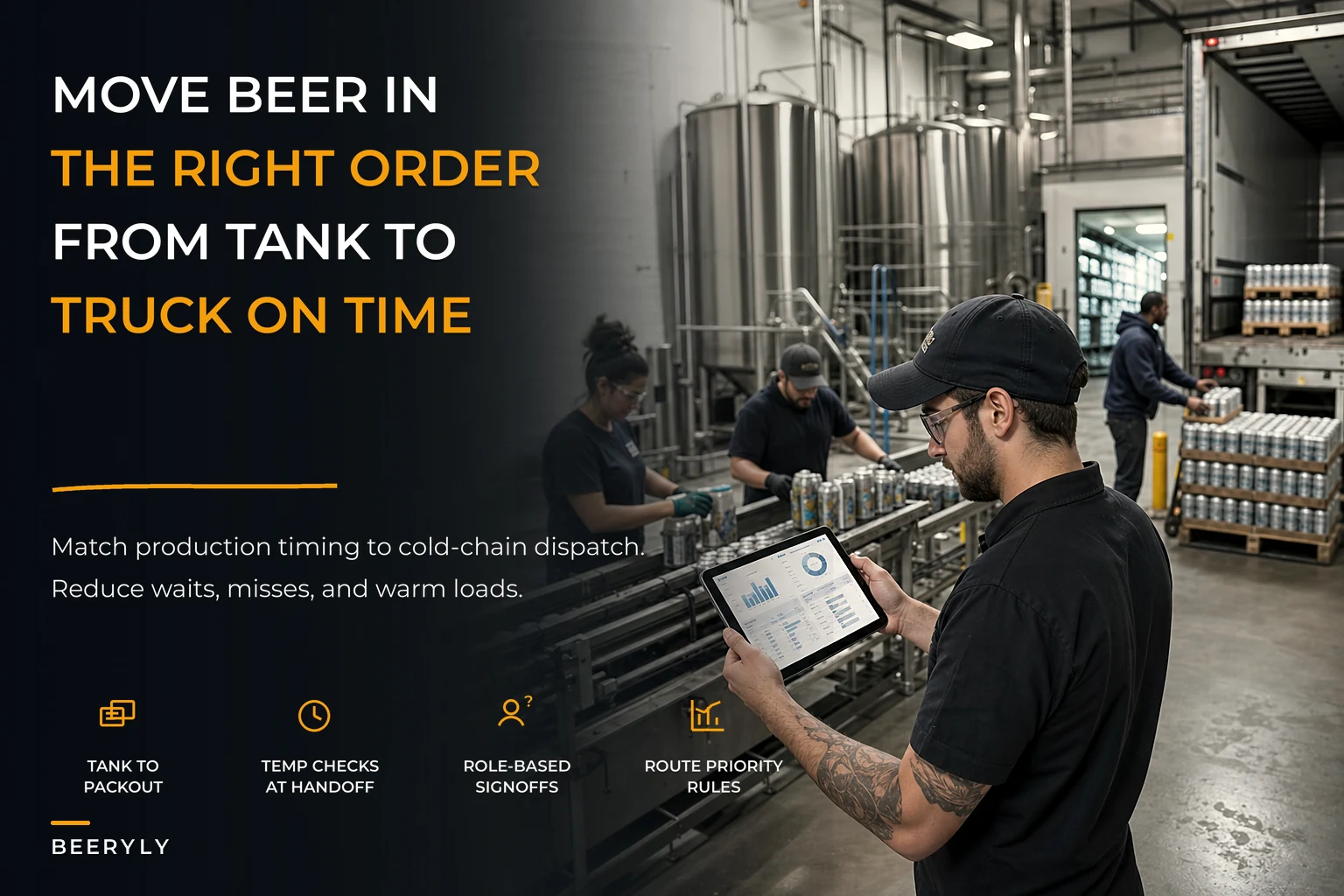
Visual workflow of the handoffs.
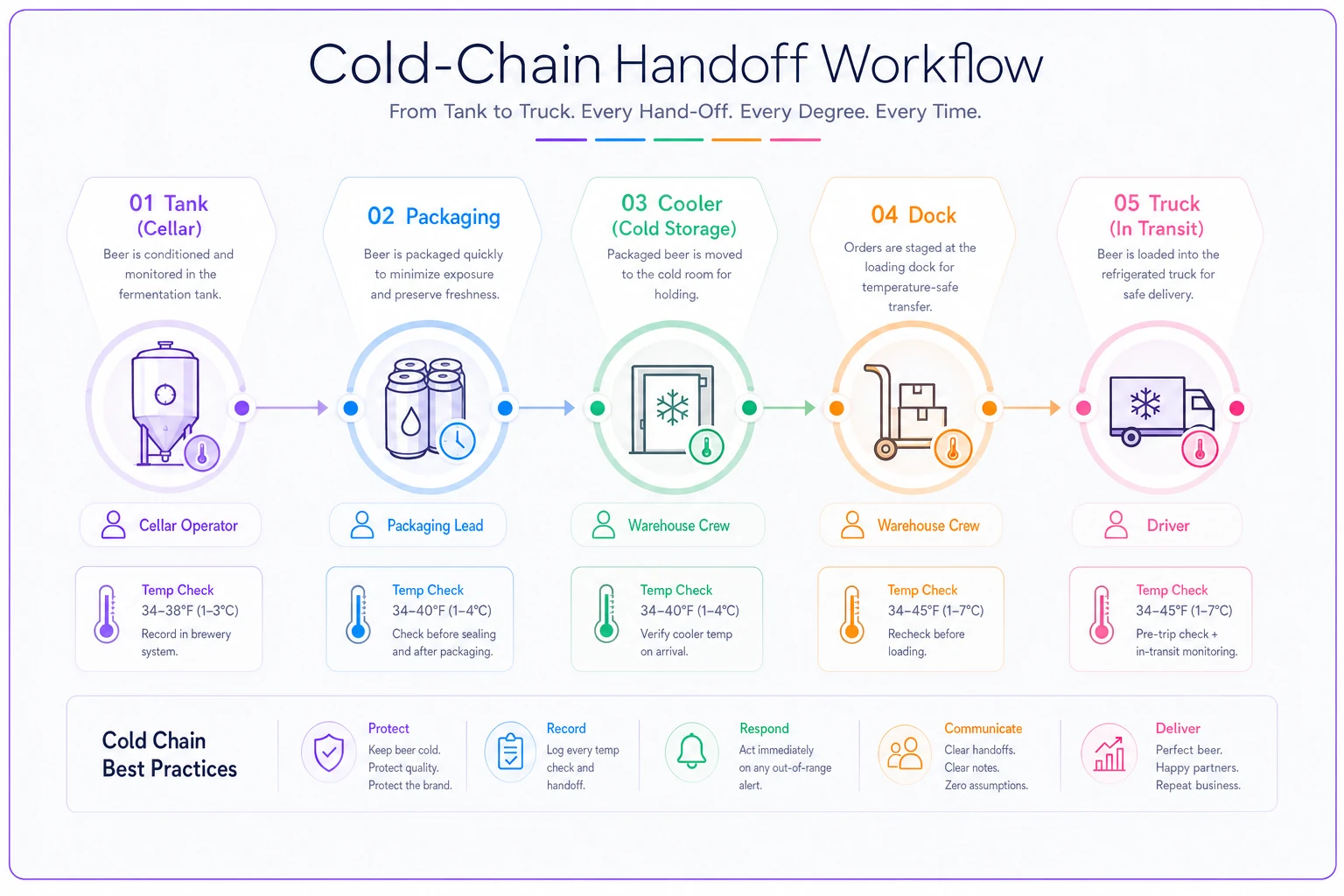
| Handoff Point | Who Checks | Acceptable Range | Documentation | Rejection Protocol |
|---|---|---|---|---|
| Tank to packaging | Cellar operator | 32-34°F | Packaging log | Hold for re-chill |
| Package to cooler | Packaging lead | 34-38°F | Cooler placement sheet | Immediate re-cool |
| Cooler to dock | Warehouse crew | 36-40°F | Loading checklist | Check cooler time |
| Dock to truck | Driver + loader | 38-42°F | Bill of lading | Refuse shipment |
The magic isn't the temperature ranges—any brewer knows those. It's assigning specific people to specific checks. When everyone's responsible, nobody's responsible. When Jake from packaging owns the cooler-entry check, that check actually happens.
Assign specific people to each handoff check so those checks actually happen.
Most cold chain failures happen during dock dwelling—that 20-to-90 minute window when pallets sit between cooler and truck. Fix this with loading windows that actually match your cooler-pull timing. If it takes 25 minutes to stage a full truck load, don't schedule the truck for 7:00 AM if your warehouse crew starts at 6:45.
Cost-to-serve math that production teams can actually use
Your head brewer doesn't care that delivering to the downtown gastropub costs $0.47 per case while the suburban grocery chain costs $0.31. But they'll care when you show them that making special one-off batches for that gastropub means each case actually costs closer to $1.93 to deliver once you factor in the partial truck load.
Build a cost-to-serve matrix that translates to production decisions:
Full truck routes (18+ pallets):
-
Base delivery cost
$180-220
-
Per case cost
$0.28-0.34
-
Worth making
Everything, including seasonal experiments
Half truck routes (8-12 pallets):
-
Base delivery cost
$180-220 (same truck cost)
-
Per case cost
$0.51-0.76
-
Worth making
Core lineup plus proven seasonals
Small routes (2-4 pallets):
-
Base delivery cost
$180-220 (still same truck)
-
Per case cost
$1.40-2.80
-
Worth making
Only high-margin specialties or minimum order quantities
Now your production team understands why making three cases of that barrel-aged stout exclusively for the craft beer bar loses money unless you're charging $180+ per case wholesale. The math forces conversations about batch sizes, variety counts, and account prioritization that ops teams usually avoid until it's too late.
A 2,000-barrel brewery we worked with cut SKUs from 31 to 19 after running these numbers. Their variety-seeking accounts complained for about two weeks, then forgot about it. Delivery costs dropped 24% because trucks were fuller. Production runs became predictable enough to avoid the scheduling chaos that was killing their efficiency.
The handoff checklist that stops finger-pointing
Friday afternoon, 4:30 PM. The distributor calls saying three pallets of your flagship IPA arrived warm. Production swears it left the tank at 33°F. Warehouse says the cooler's been at 38°F all week. The delivery driver claims his refrigeration unit was running the whole time. Everyone's right, everyone's wrong, and you're eating the cost of 72 cases of questionable beer.
This happens when handoffs exist in people's heads instead of on paper. Build role-based handoff protocols that create a paper trail:
Packaging to Warehouse Handoff:
-
Packaging lead fills out
batch number, package time, case count, current temp
-
Warehouse accepts
cooler placement, time entered, receiving temp
-
Both sign the handoff sheet
-
Sheet stays with the pallet
Warehouse to Loading Dock:
-
Warehouse pulls pallet, records pull time and temp
-
Stages in designated dock zone (marked and numbered)
-
Records staging time and ambient dock temp
-
Keeps pallet sheet attached
Loading Dock to Driver:
-
Loader and driver jointly inspect each pallet
-
Both record truck temp before loading
-
Both verify case counts match paperwork
-
Both sign final bill of lading
-
Each keeps a copy
Nine months into using this system, that same brewery discovered their dock dwelling problem happened every Tuesday and Thursday. Why? Their warehouse guy took lunch at 11:30, right when the afternoon trucks arrived. Pallets sat for 45 minutes in summer heat. Simple fix once they could actually see it in the data.
Loading window alignment that production can actually hit
The fantasy: Production finishes packaging at 3 PM, warehouse loads at 4 PM, truck leaves at 5 PM.
The reality: Production finishes at 5:47 PM because the canning line threw error codes all afternoon, warehouse crew left at 5 PM, and the truck driver's been waiting since 3:30 and is threatening to leave empty.
Loading windows fail because they assume perfect execution. Build windows that account for how brewery distribution operations actually run:
Morning windows (5 AM - 9 AM):
-
Requires
Previous day packaging completion
-
Buffer
14-16 hours from packaging to loading
-
Best for
Stable flagship products
-
Recovery option
Next-day morning slot
Afternoon windows (2 PM - 6 PM):
-
Requires
Morning packaging completion
-
Buffer
4-6 hours from packaging to loading
-
Best for
Quick-turn specialty releases
-
Recovery option
Evening overtime loading
Flex windows (as-needed):
-
Requires
24-hour advance scheduling
-
Buffer
Negotiable based on product
-
Best for
Distributor pickups
-
Recovery option
Following week's scheduled slot
The template that works:
-
Lock in three fixed window types per week
-
Assign specific beer styles to specific windows
-
Build 20% slack into each window
-
Create overflow rules for when things break
A 3,000-barrel brewery reduced late shipments from around 30% to under 10% just by admitting their packaging line needed four hours for changeovers, not the theoretical two hours they'd been scheduling against.
When manual tracking becomes impossible
Manual brewery distribution operations work until they don't. It usually breaks around 2,500-3,000 barrels annually, or when you hit 15+ SKUs, or when you're juggling self-distribution alongside distributor territories.
The symptoms show up everywhere at once. Your Excel sheets conflict because production updates theirs at different times than warehouse updates theirs. The routing spreadsheet shows different delivery dates than the production schedule. Nobody knows if that limited release sold through or if cases are still sitting in a distributor's warehouse.
This is where operational software starts making sense—not because you need fancy features, but because you need one source of truth. When production schedules automatically update delivery availability, when temperature logs link to specific shipments, when route changes immediately flag production conflicts, that's when brewery distribution operations stop being a daily crisis and start being predictable.
The AI automation piece handles the tedious stuff: matching production batches to delivery requirements, flagging temperature excursions before beer ships, calculating actual cost-to-serve as routes happen rather than weeks later in a spreadsheet, and auto-generating the handoff documentation that nobody wants to fill out but everybody needs when something goes wrong.
Breweries will spend $200k on a new canning line but resist spending $3k annually on software that keeps that canning line's output from spoiling on the dock. One avoided recall pays for a decade of operational software.
From loading dock chaos to predictable distribution
The best brewery distribution operations feel boring. Trucks show up when they're supposed to. Beer's cold when it needs to be cold. Production knows what to make and when. Nobody's scrambling at 5 AM trying to figure out what to load.
Getting there doesn't require perfection. It requires connecting pieces that are already moving. Your production schedule needs to see delivery windows. Your route planning needs to factor in cold chain requirements. Your cost accounting needs to influence production decisions. Your handoff protocols need to create accountability without adding hours of paperwork.
Start at the loading dock. Stand there during your busiest shipping window and watch where things actually break. Usually it's not where you think. That refrigerated truck that's always late? Maybe your loading window conflicts with three other breweries on their route. Those temperature excursions? Could be happening during the 15-minute forklift ride from cooler to truck, not in storage.
Fix the real problems, not the theoretical ones. Build systems that match how your brewery actually operates. Connect production to distribution with rules simple enough that your newest employee can follow them.
And accept that distribution complexity grows exponentially, not linearly. What works at 1,000 barrels breaks at 2,500. What works at 2,500 breaks at 5,000. Build systems that can evolve, document what matters, and automate the repetitive stuff before it buries you.
Your beer deserves to reach customers in the same condition it left your tanks. Everything else—the schedules, handoffs, temperature logs, loading windows—just exists to make that happen consistently.
Ready to elevate your brewery operations?
Join 500+ craft breweries using Beeryly to increase production efficiency, reduce waste, and grow sales.