



Three months ago, a brewery owner showed me his inventory room. Pallets of Galaxy hops from two different harvest years sat next to each other. The older batch—$8,000 worth—had started losing aroma compounds. Meanwhile, he'd just placed another $12,000 order because his assistant didn't realize they already had stock buried in the back.
This wasn't a small operation either. They were producing around 8,000 barrels annually, running four flagship beers plus rotating seasonals. The kicker? Their working capital was completely sideways. About $140,000 tied up in inventory, with roughly 15% going bad each quarter.
The problem runs deeper than just poor organization. When you're dealing with hops, yeast, and packaging materials, you're essentially managing three different decay curves while trying to predict demand for products that might not exist yet. Your Citra hops degrade differently than your Cascade. Your London Ale yeast has different storage requirements than your Saison strain. And those branded crowns you ordered for a collaboration? They become worthless metal if the partnership falls through.
The triple threat that kills brewery margins
Most brewery inventory systems break because they treat all ingredients like they're aluminum cans. They're not. You've got three distinct categories fighting for your attention and cash, each with its own shelf-life curve and risk profile.
Hops start degrading the moment they leave cold storage. Alpha acids drop predictably—about 20-30% per year at room temperature, but the real killer is the aroma compound loss. Those expensive New Zealand hops you bought for your summer IPA? After six months at improper storage, they smell like wet cardboard instead of tropical fruit. A brewery producing 5,000 barrels might carry $60,000 in hop inventory. Poor rotation means you're essentially lighting $9,000 on fire annually.
Yeast presents a different challenge. Unlike hops where degradation is gradual, yeast viability can cliff-dive. One week your pitch is at 95% viability, two weeks later it's at 60%. You either overpitch (wasting money) or underpitch (ruining beer). Most breweries keep 3-4 house strains plus specialty strains for seasonals. That's easily $8,000-12,000 in yeast inventory that needs constant monitoring.
Packaging materials seem stable until they're not. Labels fade. Adhesive fails. Boxes get moisture damage. But the real problem is obsolescence risk. You order 50,000 labels for a beer that doesn't sell. Now you're sitting on $3,500 of custom-printed garbage. One brewery I worked with had $22,000 in obsolete packaging materials—enough to fund their grain bill for two months.
Why traditional inventory formulas fail in brewing
The standard reorder point formula every business textbook teaches goes something like: (Average Daily Usage × Lead Time) + Safety Stock. Apply that to brewery operations and everything falls apart.
Take control of your brewery’s workflow.
Beeryly helps you schedule batches, track inventory, and monitor sales with ease.
- Production timeline management
- Inventory tracking & alerts
- Sales & distribution monitoring
No credit card required
Your "average daily usage" for Mosaic hops might be zero for three weeks, then 200 pounds in two days for your seasonal DIPA brew. Your lead time varies from 3 days for domestic to 8 weeks for specialty imports. And safety stock? The formula assumes products don't expire.
Traditional FIFO (First In, First Out) makes sense for widgets. But brewery ingredients need FEFO—First Expired, First Out. That batch of Pilsner malt from January should get used before the February delivery, even if the February batch arrived at your dock first because January's order got delayed in transit.
Breweries either overstock everything (tying up capital) or run constant fire drills when they realize tomorrow's brew day needs ingredients they don't have. Neither approach scales.
Building risk tiers that match reality
Not all ingredients deserve the same treatment. A smart perishable inventory strategy for breweries starts with categorizing every SKU by two factors: spoilage risk and operational impact.
| Tier | Examples | Guidance |
|---|---|---|
| Tier 1 (Critical/High Spoilage) | Liquid yeast strains; Wet hops (when in season); Specialty fruit purees; Pre-printed seasonal packaging | These items need tight controls. Maximum inventory levels should cover 2-3 weeks of planned usage, never more. Your reorder triggers need buffers for supplier issues but not so much that product expires. |
| Tier 2 (Critical/Moderate Spoilage) | Pelletized hops; Dry yeast; Specialty malts; Standard crown caps | You can stretch to 4-6 weeks of coverage here. These ingredients won't crater overnight but still need rotation discipline. This tier usually represents about 60% of ingredient spending. |
| Tier 3 (Important/Low Spoilage) | Base malts; Generic packaging; Cleaning chemicals; CO2 | These can handle 8-12 week inventory levels without significant risk. The challenge here is storage space, not spoilage. |
Tier 1 (Critical/High Spoilage):
-
Liquid yeast strains
-
Wet hops (when in season)
-
Specialty fruit purees
-
Pre-printed seasonal packaging
These items need tight controls. Maximum inventory levels should cover 2-3 weeks of planned usage, never more. Your reorder triggers need buffers for supplier issues but not so much that product expires.
Tier 2 (Critical/Moderate Spoilage):
-
Pelletized hops
-
Dry yeast
-
Specialty malts
-
Standard crown caps
You can stretch to 4-6 weeks of coverage here. These ingredients won't crater overnight but still need rotation discipline. This tier usually represents about 60% of ingredient spending.
Tier 3 (Important/Low Spoilage):
-
Base malts
-
Generic packaging
-
Cleaning chemicals
-
CO2
These can handle 8-12 week inventory levels without significant risk. The challenge here is storage space, not spoilage.
The hidden cost of supplier concentration
Supplier risk multiplies your spoilage problem in ways most breweries don't track. When you're buying 80% of your specialty hops from one distributor, their delivery hiccup becomes your spoilage event.
A brewery learned this lesson expensively when they sourced all their Centennial hops from a single farm because of the price break. When that farm's harvest came in three weeks late, the brewery had already committed to a hop-forward fall seasonal. They panic-bought from spot markets at 3x the price, then still had to take delivery of the original order. Result: $18,000 in excess hop inventory that aged out before they could use it.
The fix isn't just "diversify suppliers"—that's obvious. The real strategy involves matching supplier relationships to your tier system. Tier 1 items need 2-3 qualified suppliers with staggered order cycles. You might pay 5-8% more per pound, but you avoid the 30% loss from spoilage or emergency purchases.
For Tier 2, you can concentrate more with a primary and backup supplier. Tier 3 items? Single-source away if the pricing makes sense—these won't spoil before you can find alternatives.
Lot rotation policies that actually work
Every brewery says they rotate stock. Few actually do it systematically. The problem starts with receiving—new inventory gets stacked wherever there's space, usually in front of older stock.
A functional FEFO system requires three things most breweries skip:
First, visible expiration tracking. Not just harvest dates on hop boxes, but actual "use by" dates based on your storage conditions. A simple spreadsheet works, but even masking tape and markers beat nothing. Mark every container, pallet, or bag with the month it needs to be used.
Second, dedicated staging areas. Your walk-in cooler needs a "use first" section separate from bulk storage. When preparing for brew day, pull from "use first" before touching newer inventory. This seems basic until you watch a brewer grab the nearest bag of grain because they're rushing to hit mash-in temperature.
Third, monthly rotation audits. Not annual, not quarterly—monthly. Set a recurring calendar reminder for the first Monday. Physical count what's expiring in the next 30 days and plan your production schedule around it. One brewery started doing this and cut their hop spoilage from $11,000 to $3,000 annually just by brewing recipes that used up aging inventory.
Label every container, pallet, or bag with the month it needs to be used to make FEFO practical for every shift.
Here's a simple workflow that puts those steps into practice.
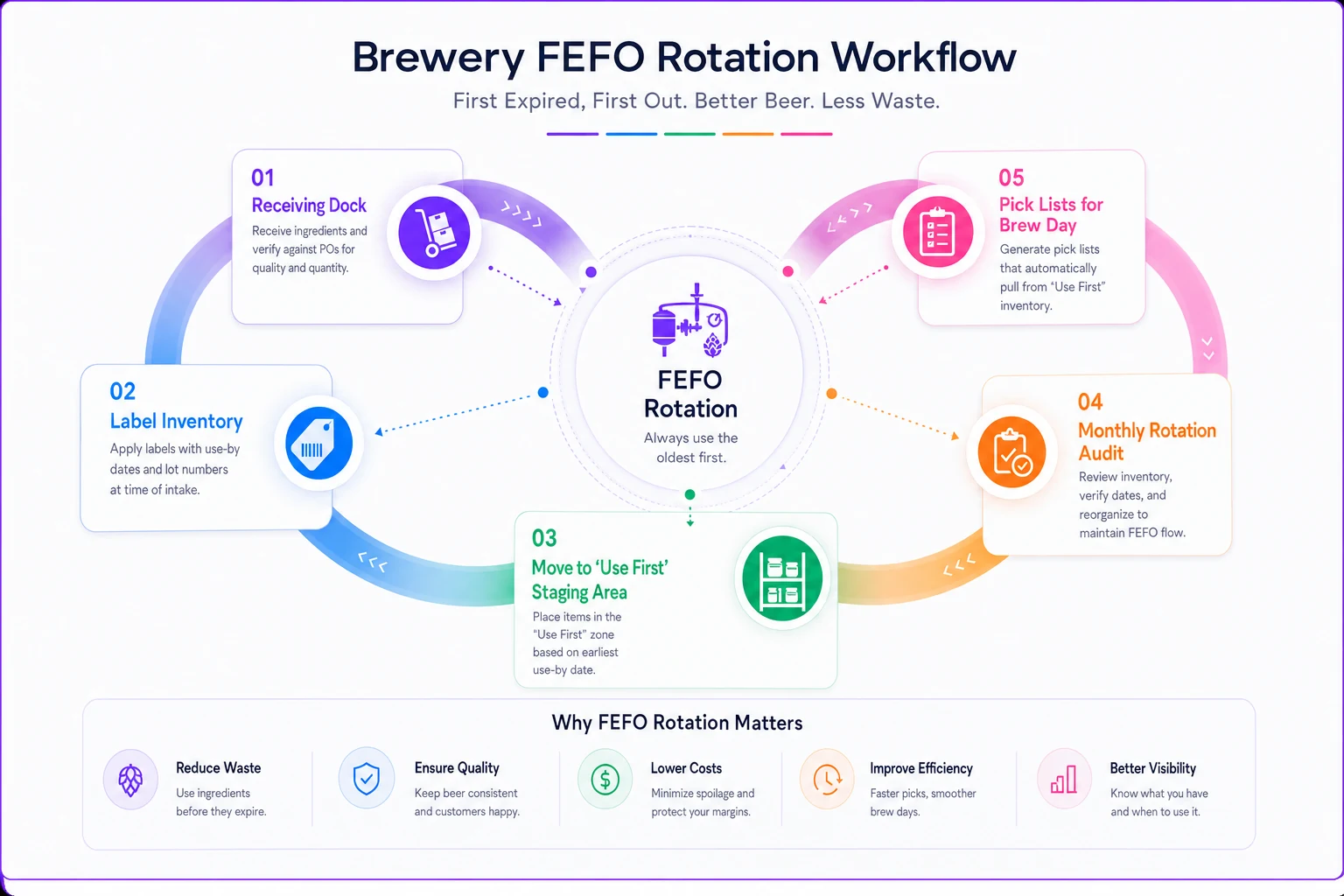
A visual workflow like this helps teams understand where errors happen and who owns each step.
Safety stock formulas adjusted for spoilage
Traditional safety stock calculations assume infinite shelf life. For breweries, your safety stock formula needs a decay factor.
For hops: Safety Stock = (Peak Weekly Usage × Lead Time Variability) × (1 - Degradation Rate)
If you use 100 pounds of Cascade weekly during peak season, with a 2-week lead time variability, and lose 2% quality monthly, your safety stock should be around 190 pounds, not the 200 pounds a standard formula suggests.
For yeast, the calculation gets more complex because viability drops non-linearly:
Safety Stock = (Cells Needed per Batch × Batch Frequency × Lead Time) / (Projected Viability at Reorder Point)
If you need 500 billion cells per batch, brew twice weekly, have a 1-week lead time, and expect 80% viability by reorder time, you need 1.25 trillion cells in safety stock, not 1 trillion.
This seems like overengineering until you calculate the cost of either expedited shipping (usually 3x normal) or a failed batch (potentially $3,000-8,000 in lost product).
Practical implementation without software paralysis
Most brewery management software treats inventory as an afterthought. You don't need to wait for perfect tools to implement better practices. Start with a basic framework that tracks four things:
The Weekly Snapshot
-
Current inventory levels by tier
-
Expiration dates for Tier 1 items
-
Pending orders and expected delivery dates
-
Last week's usage rates
This takes about 45 minutes once you have the routine down. The data tells you what's really happening versus what you think is happening.
The Monthly Review
-
Calculate actual spoilage losses
-
Compare planned versus actual usage
-
Identify slow-moving SKUs
-
Adjust reorder points based on real data
Track this in a simple spreadsheet with columns for: SKU, Tier, Current Quantity, Expiration Date, Weekly Usage Rate, Reorder Point, and Supplier Lead Time.
The Quarterly Adjustment
-
Renegotiate supplier minimums based on actual usage
-
Review tier assignments
-
Eliminate SKUs with consistent spoilage
-
Adjust safety stock levels based on seasonal patterns
Every three months: implement the adjustments and monitor results to ensure the changes actually reduce spoilage and free up cash.
When automation makes sense (and when it doesn't)
Small breweries under 2,000 barrels annually probably don't need sophisticated inventory software. A good spreadsheet and disciplined processes beat expensive software you won't maintain. The tipping point comes when you're managing 30+ active SKUs across multiple storage locations.
That's when operational software with AI automation starts earning its keep. Not the basic inventory modules in brewery management systems—those just digitize the mess you already have. You need something that understands expiration dates, automatically generates pick lists based on FEFO rules, and alerts you before problems happen, not after.
The right platform can track degradation curves for different hop varieties, predict yeast viability based on storage time and temperature, and even suggest recipe adjustments to use up inventory approaching expiration. It connects your purchasing, production planning, and inventory management into one workflow.
But automation only amplifies what you're already doing. If you don't have basic processes in place, software just helps you make mistakes faster. Get the manual system working first, then add technology to scale it.
The compound effect on working capital
Most breweries miss this: fixing inventory spoilage doesn't just save the cost of wasted ingredients. It fundamentally changes your cash conversion cycle.
A typical craft brewery producing 5,000 barrels might carry $180,000 in total inventory. With a 15% annual spoilage rate, that's $27,000 in direct losses. But the real impact is on working capital efficiency.
When you implement proper FEFO rotation and tier-based reordering, several things happen:
Inventory levels drop 20-30% because you're not panic-buying or keeping excess safety stock. That frees up $36,000-54,000 in cash. Spoilage drops from 15% to around 5%, saving $18,000 annually. Order frequency increases but order sizes decrease, improving cash flow timing.
The money you're not tying up in dying hops can fund equipment upgrades, marketing programs, or just provide breathing room during slow seasons. One brewery used their freed-up capital to add a canning line six months earlier than planned.
Making it stick when everything else is on fire
The hardest part isn't designing the system—it's maintaining it when you're juggling equipment breakdowns, staff issues, and demanding distribution partners.
The key is making inventory discipline part of your brewing culture, not an add-on task. Your brewers need to understand that pulling the oldest hops first is as important as hitting target gravities. Your warehouse team needs to know that proper rotation prevents the 2 AM emergency supply runs they hate.
Start with one category—usually hops since they're expensive and visible. Get that working smoothly before adding yeast, then packaging. Build momentum with small wins rather than trying to revolutionize everything at once.
Set up simple metrics everyone can understand. Post a chart showing monthly spoilage dollars. Celebrate when you hit zero spoilage weeks. Make it visible that this matters.
Most importantly, assign ownership. Someone needs to own inventory performance the same way your head brewer owns beer quality. Without clear accountability, even the best system degrades back to chaos within months.
The path forward
Running a brewery means accepting that some waste is inevitable. Recipes change, collaborations fall through, and sometimes you just guess wrong about what customers want. But the difference between 15% losses and 5% losses might be the margin that lets you survive a tough year or expand to that second location.
Start simple. Pick your highest-value ingredient category and implement FEFO rotation this week. Build from there. Track your spoilage honestly—most breweries underestimate it by half because they don't count labor time or opportunity costs.
Remember that every pound of hops that expires, every yeast cell that dies, and every obsolete label represents cash you could have used to grow your business. In an industry where margins are already tight, getting inventory right isn't just about operational excellence—it's about survival.
The breweries that thrive long-term aren't necessarily the ones with the best recipes or the coolest taprooms. They're the ones that treat ingredient management as seriously as they treat brewing. Because at the end of the day, you can't sell beer made from expired hops, no matter how good your branding is.
Ready to elevate your brewery operations?
Join 500+ craft breweries using Beeryly to increase production efficiency, reduce waste, and grow sales.