


Most small breweries lose between $8,000 and $15,000 worth of kegs annually. Not from theft or damage—from basic tracking failures that create invoice disputes, missing deposits, and kegs sitting forgotten in distributor warehouses for months.
The keg tracking brewery systems that actually work don't require RFID tags or expensive scanning equipment. They need clear deposit policies, simple scanning workflows that your cellar team will actually follow, and billing rules that prevent disputes before they happen.
The hidden cost structure of keg losses
A 15-barrel brewery producing 600 barrels annually typically owns around 120 half-barrel kegs and 80 sixtels. At current stainless prices, that's roughly $42,000 in cooperage inventory. When tracking breaks down, the financial impact compounds in ways most breweries don't fully calculate.
Direct keg replacement runs $350 per half-barrel. The operational disruption costs more. When you're missing 12 kegs during a busy week, you're either rushing expensive overnight keg orders, short-filling production runs, or telling accounts you can't fulfill orders. One brewery in Vermont discovered their "missing" kegs were creating $2,800 monthly in rush shipping charges and lost sales—far exceeding the replacement value.
Invoice disputes multiply this damage. Without clear tracking, you're fighting over deposits three months after delivery, spending hours reconciling accounts instead of selling beer. These disputes poison distributor relationships right when you need shelf space most.
Why traditional tracking fails at small scale
Excel spreadsheets work until you hit about 40 kegs in circulation. After that, manual updates fall behind reality within days. Your production manager updates the sheet when kegs leave. Sales updates it when creating invoices. The delivery driver forgets to note returns. By Thursday, nobody trusts the data.
Take control of your brewery’s workflow.
Beeryly helps you schedule batches, track inventory, and monitor sales with ease.
- Production timeline management
- Inventory tracking & alerts
- Sales & distribution monitoring
No credit card required
QR code systems seem like an obvious upgrade, but implementation usually stalls. The codes get scraped off during cleaning. Drivers skip scanning because their phones won't connect in cold storage. The fancy dashboard shows beautiful analytics based on incomplete data.
Even basic barcode scanning fails when you implement it wrong. Breweries buy scanners, create elaborate workflows, then watch adoption die within weeks because they didn't account for how work actually happens in a brewhouse. The person pulling kegs for delivery has wet gloves. The scanner is across the room. They'll scan "later"—which means never.
Building a deposit structure that prevents disputes
Your deposit policy either protects you or creates arguments. Most breweries set deposits at $30-50 for half-barrels, thinking lower deposits encourage sales. This actually creates more problems. When deposits don't reflect replacement cost, accounts treat kegs as disposable.
Setting deposit amounts that change behavior
Calculate deposits at 75% of your actual replacement cost including freight. For a $350 half-barrel, that's a $260 deposit. This seems high until you compare it to the hidden costs of missing kegs. Accounts suddenly care about returns when they have real money tied up.
Structure your deposits in tiers:
New accounts (first 6 months):
-
Half-barrel
Full replacement cost ($350)
-
Sixtel
Full replacement cost ($240)
-
Minimum 50% deposit before delivery
-
No net payment terms until 3 months history
Established accounts (6+ months, clean history):
-
Half-barrel
75% replacement ($260)
-
Sixtel
75% replacement ($180)
-
Standard net-30 terms
-
Deposit rolls forward each month
Premium accounts (12+ months, zero disputes):
-
Half-barrel
50% replacement ($175)
-
Sixtel
50% replacement ($120)
-
Net-45 terms available
-
Quarterly deposit reconciliation
This tiered approach rewards good behavior while protecting you from new accounts who might disappear with your cooperage.
The deposit documentation that eliminates arguments
Every deposit dispute starts the same way: "We never agreed to that amount." Prevent this with a simple deposit acknowledgment form that accounts sign before first delivery. Include these elements:
-
Exact deposit amounts by keg type
-
Return timeframe (typically 60 days)
-
Condition requirements for deposit return
-
Late return penalties ($5/week after 60 days)
-
Damaged keg assessment process
-
Signature line with printed name and date
Store these forms digitally with automated backups. When disputes arise three months later, you have documentation instead of memories.
Implementing scanning workflows that people actually use
The best keg tracking brewery system is the one your team actually uses. This means designing around real cellar operations, not theoretical best practices.
Morning keg pulls
The person pulling kegs for delivery starts at 5 AM, usually alone. They're moving fast, handling wet kegs in cold storage. Traditional scanning requires them to remove gloves, pull out phone or scanner, scan each keg, enter destination, and save transaction.
This workflow dies by day three.
Instead, implement batch scanning at the loading door. Mount a cheap tablet ($200 refurbished iPad) in a waterproof case at chest height. Create preset buttons for your top 10 accounts. The workflow becomes loading truck, tapping account name once, scanning all kegs rapidly, then tapping confirm.
Takes 30 seconds for a 20-keg load. The same person who skipped individual scanning will consistently use batch scanning because it fits their actual work pattern.
Return processing that captures every keg
Returns create the biggest tracking gaps. Drivers drop empties in the yard. Someone moves them to cleaning. Someone else moves them to storage. Each handoff loses data.
Fix this with a single-point return station. Paint a yellow square in your loading area labeled "RETURNS - SCAN HERE." Mount another tablet. Every returned keg goes in the square first. The driver (or whoever unloads) scans everything at once. Only then do kegs move to cleaning.
This physical constraint—the painted square—creates a scanning bottleneck that ensures capture. It's crude but effective. One brewery in Michigan went from 60% return capture to 95% just by adding this painted square and making it the only path to cleaning.
The weekly reconciliation that catches errors
Even good scanning misses kegs. Implement a Thursday afternoon count that compares physical inventory to system records. This isn't a full audit—just a quick verification of what's on-hand.
Here's a simple visual of the scanning and return workflows.
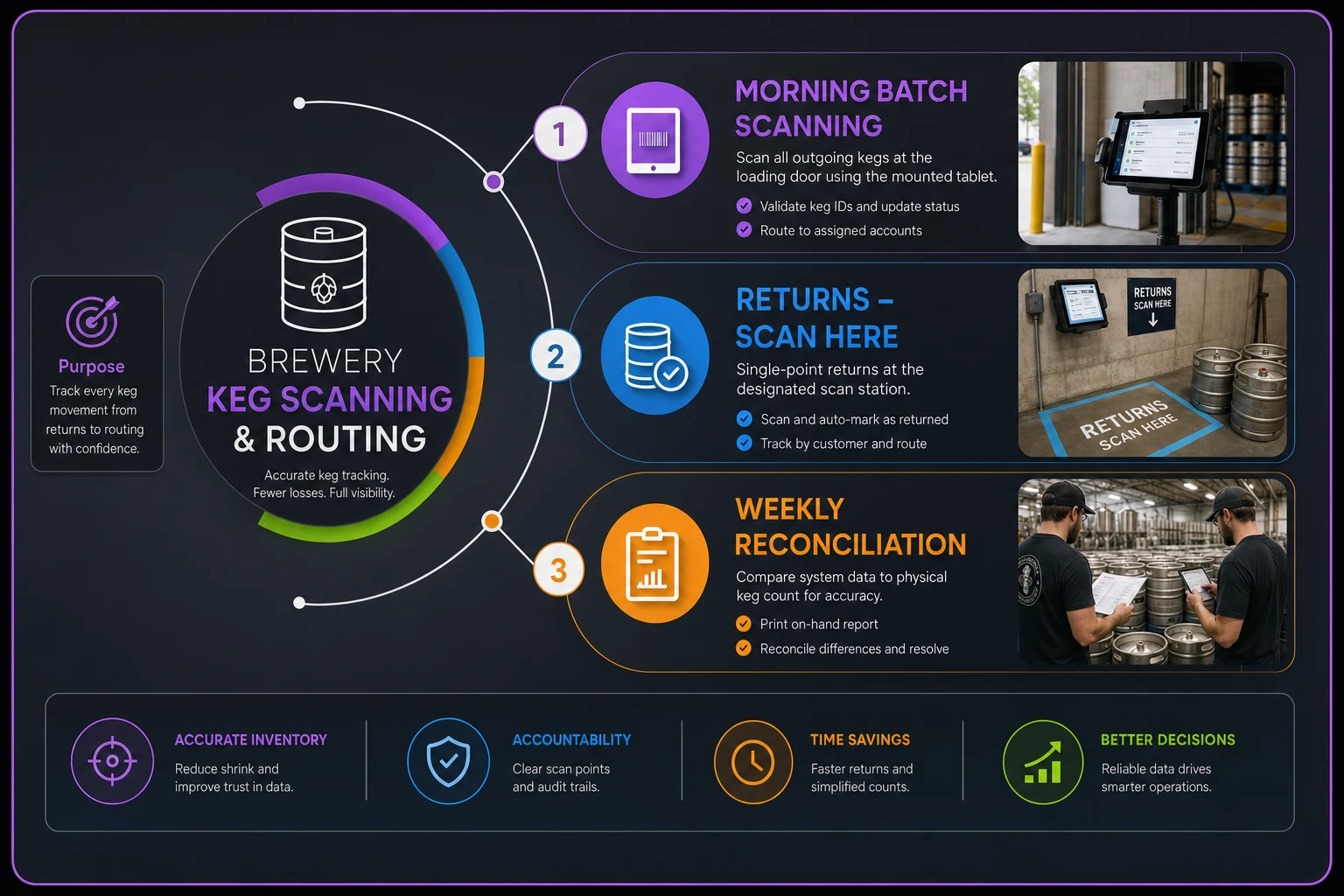
Mount the tablet at chest height and set preset account buttons to make batch scanning fast and reliable for early-morning pulls.
Print your system's on-hand report. Send someone to count kegs in storage. Mark differences. Investigate anything over 5 kegs variance. This 20-minute weekly check catches problems before they compound into missing dozens of kegs.
Routing rules that match operational reality
Standard keg tracking assumes simple out-and-back movement: brewery to account to brewery. Reality is messier. Kegs go to distributors who send them to retailers. Event kegs move between venues. Self-distribution routes hit multiple stops with partial returns.
Distributor handoff tracking
When kegs go to distributors, you lose direct visibility. The distributor's tracking rarely matches yours. They might deliver your keg to a retailer Tuesday, but not update their system until Friday's batch processing. Meanwhile, you're showing the keg at the distributor while the retailer is already tapping it.
Create transfer documentation for every distributor delivery. Include keg serial numbers, delivery date and time, receiving signature, and photo of loaded kegs.
This seems excessive until a distributor claims they never received 15 kegs worth $5,250. The photo and signature end that argument immediately.
Establish a weekly reconciliation call with major distributors. Every Thursday at 2 PM, compare active keg lists. You read your serials showing at their warehouse. They confirm or correct. This 10-minute call prevents months of confusion.
Multi-stop route documentation
Self-distribution routes create unique tracking challenges. Your driver leaves with 30 kegs for 6 accounts. Account 3 isn't ready, so those kegs go to Account 4 temporarily. Account 5 swaps two sixtels for a half-barrel. By end of day, the planned route and actual route look nothing alike.
Build routes with flexibility assumed. Instead of rigid stop-by-stop tracking, use zone-based routing:
Downtown zone (Monday/Thursday):
-
15-20 kegs typical
-
4-6 accounts
-
Driver discretion on order
-
Photo at each stop showing delivered kegs
-
Return scan at brewery end-of-day
Suburbs zone (Tuesday/Friday):
-
25-30 kegs typical
-
8-10 accounts
-
Must hit grocery stores before 11 AM
-
Everything else flexible
-
Batch scan returns
This zone approach matches how drivers actually work while maintaining tracking accuracy.
Sample billing policies that prevent payment disputes
Most keg disputes happen because billing policies don't match operational reality. Your terms say net-30, but you're invoicing net-45 because the bookkeeper is behind. Accounts get confused. Arguments follow.
The monthly keg statement that eliminates surprises
Send every account a monthly keg statement separate from invoices. This simple document shows kegs currently at location, days outstanding per keg, upcoming deposit charges (kegs over 60 days), and previous month's returns processed.
| Keg ID | Product | Delivered | Days Out | Status |
|---|---|---|---|---|
| HB-042 | IPA | Oct 15 | 12 | Active |
| HB-156 | Pilsner | Sep 28 | 29 | Active |
| SX-088 | Stout | Aug 30 | 58 | Due Soon |
| HB-199 | IPA | Aug 15 | 73 | Overdue - $65 charge pending |
Accounts seeing "Due Soon" warnings return kegs before deposit charges hit. This proactive communication prevents 80% of deposit disputes.
Escalating late fees that actually work
Standard late fees fail because they're either too small to matter or too large to enforce. $50 monthly late fees get waived because you need the relationship. $5 fees aren't worth collecting.
Instead, use escalating weekly fees that start small but compound:
-
Days 61-67
$5 per keg
-
Days 68-74
$10 per keg (total $15)
-
Days 75-81
$15 per keg (total $30)
-
Day 82+
$25 per week per keg
This structure creates urgency without immediate penalty. Accounts have three weeks of small fees to return kegs before charges become painful. You're more likely to collect $15 than $50, and accounts understand the escalation.
The credit hold process that protects relationships
When accounts accumulate overdue kegs, threatening credit holds creates adversarial dynamics that damage long-term relationships.
Implement a collaborative hold process instead:
-
Week 1 (5+ kegs overdue) Friendly email noting overdue kegs, asking if they need help with returns.
-
Week 2 Phone call from sales (not accounting) offering to pick up empties during next delivery.
-
Week 3 Delivery driver brings keg return manifest, helps account locate empties during delivery.
-
Week 4 Partial hold—new orders require 50% keg return from previous orders.
-
Week 6 Full hold with clear reinstatement terms.
This graduated approach solves most overdue situations before holds become necessary. Accounts appreciate the help instead of resenting the punishment.
Technology integration without the enterprise price tag
Full keg tracking brewery platforms start around $500 monthly, with setup fees pushing initial investment over $3,000. For breweries under 1,000 barrels annually, this math doesn't work.
Build effective tracking with basic tools. Google Sheets + Google Forms: Create a simple form for keg movements. Drivers submit via phone. Data flows to a master sheet. Add basic formulas for days outstanding and location tracking. Total cost: free.
Square for Retail + custom fields: If you're already using Square, add custom fields for keg deposits and returns. Track through your existing point-of-sale. Total cost: included in processing fees.
Basic barcode scanner + inventory app: Buy a $100 Bluetooth scanner. Use any inventory app that supports barcode scanning (dozens available for under $30 monthly). Create barcodes with a free generator. Total cost: $130 setup, $30 monthly.
The key isn't sophisticated technology—it's consistent process. A Google Form that everyone uses beats enterprise software that sits idle.
Measuring success beyond missing kegs
Most breweries measure keg tracking success by counting missing kegs. This misses the operational improvements that matter more.
Float efficiency: Kegs in trade ÷ Total kegs owned. Target: 65-75%. Below 65% means kegs sitting idle. Above 75% risks shortage during busy periods.
Return velocity: Average days from delivery to return. Target: 28-35 days. Longer means accounts are hoarding or you're not collecting efficiently.
Dispute rate: Deposit disputes ÷ Total deliveries. Target: Under 2%. Higher rates indicate process problems, not customer problems.
Cellar touches: How many times staff handle each keg from return to cleaning to storage to loading. Target: Under 4. Each touch is an opportunity for tracking failure.
Revenue per keg: Annual keg beer revenue ÷ Average kegs in circulation. This shows whether better tracking actually improves sales capacity.
One Colorado brewery discovered their improved tracking didn't reduce missing kegs much (from 8% to 6% annually), but it shortened return cycles from 43 to 31 days. This freed up enough kegs to add two new accounts worth $4,000 monthly. The real win wasn't finding lost kegs—it was using existing kegs more efficiently.
Common implementation failures to avoid
Over-engineering the initial system: Breweries design elaborate tracking with 15 data fields per keg movement. Cellar staff revolt. Simplify to absolute minimums: keg ID, destination, date. Add complexity only after basic tracking works.
Ignoring seasonal patterns: Your summer tracking needs different rules than winter. Festival season might see 40% of kegs off-site simultaneously. Build flexibility for seasonal surges or the system breaks during your busiest periods.
Punishing honesty: When someone admits they forgot to scan returns, thanking them for honesty works better than lectures about process. Culture beats compliance every time.
Tracking everything except money: Beautiful keg movement reports mean nothing if you're not collecting deposits. Connect tracking to billing immediately, not "after we get the system working."
Starting implementation without disrupting operations
Don't implement keg tracking during busy season. Start next Monday with one small piece.
Week 1: Implement return scanning only. Put up the painted square. Mount the tablet. Scan returns for a week without changing anything else. This proves the process works without risk.
Week 2: Add departure scanning for your biggest distributor only. Keep scanning returns. Work out the kinks on one partner before expanding.
Week 3: Create deposit documentation for new accounts only. Existing accounts continue current terms. Test the forms and process on low-risk situations.
Week 4: Send your first monthly statements to your top 10 accounts. See how they respond before sending to everyone.
This staged approach maintains operations while building new habits. By week 8, you'll have full implementation without having risked a production crisis.
The competitive advantage hiding in better operations
Most small breweries compete on beer quality and branding. Operational efficiency creates sustainable advantage that's harder to copy. When your kegs turn 12 times annually while competitors achieve 8 turns, you're generating 50% more revenue from the same cooperage investment.
This efficiency compounds. Better tracking means fewer emergency keg purchases. Less time fighting invoice disputes. Stronger distributor relationships because you're easy to work with. These advantages accumulate into market position.
Some breweries are implementing AI-powered operational software for keg tracking. They're recognizing that manual tracking fails at scale, and fixing this before growth is easier than retrofitting during crisis. A platform that automatically matches returns to deliveries, flags overdue kegs, and generates statements eliminates hours of weekly administrative burden.
But even basic tracking beats no tracking. Start with the painted square and a clipboard if needed. Build habits first, technology second. The perfect system implemented next year loses to the adequate system working today.
The tracking playbook that works doesn't require massive investment or operational disruption. It requires deciding that bleeding money through missing kegs and invoice disputes is no longer acceptable, then implementing simple fixes consistently until the bleeding stops.
Your kegs are already moving. The only question is whether you're tracking them or hoping they come back. In a business where margins are measured in pennies per ounce, hoping is expensive.
Ready to elevate your brewery operations?
Join 500+ craft breweries using Beeryly to increase production efficiency, reduce waste, and grow sales.