

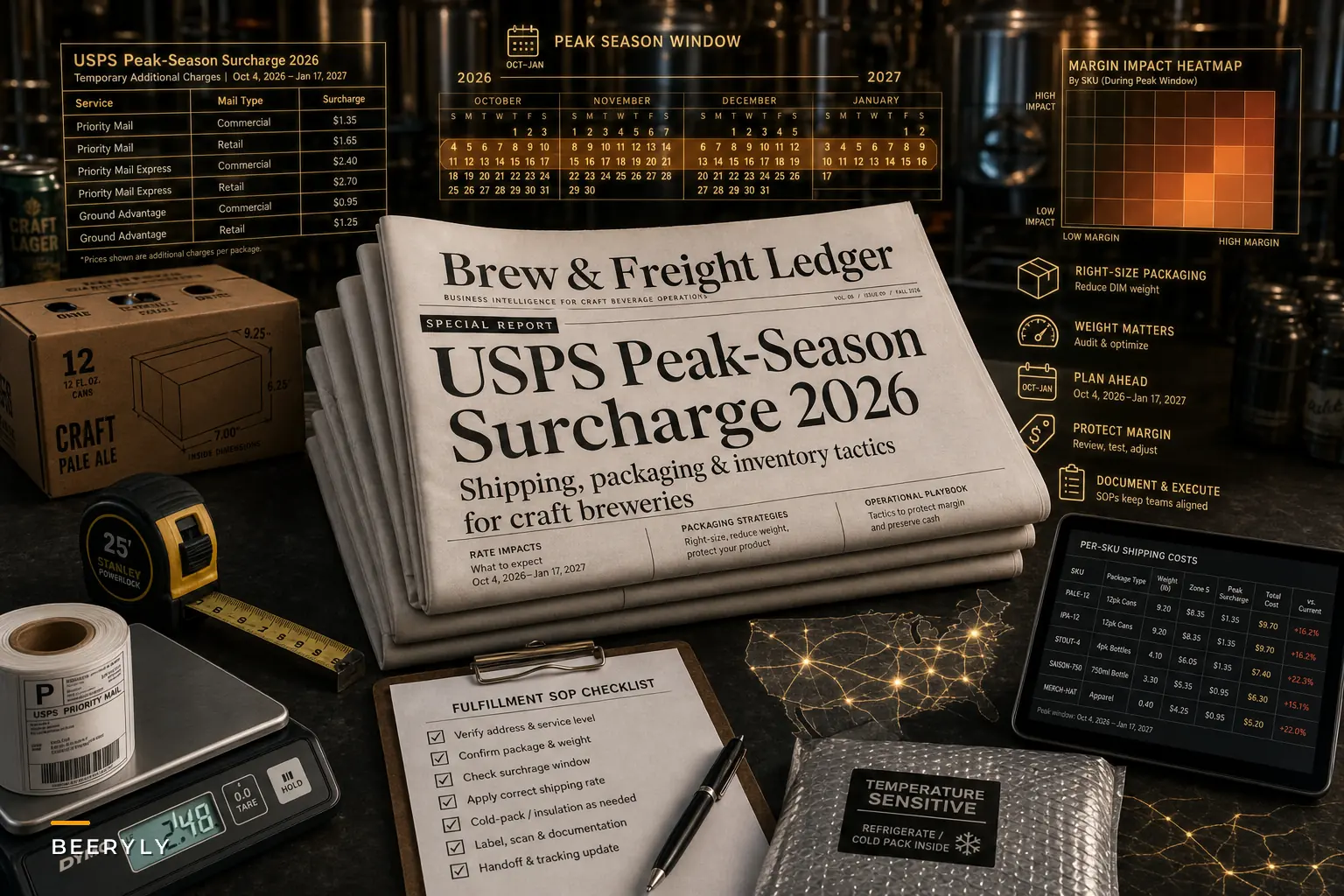

The Postal Service filed notice on August 25, 2026 for a temporary peak‑season price increase running October 4 through January 17, 2027. It's about a 6% average bump across Priority Mail, Ground Advantage, Priority Mail Express, and Parcel Select. The USPS announcement lays out the full schedule, and Supply Chain Dive's coverage adds the detail that actually matters: these hikes aren't flat. They skew heavier by zone and weight.
That "6% average" is exactly what fools people. Averages hide where the pain lands. If most of your shipments are light and local, you'll barely feel it. But if you're shipping heavy glass and cans to zone 7 and 8 customers — or moving apparel-heavy merch boxes cross-country — some of those individual lines will jump well past 6%. For breweries, weight and distance are basically the whole game.
So this isn't a news blip worth skimming. It's a useful forcing function to look honestly at how you pack, price, and route everything leaving your building for the next three and a half months.
Start by finding the shipments that will actually get hit
When a carrier raises rates, the instinct is to panic across the board. Resist that. The smarter first move is figuring out which outbound flows are actually exposed.
Breweries typically have four distinct parcel streams, and they respond very differently to a peak surcharge:
-
Merchandise (shirts, hats, glassware, sticker packs) — light-to-medium weight, high margin, forgiving.
-
Sampler / variety packs — heavy, fragile, distance-sensitive, thin margin. This is your real danger zone.
-
Subscription / DTC beverage shipments (where state law allows) — heavy, sometimes cold-chain, already expensive before any surcharge.
-
Inbound supplier parcels — labels, packaging materials, small hardware, promo inserts. Easy to overlook, but suppliers eat these hikes and pass them through.
Sampler and DTC boxes are where a 6% "average" quietly becomes a 9–12% real increase on specific zones. A four-pack of cans in a protective mailer going three states over is not a light parcel. When per-zone multipliers stack on top of dimensional weight, that box can cross a pricing threshold you didn't plan for.
The mistake isn't failing to react — it's reacting evenly across everything. You want surgical adjustments on the heavy, far-traveling boxes and basically a shrug on the light local merch.
The underlying problem this exposes: most breweries don't know their true per-box cost
A rate increase only really hurts if you didn't have shipping baked into your cost model to begin with. And a lot of breweries don't.
Take control of your brewery’s workflow.
Beeryly helps you schedule batches, track inventory, and monitor sales with ease.
- Production timeline management
- Inventory tracking & alerts
- Sales & distribution monitoring
No credit card required
When merch and DTC started as a taproom side hustle, shipping got treated like a rounding error. Someone set a flat $8 or $12 fee at checkout a few years back and nobody touched it since. Postage crept up. Box costs crept up. Dunnage and ice packs crept up. The flat fee stayed frozen. The result is a slow bleed that never shows up as a single scary line item — it just quietly erodes margin across hundreds of orders.
A temporary surcharge on top of that frozen fee is what finally pushes some SKUs underwater during exactly the months you're shipping the most volume.
A quick way to see the damage
| Cost component | Before surcharge | During surcharge (peak) |
|---|---|---|
| Product cost (4 cans) | ~$5.20 | ~$5.20 |
| Box + inserts + dunnage | ~$3.40 | ~$3.60 |
| Postage (zone 6, ~4 lbs) | ~$12.80 | ~$14.10 |
| Pick/pack labor | ~$2.50 | ~$2.50 |
| Total cost to serve | ~$23.90 | ~$25.40 |
| Charged at checkout | $28.00 flat | $28.00 flat |
| Margin per box | ~$4.10 | ~$2.60 |
That's a single box losing roughly a third of its margin without anything changing on your end. Multiply that across a peak-season push and "6% average" stops sounding comforting pretty fast.
Packaging is the lever you control the most
You can't negotiate the surcharge away. But you have real control over weight, dimensions, and how many boxes leave the building per order — and those three things drive the bill.
-
Right-size aggressively. Dimensional weight punishes oversized boxes. If a mailer is 30% empty air, you're paying to ship that air at peak rates. Matching box sizes to actual contents is unglamorous work, and it's usually the single biggest win.
-
Consolidate multi-item orders. When someone buys a hat, a shirt, and a sticker pack, splitting it into two packages because two people picked it separately is pure waste. During peak, that split can cost more than the profit on the shirt.
-
Reconsider flat-rate for heavy boxes. Flat-rate options don't care about zone. If your sampler packs mostly ship to distant zones, a flat-rate box that fits can beat weight-based pricing once the surcharge lands — even when flat-rate feels expensive on paper. Run the math per-SKU instead of assuming.
-
Lighten the dunnage. Molded pulp and right-sized inserts often protect glass and cans as well as heavier fill, at a fraction of the shipping weight. Fragile-product breweries tend to over-pack out of caution, which is understandable — but there's usually 4–8 ounces to shave per box without raising breakage rates.
One pattern worth flagging: breweries that work from a fixed box catalog almost always default to "one size up" as a safety habit. That habit alone can add a full zone-equivalent of cost during peak. Auditing your box catalog is boring work, and it pays off.
Audit your box catalog to eliminate "one size up" defaults before peak season.
Here's a quick visual of the packaging optimization flow to run through with your team.
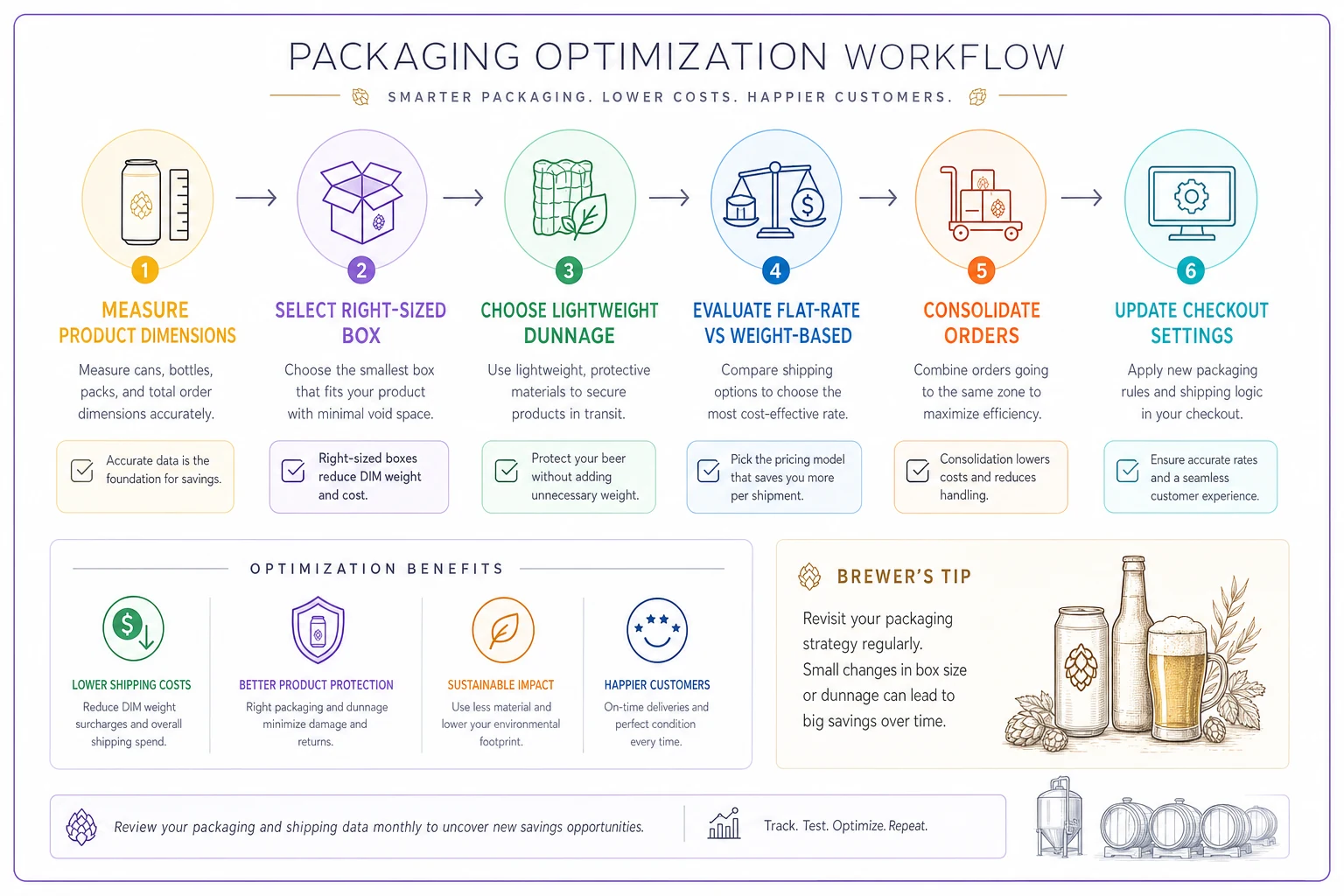
Auditing and right-sizing often deliver the largest single-percentage wins because they directly reduce dimensional weight penalties and avoid zone-triggering packaging choices.
Rerouting demand instead of eating the cost
Not every order needs to ship. Peak season is a good time to actively steer customers toward channels that don't touch a parcel carrier at all.
-
Local pickup / taproom pickup at checkout, promoted hard for in-region customers. Zero postage, and it gets them in the door.
-
Retail and distributor tie-ins — if a customer is near a store that carries you, nudging them there costs you a parcel but keeps the relationship intact.
-
Regional order minimums that make heavier boxes economical, so you're at least shipping enough per box to justify the postage.
When rerouting makes sense — and when it doesn't
When it makes sense: you have a physical taproom or solid local retail presence, and a meaningful chunk of DTC customers are within an hour's drive. Offering pickup can quietly pull 15–25% of orders off the carrier during peak without much friction.
When it's a bad idea: if your brand's whole promise is "we ship to you." Adding friction or minimums to a subscription base that expects doorstep delivery will cost more in churn than you'll ever save in postage. Don't solve a shipping problem by breaking a customer expectation.
Who should skip this entirely: breweries in states where DTC beverage shipping is already legally restricted and merch is your only parcel volume. Your exposure is relatively low — spend the energy on inbound supplier costs instead.
Don't forget the inbound side
Everyone focuses on what goes out. The quieter hit is inbound. Label printers, carton suppliers, promo-insert vendors — a lot of them ship small parcels to you, and their carrier costs go up during the same window. Some pass it through as a line item. Some bury it in a vague "handling" bump.
A practical move before October: pull forward non-perishable packaging and promo material orders so they arrive before the surcharge window opens. Buying your holiday box inventory and inserts in September instead of drip-ordering through December can dodge the surcharge entirely on inbound freight — and it protects you from the packaging stockouts that hit suppliers every year during this window anyway.
Just don't over-buy perishable or dated material to save a few dollars on freight. Shipping savings that turn into obsolete inventory in February is a bad trade.
A short peak-season readiness checklist
Run through this before October 4:
-
[ ] Identify your top 10 shipping SKUs by volume and calculate real cost-to-serve per box with the surcharge applied
-
[ ] Flag every SKU where margin drops below your floor at peak rates
-
[ ] Audit your box catalog and eliminate "one size up" defaults
-
[ ] Test flat-rate vs. weight-based on your heavy, far-shipping boxes
-
[ ] Update checkout shipping fees where flat rates are now underwater
-
[ ] Turn on and promote local pickup for in-region customers
-
[ ] Pre-order non-perishable packaging and promo materials before the window opens
-
[ ] Set a mid-season checkpoint (early December) to re-check margins against actual order data
Set a mid-season checkpoint (early December) to re-check margins against actual order data
A real scenario
A small regional brewery running a modest DTC merch and sampler operation — somewhere around 300–400 outbound parcels a month during the holidays — had frozen their checkout shipping at a flat $10 two years earlier. When they actually ran the numbers ahead of peak season, they found their sampler boxes to zones 5 through 8 were already close to break-even before any surcharge. The temporary increase would tip most of them negative.
They didn't raise prices across the board. They did three things: right-sized two of their box types, switched their heaviest sampler to a flat-rate box that happened to fit, and turned on taproom pickup with a small "skip the shipping" nudge at checkout. Pickup absorbed a solid chunk of local orders, the flat-rate swap stabilized the far-zone boxes, and the right-sizing shaved weight across everything else.
Net effect over the peak window was roughly a $2–$3 per-box improvement — not dramatic, but the difference between bleeding and holding a thin positive margin. None of it touched the sticker price customers saw. It was just cost math done in September instead of discovered in the January reconciliation.
The takeaway
The surcharge itself is temporary and modest on average. What it tends to expose usually isn't temporary: shipping costs that were never properly measured, checkout fees frozen in a different era, packaging habits built for convenience rather than cost.
Breweries that come through peak season in decent shape aren't the ones who found a clever carrier workaround. They're the ones who already knew, box by box, what it actually costs to get product out the door — and adjusted the few SKUs that needed it while leaving the rest alone. Do the measurement now, in September. By the time the surcharge is live, you don't want to be figuring out which boxes are underwater.
Breweries that come through peak season in decent shape aren't the ones who found a clever carrier workaround. They're the ones who already knew, box by box, what it actually costs to get product out the door — and adjusted the few SKUs that needed it while leaving the rest alone. Do the measurement now, in September. By the time the surcharge is live, you don't want to be figuring out which boxes are underwater.
Ready to elevate your brewery operations?
Join 500+ craft breweries using Beeryly to increase production efficiency, reduce waste, and grow sales.