
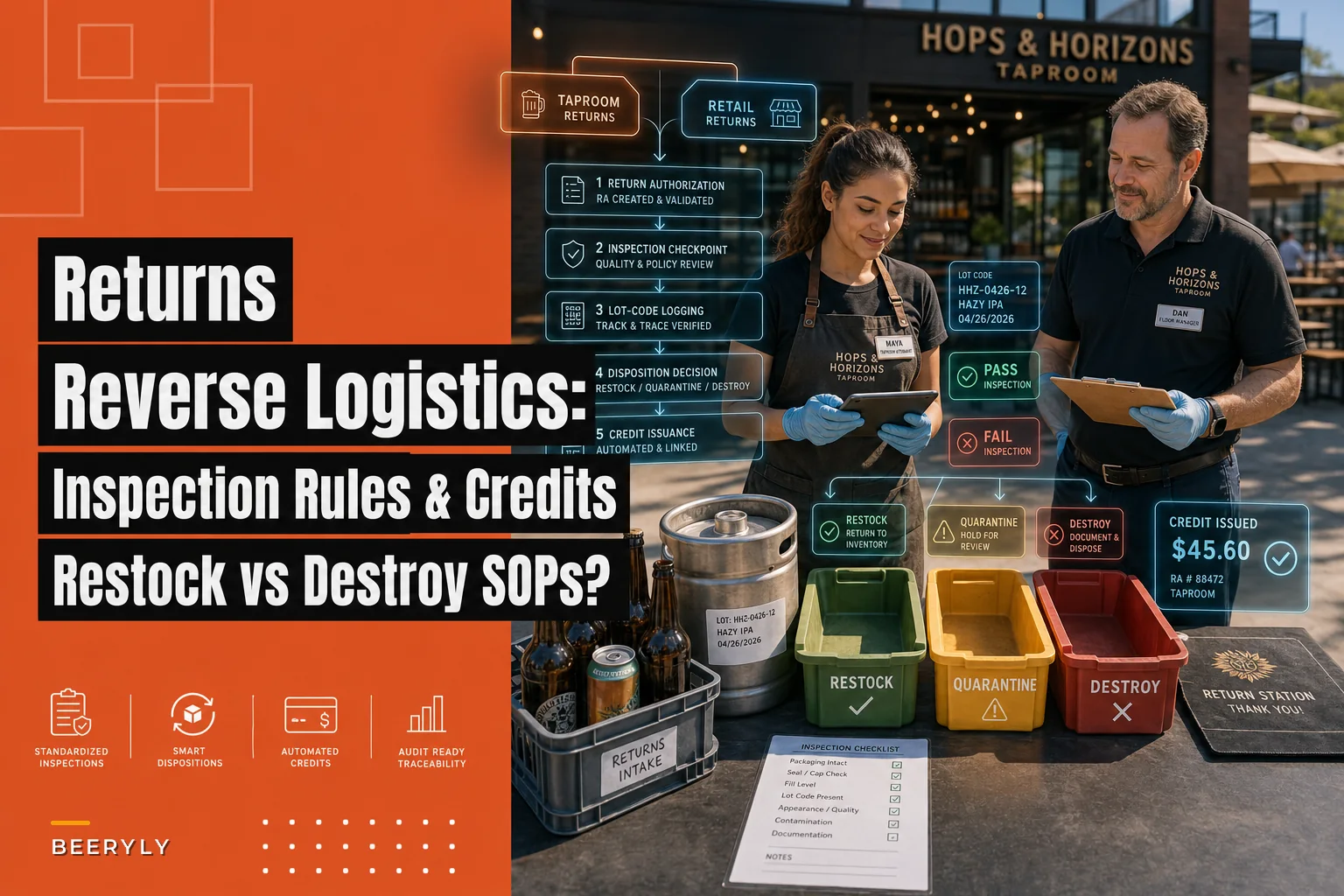

Most breweries have a returns policy that's basically one sentence buried in a distributor agreement or scrawled on a whiteboard behind the taproom register. Then a case of hazy IPA comes back "flat," a keg comes back "off," and nobody can agree on whether it gets credited, restocked, or dumped. The taproom lead makes a call, the AR person makes a different one, and three weeks later there's a fight over a $180 credit that already got issued twice.
The messy part isn't the beer coming back. It's that nobody defined the rules before the product showed up at the dock. This post covers exactly that — the acceptance criteria, credit logic, inspection steps, and the restock-vs-destroy decision — split between retail/distribution returns and taproom returns, because they fail in completely different ways.
The two return channels that get treated as one (and shouldn't)
The single biggest mistake is running taproom returns and wholesale/retail returns through the same loose process. They're not the same risk.
A retail return usually means sealed packaged product coming back from a distributor or account — cases, six-packs, kegs. The risk here is billing disputes and product age. Was it stored cold? Is it past code? Did the account actually buy this lot from you, or is someone trying to unload gray-market inventory?
A taproom return is a customer handing back a pour or a growler across the bar. The risk is almost entirely contamination and giveaway abuse — someone drinks 80% of a pint then calls it "sour," or a returned growler gets refilled without anyone checking what was in it last.
Same word, "return." Totally different SOP. When you collapse them into one policy, you end up applying keg-credit logic to a $7 pour and food-safety logic to a distributor pallet. Split them from the start.
Retail and distribution returns: acceptance criteria before anything touches the cooler
The pattern that causes disputes: product arrives back, someone eyeballs it, and it goes into the cooler before a decision is logged. Now it's mixed with sellable inventory and you've lost any ability to prove condition on arrival. Every credit argument after that becomes a he-said-she-said.
Take control of your brewery’s workflow.
Beeryly helps you schedule batches, track inventory, and monitor sales with ease.
- Production timeline management
- Inventory tracking & alerts
- Sales & distribution monitoring
No credit card required
Fix the sequence. Nothing returned enters sellable inventory until it clears acceptance. And by physically — a return staging zone, taped off, with a "DO NOT RESTOCK" sign. Not conceptual. Physical.
Your acceptance criteria for packaged returns should be explicit enough that a new hire can apply them without asking questions:
-
Within code date with at least 30 days of shelf life remaining (adjust to your style — a pastry stout has different tolerance than a NEIPA)
-
Original lot traceable to your records — if the lot code is smudged or missing, it's automatically destroy, no credit
-
Storage attestation
the account confirms cold storage, or it's flagged for sensory before any restock decision
-
Quantity matches the return authorization — no "we rounded up"
-
Packaging intact — no crushed cans, leaking kegs, or re-taped cases
The lot-code rule matters more than people think. If you can't tie returned product back to a specific batch, you can't include it in a recall trace and you can't defend the credit. Missing lot code = destroy. Make that non-negotiable, because it also closes the gray-market loophole where someone returns beer you never sold them.
Credit policy: decide the trigger, not just the amount
Billing disputes rarely start over the dollar amount. They start over when the credit fires. A distributor expects credit on pickup. Your AR person wants credit only after inspection. Both are reasonable positions, and if you never pick one, you get double-issued credits and "where's my money" calls.
Pick this rule and write it down: credit is issued after acceptance inspection, not at pickup. Pickup generates a return authorization number and a pending line. The credit converts to actual only after the product clears — or partially, based on what passed.
| Condition on arrival | Credit issued | Disposition |
|---|---|---|
| In code, cold-attested, lot traceable, packaging intact | 100% | Restock as sellable |
| In code, lot traceable, storage unconfirmed | 100% pending sensory | Restock only if sensory passes |
| Under 30 days code, packaging intact | 50% | Restock as short-code / staff / discount |
| Out of code, or lot code missing | 0% | Destroy, documented |
| Crushed / leaking / tampered | 0% | Destroy, documented |
| Quantity mismatch vs RA | Credit matched qty only | Investigate variance |
The "under 30 days = 50%" line does real work. It stops the argument where an account returns near-code product expecting full credit, and it gives you a legitimate outlet — staff sales, a taproom discount bin, a clearance option — instead of dumping beer that's technically fine.
This also connects directly to how you track containers coming back. If your keg and case flow is already messy, your returns process inherits that chaos. Getting the tracking side clean first — the kind of low-cost routing and reconciliation covered in the lost kegs and billing errors playbook — makes returns acceptance far less painful because you already know what left, on what invoice, in what lot.
Inspection steps that a taproom lead can actually run
The inspection can't require a QC lab or it won't happen on a busy Friday. Build it so a shift lead can complete it in a few minutes and log the result.
A workable inspection sequence for a returned keg or case:
-
Match the RA — pull the return authorization, confirm SKU, quantity, and account.
-
Read the lot code — record it. No readable code, stop, disposition = destroy.
-
Check the date — days of remaining shelf life against your policy threshold.
-
Visual — dents, leaks, bulging cans, re-taped boxes, rust on keg valves.
-
Storage check — confirm cold chain; if warm-stored or unknown, route to sensory.
-
Sensory (only if triggered) — pull one unit, pour, check for gushing, haze changes, obvious off-aromas. This is a screening pass, not a full panel.
-
Log the disposition — restock / short-code / destroy, with a reason code and who decided.
Step 6 is where breweries either over-invest or skip entirely. You don't need a sensory panel on every return. You need it only when the storage attestation is missing or the visual raises a flag.
Only run sensory checks when storage attestation is missing or visuals raise a flag to keep inspections fast and focused.
Contamination risk is why destroy has to be a real, documented outcome and not a shrug. A keg that came back "foamy" might be a bad coupler at the account — or it might be a wild yeast infection that you absolutely do not want near your fill line or your cooler. When you can't confirm a keg is clean, destroy and document. The cost of one dumped keg is trivial compared to a contamination event spreading through returned inventory you restocked.
Restock vs destroy: the decision that protects your inventory integrity
The restock-vs-destroy call is where money and safety collide. Restock too aggressively and you risk putting compromised beer back into circulation. Destroy too aggressively and you're eating margin on product that was perfectly fine.
Restock as fully sellable only when: in code with healthy shelf life, cold chain confirmed, lot traceable, packaging perfect, and no sensory trigger. That's the clean path.
Restock as restricted (staff, discount bin, taproom-only) when it's fine but short-dated, or fine but you can't sell it as fresh at full price. This category is underused and it's where a lot of recoverable value quietly hides.
When aggressive restocking is a bad idea
If your cold chain to accounts is unreliable, don't build a returns policy that leans on restocking. You'll be quietly recirculating heat-damaged beer under your own label. Breweries with shaky distribution temperature control — which usually shows up as inconsistent freshness complaints — should default toward destroy on anything storage-unconfirmed until the upstream problem is fixed. That's an operations fix, not a returns fix, and it's worth working through your production-to-cold-chain alignment before loosening restock rules.
Taproom returns: a completely separate, tighter script
Taproom returns are small-dollar and high-frequency, and they get abused precisely because staff have no script. The tension: you want to comp a genuinely off pour instantly for the sake of the guest, but you don't want to train regulars that "I didn't love it, half a glass gone" earns a free beer.
The rule that works: generous on the first sip, firm after that.
-
Guest doesn't like a beer after a small taste → replace or refund, no friction, log it.
-
Guest is more than roughly a third through the pour → offer a taste of an alternative, not a full comp.
-
Guest reports an actual defect (gushing, sour when it shouldn't be, visible contamination) → pull the entire keg from service immediately, comp the guest, and flag the keg for inspection. This is the one that matters.
That last point is the whole point. A single "this tastes sour" complaint in the taproom is your earliest possible contamination warning. If your script tells staff to just comp the guest and keep pouring, you'll serve a compromised keg to fifty more people before anyone notices a pattern. The correct move is comp and pull the keg. One guest complaint is cheap. A tapped infected keg running all night is not.
Growlers and crowlers: the contamination trap nobody scripts
Refillable growlers are a real contamination vector and most taproom policies ignore it entirely. A guest brings back a growler that sat in a hot car for a week with dregs in it, and it gets rinsed and refilled. Nobody thinks twice.
-
No refill of outside/unknown growlers without inspection — sniff and visual, minimum.
-
Refuse anything with visible residue, film, or off-smell. Offer a fresh container instead.
-
Never take a returned or opened crowler back into inventory. Once it's sealed and left, it's gone.
These aren't customer-service rules, they're food-safety rules. Write them that way so staff don't feel like they're being rude — they're following a standard that protects the customer, and the brewery.
A short real scenario
A mid-size production brewery with a busy taproom and around 60 wholesale accounts was running maybe 15–20 packaged returns a month with no acceptance gate. Product came back, got eyeballed, went into the cooler, and credits got issued at pickup. They were losing somewhere in the range of $2k–$3k a month between double-issued credits, restocked short-code beer that customers then complained about, and product destroyed after it had already been credited and shelved.
They changed three things: a taped-off return staging zone with a hard "no restock before acceptance" rule, credit converting only after inspection instead of at pickup, and a written restock/destroy table with reason codes. Within a couple of months the double-credit problem basically disappeared, freshness complaints on restocked product dropped, and the underrated win — two accounts with repeatedly failing returns turned out to have warm storage. They only caught it because the destroy logs showed a pattern. That discovery probably saved more margin than all the credit fixes combined.
Where a management system quietly helps
None of this requires software to work — the discipline is the SOP. But the two things that fall apart at scale are logging and pattern detection, and that's where an operational workflow platform earns its keep.
When every return authorization, lot code, disposition, and credit trigger lives in one place instead of a shift lead's memory and a spreadsheet, the double-credit failure mode basically can't happen — the credit is tied to the acceptance record, not to whoever answered the phone at pickup.
Here's a simple workflow image that shows how return authorization, inspection, disposition, and credit issuance tie together.
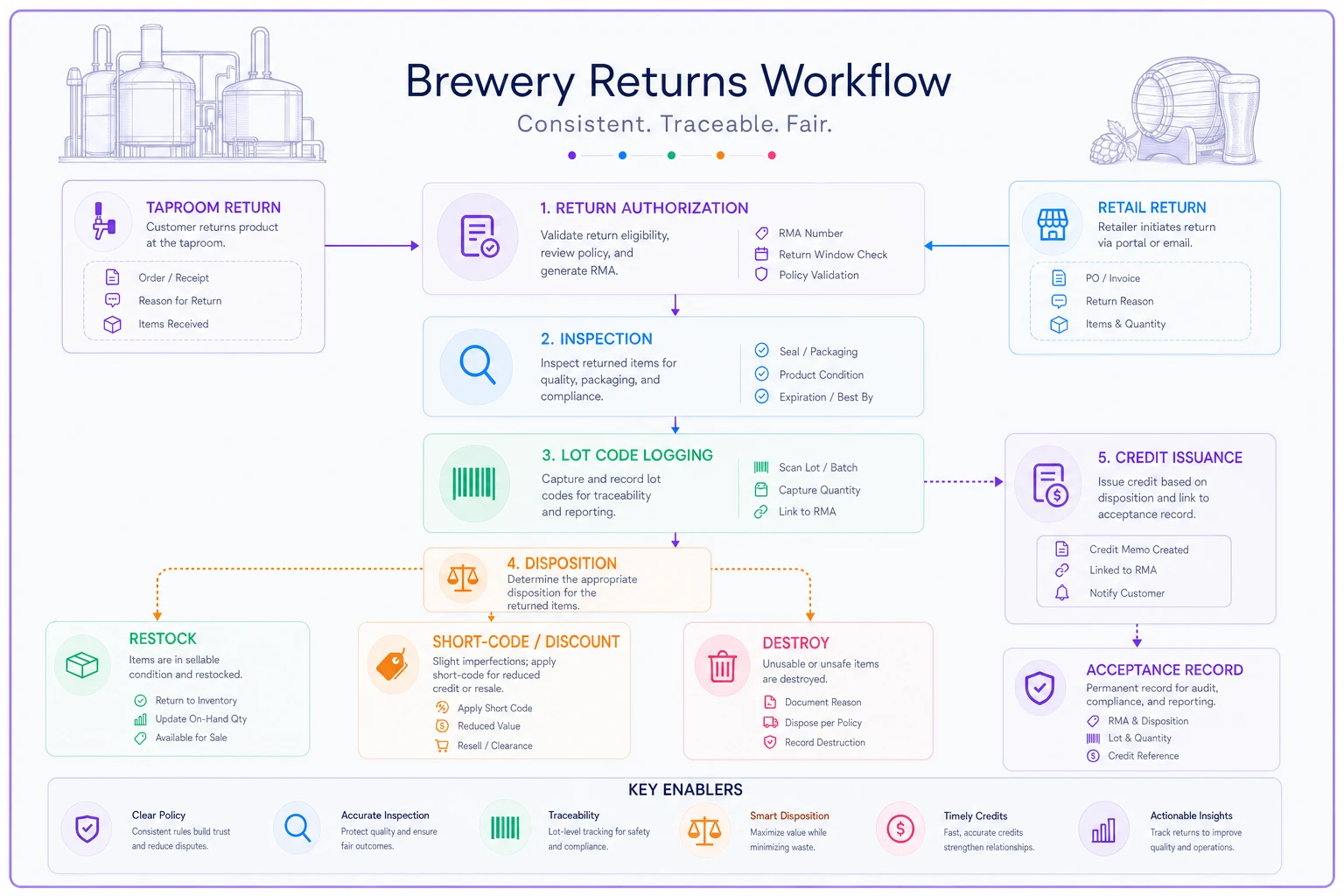
The bigger payoff is pattern visibility. AI-assisted operational software can flag when one account's returns keep failing sensory, when a specific lot shows up in returns more than others, or when destroy volume spikes in a given week. That's the kind of signal that's invisible when returns are scattered across notes and emails. It's not about replacing the shift lead's judgment. It's about surfacing the "wait, why does this account keep sending back warm beer" question before it costs you a quarter of margin.
The one thing to fix first
If you do nothing else this week: stop letting returned product enter sellable inventory before a disposition is logged. Tape off a corner of the receiving area. That single physical rule prevents double-credit disputes and contamination-mixing risk in one move.
A returns policy isn't paperwork. It's the last checkpoint between a bad keg and your customer, and between a fuzzy credit and a distributor argument. Draw the line at the dock, write the disposition rules down, and split your taproom and retail channels so each one gets the logic it actually needs.
A returns policy isn't paperwork. It's the last checkpoint between a bad keg and your customer, and between a fuzzy credit and a distributor argument. Draw the line at the dock, write the disposition rules down, and split your taproom and retail channels so each one gets the logic it actually needs.
Ready to elevate your brewery operations?
Join 500+ craft breweries using Beeryly to increase production efficiency, reduce waste, and grow sales.