

Marketing lands a big account. The buyer wants a limited-run pastry stout in 16oz cans with a co-branded sleeve, delivered in three weeks, on shelf for a holiday weekend. Everyone's excited. Someone says yes in a hallway conversation. Nobody loops in QC. Nobody checks whether the sleeve artwork was actually approved by the brand partner. Nobody confirms the can supplier can hit the date. And nobody asks the one question that sinks these runs: does this beer even hold up in a warm truck for four days?
Three weeks later you're running a beer you've never packaged, on a format you rarely use, against a deadline with zero room for a re-brew. That's the specific failure this article is about — the gap between "promotion approved" and "production started," where rushed limited runs turn into recalls, dumped pallets, and angry accounts.
The fix isn't more meetings. It's a required change-control gate that a promotional run cannot pass without four specific signoffs.
Why promotional runs skip the normal guardrails
Your standard SKUs have invisible guardrails built from repetition. You've packaged your flagship IPA two hundred times. The crew knows the fill weights, the seamer settings, the label registration, the shelf life. QC has a sampling history. Nobody has to think hard.
A promotional limited run strips all of that away at once. New format, new artwork, new ingredient, new customer, compressed timeline — sometimes all five. And the part people consistently miss: the excitement around a promo actively suppresses normal skepticism. When sales closes a marquee account, questioning the timeline feels like being the person who kills the deal. So the questions don't get asked.
In practice, this usually plays out when the commitment gets made verbally before anyone with production visibility is in the room. By the time the brewer or packaging lead hears about it, the date is already promised to the customer. The negotiation is over. Now it's just "make it work."
The pattern holds across breweries of every size: the problem is never the beer or the crew. It's that promotions get approved through a sales process and executed through a production process, with no formal handoff between the two. Change-control is that handoff.
The four gates a promotional run must clear
A promotions production change-control gate isn't a document. It's a hard stop with named owners. A run doesn't get scheduled until all four of these are signed.
Take control of your brewery’s workflow.
Beeryly helps you schedule batches, track inventory, and monitor sales with ease.
- Production timeline management
- Inventory tracking & alerts
- Sales & distribution monitoring
No credit card required
Gate 1: Packaging and artwork approval
This is the one that generates the most expensive mistakes because the errors are invisible until you have 40 barrels in cans.
-
Final artwork is approved in writing by every party — including the co-brand partner or account, not just your marketing team
-
The required regulatory copy is present and correct
ABV, government warning, net contents, allergen statements if the recipe changed
-
The format is confirmed and sourced — if this is a 16oz can and you normally run 12oz, the cans, ends, sleeves or labels are ordered and have a confirmed delivery date that clears your packaging day with buffer
-
Label registration and application has been checked against the actual format, not assumed from your standard SKU
A common example: a brewery commits to a special release with a customer's logo on the can. Marketing approves the artwork internally. Nobody sends the final proof back to the account for signoff. The run gets packaged. The account rejects it because their logo color is off-spec against their brand guide. Now you've got roughly 900 cans of correct beer in incorrect packaging, and no legal way to sell them to that account. The beer's fine. The run is a loss.
Gate 2: QC signoff on a format and recipe you haven't validated
Your QC sampling plan is calibrated to your regular lineup. A promo run frequently isn't in that plan at all, and that's exactly where the risk lives.
-
Has this recipe been produced before, or is this the first run of a new formulation? First runs need tighter sampling, full stop.
-
Does the recipe introduce new microbial risk? Fruit additions, lactose, barrel character, dry-hop loads — these change your spoilage and dissolved-oxygen profile.
-
Are your QC hold points defined for this specific run, including who releases it and against what specs?
-
If it's a new package format, has fill weight, dissolved oxygen at seam, and package integrity been checked on the actual line setup?
The mistake breweries make here is assuming QC scales automatically. It doesn't. A pastry stout with lactose and cacao behaves nothing like your flagship in the can over time. If you're testing it the same way, you're not really testing it.
Gate 3: Schedule window that isn't a fantasy
This is where the promise made in the sales conversation meets the reality of your tanks, your crew, and your changeovers.
-
The brew, fermentation, conditioning, and packaging all fit before the customer's date with slack for a slow ferment
-
Packaging changeover time is accounted for — a non-standard format eats hours you don't spend on regular runs
-
There's a defined fallback if fermentation runs long or QC holds the release
If your schedule is already tight, dropping a promo into it without protection pushes your regular SKUs late and creates stockouts on the beer that actually pays your bills. The way you protect against that is covered in depth in the brewery production scheduling system to prevent late runs and stockouts — the change-control gate should tie directly into whatever scheduling logic you already run, so a promo can't be booked into a window that doesn't exist.
And because promotional formats almost always mean a changeover you don't run often, the time cost is real and underestimated. If you haven't built out format-switch timing yet, the approach in reducing packaging changeover downtime with time-motion checklists and parallel prep is worth pulling into the schedule gate directly, so the promised date reflects your actual changeover time and not a best-case guess.
Time an actual format switch on your line to validate changeover estimates — it's cheaper than a late promo.
Gate 4: A cold-chain plan for a beer that may not be built for the road
This gate gets skipped the most and causes the quietest disasters — quiet because you don't find out until the product is already in the market.
-
The stability of this specific product at the temperatures it will actually see — not lab conditions
-
Whether the account's receiving and storage are refrigerated, and whether the display location is
-
Shipping method and transit time, and whether that transit is temperature-controlled
-
A shelf-life and best-by date that reflects real conditions, not your standard SKU's spec
The failure mode is a beer that tastes perfect leaving your dock and tastes like cardboard or gushers by the time it's on shelf. The account blames your quality. You blame the truck. Nobody wins, and you've damaged a relationship you spent months building.
| Gate | Owner | Key question it answers | What happens if skipped |
|---|---|---|---|
| Packaging & artwork | Marketing + account | Is every proof approved in writing and is the format sourced with a confirmed date? | Correct beer, unsellable packaging |
| QC signoff | QC lead | Is this validated for a new recipe/format, with defined hold points? | Spoilage, DO issues, blind release |
| Schedule window | Production manager | Does it fit a real, buffered timeline with a fallback? | Late promo + stockouts on core SKUs |
| Cold-chain plan | Ops / logistics | Will this specific beer survive the real supply chain? | Quality failure in-market, damaged account |
The table above summarizes the four gates, their owners, and the risks of skipping them.
The approval workflow, step by step
Here's how the gate actually runs day-to-day. The core principle: no single person can push a promo into production alone.
-
Sales submits a promotion request before anything is promised verbally — including customer, format, recipe, quantity, and target date.
-
The request routes simultaneously to all four gate owners, not sequentially, so you're not losing days waiting on a chain of emails.
-
Each owner approves, rejects, or approves-with-conditions against their checklist. A "no" from any gate blocks the run.
-
If all four clear, the run gets a change-control number and only then does it enter the production schedule.
-
If any gate raises a condition — QC wants an extra hold point, logistics needs a temperature-controlled carrier — that condition travels with the run and gets verified before release.
-
Final release requires QC to confirm the conditions were met, not just that the beer hit spec.
The reason this works is that it forces the hard questions to be asked while the timeline is still negotiable. The whole point is to move the friction earlier — before the customer date is locked — instead of discovering the problem after the brew.
A quick diagram helps make the simultaneous routing and approval steps clear.
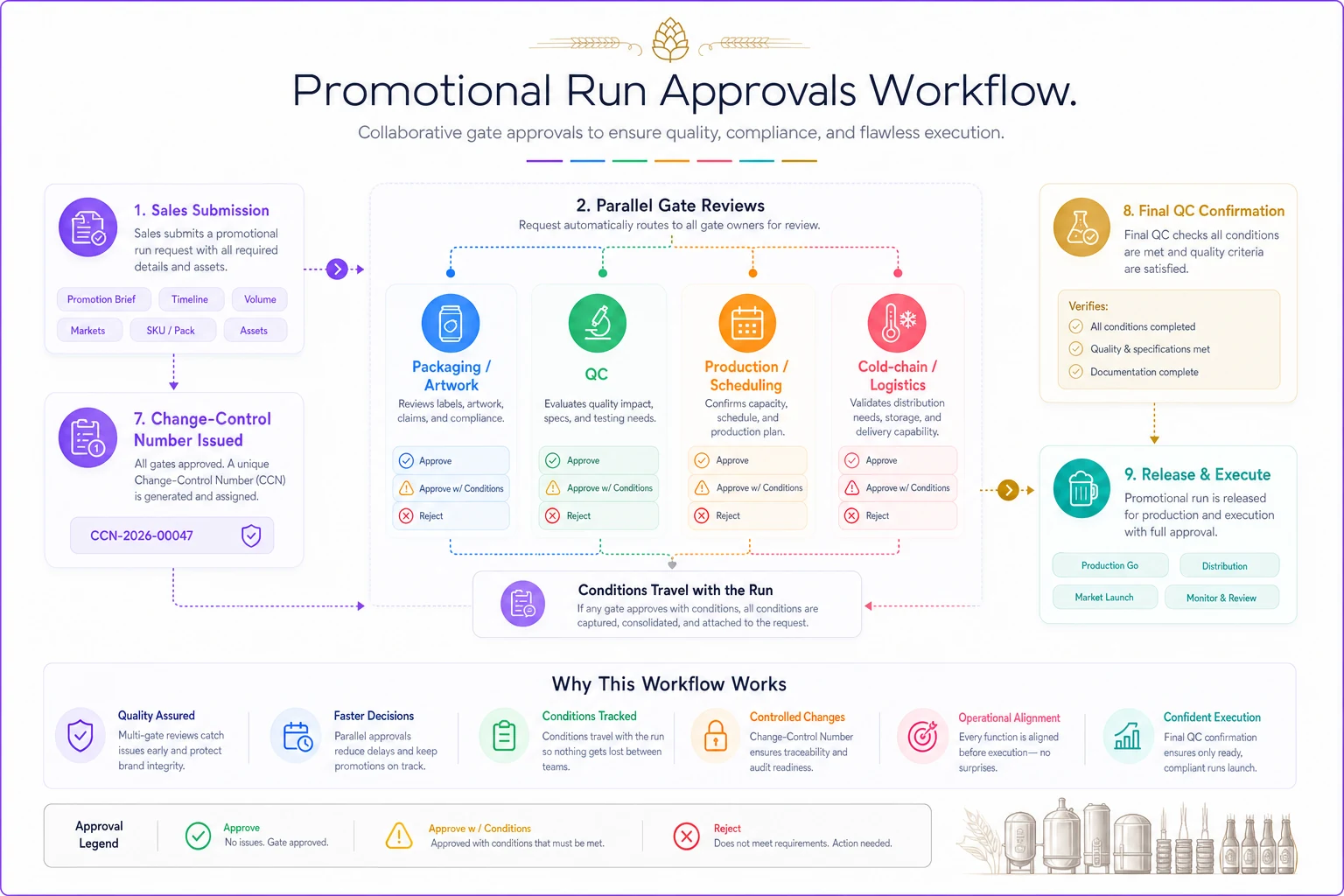
The visual reinforces that no single owner can greenlight a run alone and that conditions must travel with the change-control number.
A short real scenario
A regional brewery, somewhere around 9,000 barrels a year, ran maybe six to eight promotional or limited releases annually. Most went fine. But over one calendar year they had two go badly: one 16oz co-branded run rejected on artwork, and one fruited release that fell apart in a warehouse over a hot weekend. Between dumped product, reprint costs, and one soured account relationship, the damage landed somewhere in the range of $18k–$24k, plus a fair amount of internal finger-pointing.
The fix wasn't complicated. They stopped letting anyone verbally commit a promo. Every request had to clear the four-gate checklist before a date went to the customer. Over the following year they ran a similar number of promos — and killed exactly one at the request stage because the timeline genuinely didn't work and the cold-chain risk was too high. That "no" probably saved them another five-figure loss. The rest ran clean.
The part worth noting: the crew liked the new process more, not less. The gate meant they stopped getting handed impossible runs at the last minute.
When this makes sense — and when it's overkill
This kind of change-control gate earns its friction when your promotional runs involve new formats, new recipes, new accounts, or compressed timelines. That's where the money gets lost. If you're doing one small taproom-only release a year that never leaves your cold box, a full four-gate process is more than you need — a lightweight checklist is fine.
Where it becomes non-negotiable: any run that leaves your building for an account whose cold-chain you don't control, any first run of a formulation, and anything with co-branded or customer-owned artwork. Those three categories are where the expensive, relationship-damaging failures tend to concentrate.
For a very small brewery running only well-worn SKUs into a single local channel, the full version is probably overkill. You'd be adding process for risk you don't actually carry. But the moment you start saying yes to custom accounts and special releases, the gate pays for itself the first time it catches a bad artwork proof or an impossible date.
The beer is almost never the problem. Promotional runs fail in the gap between the excitement of closing an account and the reality of producing something new, fast, under pressure. A required approval checklist doesn't slow you down — it moves the hard questions to the one moment they can still change the outcome: before you've promised a date you can't safely hit.
Build the four gates, name an owner for each, and make it impossible to schedule a promo without all four signing off. The runs you kill at the request stage will feel like a loss in the moment. They're not. They're the ones that would have cost you a pallet of product and a customer.
Ready to elevate your brewery operations?
Join 500+ craft breweries using Beeryly to increase production efficiency, reduce waste, and grow sales.