


Your canning line sits idle for 47 minutes. The crew stands around checking phones while someone hunts for the right size pak-tech carriers in the back warehouse. Meanwhile, your dissolved oxygen meter needs recalibration, but nobody realized that until after draining the bright tank.
This exact scene plays out in craft breweries every week, burning through labor costs and production capacity that small operations can't afford to waste.
After building operational software for hundreds of brewery operations, the pattern becomes obvious: most breweries treat changeovers like an unavoidable evil instead of a controllable process. The difference between a 20-minute changeover and a 90-minute disaster usually comes down to preparation, not execution.
Why packaging changeovers spiral out of control
Tank 4 finishes packaging their West Coast IPA into 12oz cans. Someone yells "changeover!" The canning operator starts breaking down the line while the cellar crew begins transferring the hazy pale ale from Tank 7. Twenty minutes later, they realize nobody ordered 16oz lids. Another fifteen minutes pass before someone discovers the date coder needs new ink.
Small breweries face unique changeover challenges that larger operations avoid through dedicated packaging teams and redundant equipment. When you're running with 3-4 production staff who juggle cellar work, packaging, and cleaning duties, every changeover becomes a coordination nightmare.
The real killer isn't the changeover itself - it's the cascading delays. One missing component creates a 15-minute delay. That delay pushes your next changeover into shift change. Now you're training the evening crew on a beer they haven't packaged before. What should have been a 30-minute flip becomes a 2-hour production gap.
Most breweries accept this chaos as normal. They budget extra time, hope for the best, and wonder why they can't hit production targets.
Breaking down changeover time: what actually happens
A time-motion study from a 7-barrel brewhouse running a Wild Goose canning line shows exactly where the time goes.
Take control of your brewery’s workflow.
Beeryly helps you schedule batches, track inventory, and monitor sales with ease.
- Production timeline management
- Inventory tracking & alerts
- Sales & distribution monitoring
No credit card required
-
Stop current run and purge line (8 minutes)
-
Walk to cooler, locate next beer (3 minutes)
-
Realize wrong fitting on tank valve (5 minutes finding adapter)
-
Break down previous setup - carriers, labels, lids (11 minutes)
-
Clean and sanitize transfer lines (12 minutes)
-
Set up new packaging materials (7 minutes)
-
Discover label applicator needs adjustment (9 minutes)
-
Run test cans, check fills, adjust (8 minutes)
-
Wait for DO reading to stabilize (6 minutes)
-
Actually start production (4 minutes final adjustments)
Notice how much dead time exists between tasks? The operator walks back and forth across the brewery floor at least eight times. Nobody preps materials in advance. Each problem discovery triggers a mini-crisis.
After implementing parallel prep strategies, the same changeover dropped to 28 minutes. Not through fancy equipment or additional staff - just better sequencing and preparation.
The pre-flight checklist that changed everything
Airlines don't wing it during turnarounds, and neither should your packaging line. A solid changeover checklist eliminates the guesswork and panic-searching that kills efficiency.
T-minus 2 hours (during current run):
-
Confirm next beer readiness (carbonation, temperature, volume)
-
Stage all packaging materials at line
-
Print and organize labels
-
Check carrier inventory for correct size
-
Verify date/lot coding supplies
T-minus 30 minutes:
-
Pre-position cleaning chemicals
-
Set out required fittings and gaskets
-
Brief crew on changeover sequence
-
Assign parallel tasks
T-minus 10 minutes:
-
Begin warming up label applicator for new size
-
Pre-adjust conveyor guides if changing formats
-
Queue up correct recipe in filler
Changeover start:
-
Execute tasks in parallel, not sequence
-
Use dedicated roles (one person cleans, one person sets up)
-
Run materials through while sanitizing
The magic happens in those parallel tasks. While one person sanitizes transfer lines, another adjusts the depalletizer for different can heights. Someone else swaps carriers and labels. Tasks that used to happen one after another now overlap.
Assign a single person to verify carrier sizes and date/lot coding supplies during the T-minus 30 minutes to avoid last-minute searches.
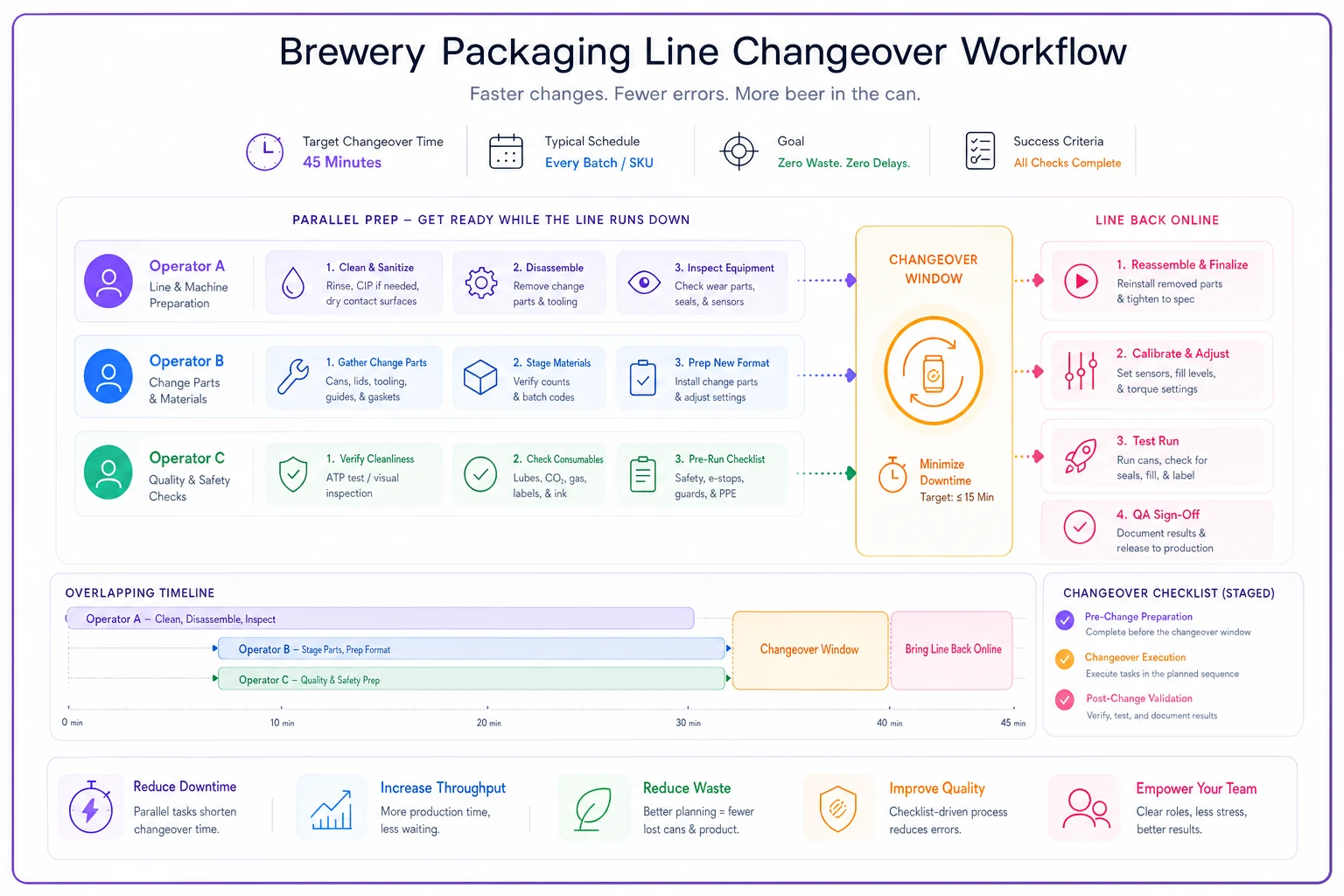
This visual shows how checklist staging and parallel roles overlap during a changeover.
Parallel prep strategies that actually work
Traditional changeovers follow a linear path: finish one task, start the next. Parallel prep means multiple tasks happen simultaneously, but it requires careful choreography.
Take a 12oz to 16oz can changeover. The old way:
-
Stop line
-
Change can guides
-
Adjust filler heads
-
Swap lid dispenser
-
Reconfigure date coder
-
Change carrier size
-
Restart
The parallel approach splits tasks between operators:
Operator A:
-
Stops line
-
Adjusts mechanical components
-
Changes can guides
-
Modifies filler settings
Operator B:
-
Swaps packaging materials
-
Changes carriers
-
Loads new lids
-
Adjusts date coder position
Operator C:
-
Begins CIP on previous tank
-
Connects new tank
-
Takes DO reading
-
Runs sample cans
Three people working parallel tasks finish in roughly the same time it takes one person to complete their longest task. Instead of 45 minutes of sequential work, you get 15 minutes of coordinated effort.
The key: each person owns specific equipment zones. No stepping on toes, no confusion about who does what.
Real changeover transformations with numbers
A 15-barrel brewery in Colorado tracked every changeover for three months before and after implementing these strategies.
Before:
-
Average changeover
67 minutes
-
Range
35-142 minutes
-
Labor cost per changeover
$67 (3 people × 1.1 hours × $20/hour)
-
Monthly changeovers
28
-
Monthly changeover labor
$1,876
After implementing checklists and parallel prep:
-
Average changeover
31 minutes
-
Range
22-45 minutes
-
Labor cost per changeover
$31
-
Monthly changeovers
28
-
Monthly changeover labor
$868
The brewery saved around $1,000 monthly in direct labor, but the real win came from increased capacity. They squeezed in an extra packaging run each week, adding roughly 60 barrels of monthly capacity without buying new equipment or hiring staff.
Another brewery running a 4-head bottle filler discovered their changeovers varied wildly depending on who ran them. Monday crew averaged 38 minutes. Thursday crew averaged 89 minutes.
The difference? Monday's lead operator came from a contract packaging background and naturally used parallel prep. Thursday's crew followed a sequential approach they'd used for years. After standardizing on the Monday approach, Thursday's times dropped to 42 minutes average.
Batch sizing rules to minimize changeover pain
Not all changeovers are equal. Switching from a 12oz lager to a 12oz pilsner takes 15 minutes. Going from 12oz cans to 750ml bottles might take 90 minutes.
Smart batch sizing reduces total changeover time by grouping similar packaging formats. Instead of bouncing between formats all week, you run all 12oz cans Monday-Tuesday, all 16oz cans Wednesday, bottles Thursday.
Minimum batch sizes by changeover type:
| Changeover Type | Setup Time | Minimum Batch | Break-even Point |
|---|---|---|---|
| Same size, different beer | 15-20 min | 2 tanks | 30 cases/hour |
| Different can size | 30-40 min | 3 tanks | 45 cases/hour |
| Cans to bottles | 60-90 min | 4 tanks | 60 cases/hour |
| Format and speed change | 90-120 min | Weekly run | 80 cases/hour |
The math is straightforward: if changeover takes 40 minutes and you save 10 minutes by running a larger batch, you need enough volume to justify potentially holding inventory longer.
Small breweries often resist batch sizing because they want maximum flexibility. Running six different SKUs in one day means five changeovers though. Group those same SKUs by package type and you might only need two changeovers.
Common changeover mistakes that kill efficiency
Starting improvements during busy season Peak summer production isn't when you redesign changeover processes. Start during slower months when mistakes won't cascade into late deliveries.
Ignoring material staging The fastest changeover still fails if materials aren't ready. One brewery cut changeover time 50% but kept running out of carriers mid-run because nobody managed inventory staging.
Over-engineering the checklist A 47-point checklist that nobody follows is worthless. Start with 10-12 critical items. Add detail only where mistakes repeatedly happen.
Not measuring consistently "Changeover" means different things to different people. Does it start when you stop the previous run or when you begin breaking down? Define clear start/stop points or your measurements become meaningless.
Assuming everyone knows the plan That parallel prep strategy works great until someone calls in sick and their replacement doesn't know the choreography. Document the standard work, train backups, post visual guides.
Warning signs your changeover process needs help
Some breweries don't realize how much changeovers hurt them until they see these patterns:
-
Packaging crew regularly works overtime to hit weekly targets
-
Different shifts show 30+ minute variations for identical changeovers
-
You're buying extra bright tanks because packaging can't keep up
-
Canning/bottling runs frequently extend past scheduled time
-
Quality holds increase after changeovers (poor startup procedures)
The overtime issue hits small breweries especially hard. When changeovers push every packaging day long, you're not just paying overtime - you're burning out skilled operators who eventually leave for breweries with better processes.
Building measurement systems without complexity
You don't need expensive software to track changeover performance. A simple spreadsheet works:
-
Date/time changeover started
-
Date/time production resumed
-
From SKU → To SKU
-
Crew members involved
-
Problems encountered
-
Total duration
Track this for one month and patterns emerge fast. Maybe Tuesday changeovers always run long because that's when you switch between can sizes. Or perhaps one operator consistently finishes 20 minutes faster than others.
The data tells you where to focus improvement efforts. No point optimizing material staging if your bottleneck is always cleaning time.
When AI-powered scheduling makes sense for changeovers
Manual changeover planning works fine until you juggle multiple variables: tank availability, packaging formats, labor schedules, material inventory, customer orders.
AI-powered operational software starts making sense for breweries running 20+ changeovers monthly. The software learns your changeover patterns - which transitions take longest, which crew members work fastest together, what sequence minimizes total changeover time.
Instead of manually scheduling based on gut feel, the system suggests optimal packaging sequences. It might recommend running all your 16oz hazy IPAs back-to-back on Tuesday because the changeover between them only takes 12 minutes, versus bouncing between formats all day.
The AI automation also handles the prep work: generating pick lists for tomorrow's materials, alerting when carrier inventory runs low, tracking which tanks are ready for packaging. Tasks that used to require constant mental tracking become automatic notifications.
For breweries under 15 changeovers monthly, spreadsheets and checklists probably suffice. But once you're coordinating multiple packaging lines, various package formats, and trying to optimize labor usage, manual scheduling becomes a full-time puzzle that operational software solves in seconds.
Making changeover improvements stick
Visual management at the line Post the changeover checklist where operators can see it. Use a whiteboard to track today's changeover times. Make performance visible without being punitive.
Regular brief training Spend 5 minutes each Monday reviewing last week's changeover performance. Celebrate improvements. Discuss problems without blame. Keep the conversation operational, not personal.
Quarterly process audits Every three months, time your changeovers again. Processes drift. New problems emerge. What worked in January might need adjustment by April.
Reward consistency over speed The operator who hits 30 minutes every single changeover is more valuable than someone who occasionally achieves 20 minutes but usually takes 45. Predictability enables better scheduling.
The real payoff of optimized changeovers
A brewery producing 2,000 barrels annually might run 150 packaging sessions per year. Each session includes one changeover averaging 60 minutes, that's 150 hours of annual downtime.
Cut those changeovers to 30 minutes and you just found 75 hours of additional capacity. At 30 cases per hour, that's 2,250 cases of extra packaging capacity without buying equipment or hiring staff.
The financial impact goes beyond direct capacity:
-
Less overtime labor (saving $8,000-12,000 annually for most small breweries)
-
Better tank utilization (tanks empty faster, reducing tank days)
-
Improved quality (less rushed startups mean fewer packaging defects)
-
Higher crew satisfaction (predictable schedules, less stress)
But the biggest win might be competitive advantage. While other small breweries struggle with 90-minute changeovers, you're flipping products in 25 minutes. You can offer more SKUs, respond faster to market demands, and maintain fresher inventory.
The path forward: measure your current changeovers, implement basic checklists and parallel prep, establish batch sizing rules, then refine based on data. Start with one packaging line, prove the concept, then expand.
Most breweries can cut changeover time in half within 60 days using these approaches. The question isn't whether it works - it's whether you'll commit to the disciplined execution that makes it stick.
Ready to elevate your brewery operations?
Join 500+ craft breweries using Beeryly to increase production efficiency, reduce waste, and grow sales.