


Most breweries don't have a portfolio strategy. They have a list of beers they happen to make, plus whatever the sales rep promised a retailer last Tuesday, plus a pumpkin thing someone got excited about in June. That's not a portfolio. That's an accumulation.
The problem shows up quietly. Your flagship IPA — the beer paying most of the bills — keeps getting bumped a week because a limited barrel-aged release needed the tank space and the taproom manager wanted it ready for a festival. Nobody made a bad decision in isolation. But strung together, dozens of small "yes" answers to marketing and sales requests quietly starve your most profitable SKUs of capacity, hops, and attention.
Brewery portfolio orchestration is the system that decides — before anyone starts brewing — which SKUs earn a spot on the calendar, on what terms, and what has to be true for a limited release to get approved. It's less about creativity and more about making sure the beers that keep the lights on never lose to the beers that just sound fun in a planning meeting.
Why the portfolio quietly bloats across almost every brewery
Nobody sits down and decides to run 34 active SKUs. It happens one reasonable decision at a time.
A distributor asks for a seasonal variant. The taproom wants a small-batch exclusive for an anniversary. A collaboration comes up with a brewery two states over. Each request looks like upside on its own. The margin math on any single new SKU rarely gets calculated against what it displaces — and displacement is the real cost.
The pattern that keeps coming up: marketing thinks in terms of demand and buzz, and production thinks in terms of tanks and yeast generations. Those two mental models rarely meet in the same room with real numbers. So marketing keeps generating requests, production keeps absorbing them, and the calendar gets more fragmented until someone notices the flagship went out of stock in three accounts during peak season.
At small volume, this is survivable. When you're running four beers on five tanks, you can hold the whole thing in your head. The head brewer knows the pumpkin ale needs to start in August, knows the IPA can't slip past a certain date, and just manages it.
Cross into double-digit SKUs with a real distribution footprint and that mental model breaks. Too many moving constraints — hop contracts, minimum batch sizes, conditioning windows, packaging changeovers, cold-chain timing — for one person to intuit anymore. And the failures stop being obvious. You don't get a dramatic blowup. You get a slow bleed of margin from underscaled batches and stranded seasonal inventory nobody wants in February.
The three filters every SKU should have to pass
The fix isn't "make fewer beers." It's making every SKU earn its place against a consistent set of filters. Three actually matter, and they need to be evaluated together — not one at a time.
Take control of your brewery’s workflow.
Beeryly helps you schedule batches, track inventory, and monitor sales with ease.
- Production timeline management
- Inventory tracking & alerts
- Sales & distribution monitoring
No credit card required
Volume. Does this SKU move enough to justify a batch at your minimum economical size? A beer that sells 40 cases a month but requires a 60-barrel minimum batch isn't a product, it's a slow-motion write-off. You're either overproducing and eating spoilage or running uneconomically small batches that wreck your cost per barrel.
Margin. Not revenue — margin, fully loaded. A hazy IPA at a premium price can still lose money if it burns through expensive hops, needs extra conditioning time, and ties up a fermenter twice as long as your pale ale. Seasonal and limited SKUs especially tend to look profitable on the price tag and terrible once you count the tank-days.
Strategic value. Some beers don't have to make the volume or margin case on their own. A collaboration that gets you into a chain account, or a taproom-only release that drives foot traffic and full-margin pint sales, earns its keep differently. The mistake is letting everything claim strategic value. If more than a handful of your SKUs are justified purely on "brand" grounds, you're rationalizing a bloated portfolio.
The insight most breweries miss: these filters interact. A SKU can be weak on volume but strong on margin and strategic value — that's a fine limited release. A SKU that's weak on all three is dead weight, and those are exactly the ones that survive because nobody ever forced the comparison.
| SKU type | Volume | Margin | Strategic value | Typical verdict |
|---|---|---|---|---|
| Flagship IPA | High | Medium-high | High | Protected — never displaced |
| Core seasonal (fall lager) | Medium | Medium | Medium | Approved on fixed calendar window |
| Barrel-aged limited | Low | High | Medium | Approved with pre-set batch cap |
| Chain-account collab | Medium | Low | High | Approved as strategic, time-boxed |
| Legacy "we've always made it" | Low | Low | Low | Sunset candidate |
That last row is the uncomfortable one. Almost every brewery has two or three legacy SKUs that fail all three filters and stay on the roster out of habit or one loud regular's loyalty. Running the filters honestly is how you find them.
Pre-approval rules: deciding before the request arrives
The reason limited releases wreck production schedules is that they get evaluated reactively. A request comes in, everyone's excited, and the "can we do this" conversation happens under time pressure with a festival date already looming.
Pre-approval rules flip that. You decide the terms under which a limited release is allowed before any specific request exists. When a real request shows up, it either fits the pre-approved envelope or it goes through a heavier exception review.
-
Minimum batch economics must clear. The release can't require a batch below your minimum economical size unless it's approved as a deliberate marketing loss with a capped spend.
-
Hop and specialty ingredient availability confirmed. No approval if it depends on ingredients not already contracted or reliably spot-available. Chasing a variety you can't source is how a "limited release" becomes a permanently delayed one.
-
Tank-days budgeted against the core plan. The release gets a specific slot that does not displace a protected SKU. If the only way to fit it is to bump the flagship, it doesn't fit.
-
Packaging changeover accounted for. A tiny specialty run that forces two extra changeovers can cost more in downtime than it earns. The changeover time is part of the approval math, not an afterthought.
-
A hard cap on quantity and a defined sell-through window. Limited means limited. Set the batch cap and the date by which it must move before you approve, not after it's sitting in the cooler.
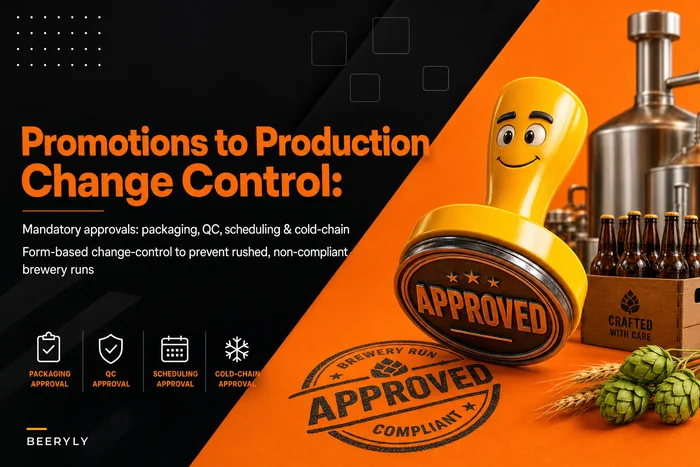
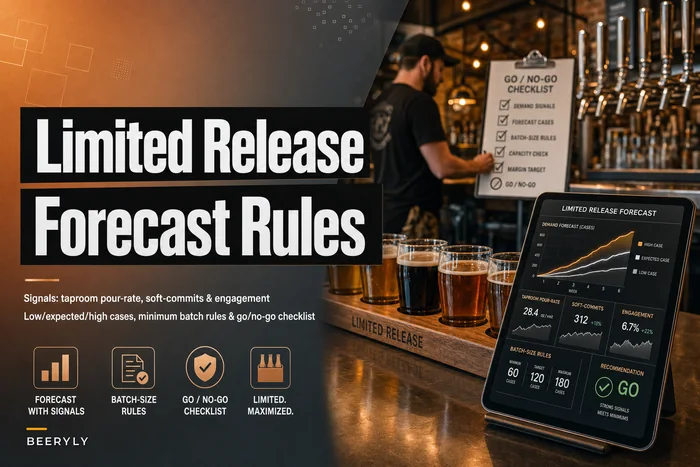
This is where change-control discipline pays off. If you've already built a structured approval flow — the kind laid out in this promotions-to-production change-control checklist — pre-approval rules become the front gate that keeps most requests from ever needing a full emergency review. And for the releases that do get a green light, running them through a go/no-go and batch-size checklist keeps the batch sized to reality instead of to enthusiasm.
One pattern worth watching: breweries that skip pre-approval rules tend to approve everything, because in the moment, saying no to an excited sales rep or a collaborator feels personal. Rules move the "no" from a personal rejection to a policy — and that's what makes it stick.
The decision calendar: where marketing requests meet batch economics
This is the part that ties everything together, and where most breweries have nothing at all: a decision calendar.
A decision calendar isn't your brew schedule. It's the layer above the brew schedule that dictates when decisions get made about what goes on it. The whole point is to force marketing and sales requests to land inside defined scheduling windows tied to real production lead times — instead of arriving whenever inspiration strikes.
How it works in practice:
-
Standing decision windows. One portfolio review every four weeks or so. Any new SKU or limited-release request gets queued for the next window. Nothing gets slotted mid-cycle except genuine emergencies.
-
Lead-time anchoring. Each decision window sits far enough ahead of production that the answer can actually be acted on. If a barrel-aged release needs a five-month runway, the decision window for fall releases can't be in September.
-
Batch-economics gate at the window. When a request is reviewed, it gets evaluated against minimum-batch economics and available tank-days at that moment — not against a fantasy of infinite capacity.
-
Seasonal core locked first. Core seasonals get their calendar slots reserved before limited requests are even considered. The flagship and the reliable fall lager aren't competing for scraps against a one-off.
Without a decision calendar, requests get answered in the order they arrive and in proportion to how loudly someone asks. With one, they get answered in the order that respects lead times and protects capacity for the SKUs that actually pay the bills.
A short workflow example
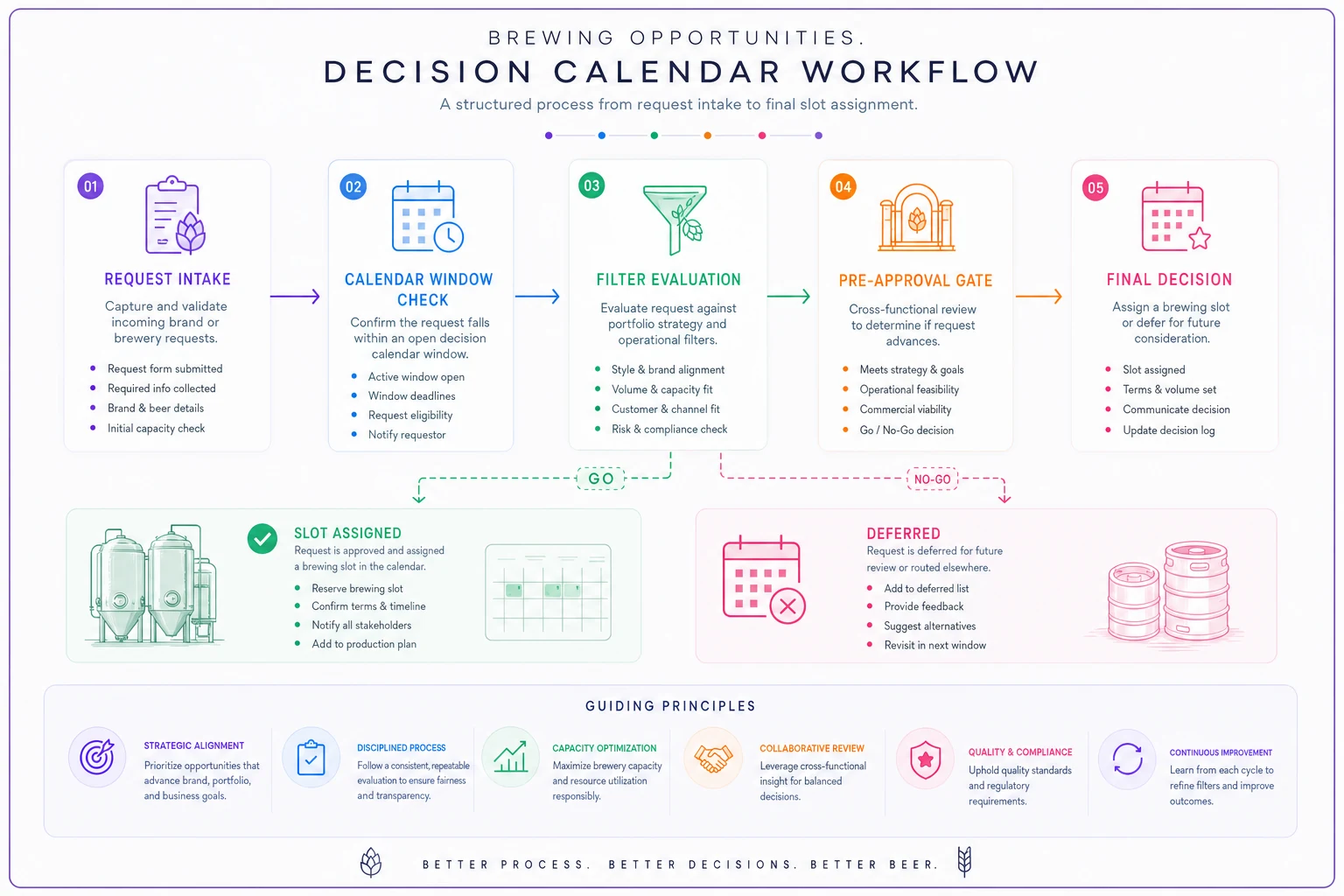
Picture a mid-size brewery running roughly a dozen active SKUs. Their fall planning decision window sits in early June. Between windows, every seasonal idea and distributor request gets logged — not approved, just logged.
In June, they review the whole batch of requests at once. Core fall seasonals get their tank-days locked first. Then the limited requests get sorted through the three filters and the pre-approval rules. Two make the cut with capped batch sizes. Three get declined because they'd have required sub-economical batches or displaced the flagship during peak season. One gets deferred to the winter window because the hops weren't contracted yet.
The difference isn't that they brewed more beer. Decisions happened together, on a schedule, with the numbers in front of everyone — instead of one panicked yes at a time. That's the whole point.
What breaks at scale, and where a system replaces intuition
At four or five SKUs, none of this needs to be formal. The problem is that breweries keep the informal approach long after they've outgrown it, usually until a painful stockout or a cooler full of unsold seasonal forces the issue.
The breakpoints tend to arrive in a fairly predictable sequence:
-
Around 8–12 SKUs, no single person can reliably hold all the constraints — hop contracts, conditioning windows, changeover costs — in their head anymore. Decisions start getting made on partial information.
-
When distribution expands, a stockout stops being a taproom annoyance and becomes a lost account. The cost of an unprotected flagship goes way up.
-
When limited releases become a marketing habit, the sheer volume of requests overwhelms any reactive process. You need pre-approval rules just to keep up.
At that point, coordination becomes the bottleneck — not the brewing, not the ingredients, but the decision-making. That's the piece worth systematizing.
When breweries move portfolio decisions into an operational platform rather than a mix of spreadsheets, group texts, and memory, the value isn't fancy. Constraints become visible in one place. AI-assisted operational software can flag when a proposed limited release would push a batch below its economical minimum, surface which SKUs are quietly failing all three filters, and surface tank-day conflicts before a beer gets promised to a distributor. The point isn't automation for its own sake — it's putting the volume, margin, and capacity math in front of the people making the call, at the moment they make it, so the decision calendar actually holds.
When this level of orchestration makes sense — and when it doesn't
When it's worth building: You're past ten active SKUs, you run limited releases more than a few times a year, and you've had at least one flagship stockout or unsold-seasonal problem that traced back to a scheduling decision. If that's you, the informal approach is already costing you more than the system would.
When it's overkill: You're a small taproom-focused operation with a handful of beers and no real distribution pressure. Formal decision windows and pre-approval rules would add friction you don't need. Keep it simple until the complexity actually hurts.
Who should not do this yet: If you don't have reliable per-SKU cost and margin data, don't start here — start with the numbers. Filters and pre-approval rules are worthless if the margin figures feeding them are guesses. Get the cost picture solid first, then layer the orchestration on top.
Bringing it together
The breweries that stay profitable as they add SKUs aren't the ones with the most disciplined brewers or the flashiest limited releases. They're the ones who stopped treating every marketing request as a standalone yes-or-no and started running them through the same filters, the same pre-approval rules, and the same decision windows every time.
Portfolio orchestration doesn't make your beer better. It makes sure the beer that pays your rent never loses its tank to the beer that just sounded exciting in a Tuesday meeting — and that every seasonal and limited release you do run has actually earned its slot on the calendar.
That protection, applied consistently, is worth more over a year than any single hyped release you'll ever brew.
The breweries that stay profitable as they add SKUs aren't the ones with the most disciplined brewers or the flashiest limited releases. They're the ones who stopped treating every marketing request as a standalone yes-or-no and started running them through the same filters, the same pre-approval rules, and the same decision windows every time.
Portfolio orchestration doesn't make your beer better. It makes sure the beer that pays your rent never loses its tank to the beer that just sounded exciting in a Tuesday meeting — and that every seasonal and limited release you do run has actually earned its slot on the calendar.
That protection, applied consistently, is worth more over a year than any single hyped release you'll ever brew.
Ready to elevate your brewery operations?
Join 500+ craft breweries using Beeryly to increase production efficiency, reduce waste, and grow sales.