

Limited releases are where a lot of breweries quietly bleed money. Not on the flagship — that one you know cold. It's the barrel-aged stout, the collab hazy, the pastry sour you brewed because a distributor rep hinted there was demand. Half the time the hint was real. The other half you're sitting on inventory that's aging out while your working capital sits frozen in a tank.
The problem isn't that limited releases are risky. It's that most breweries decide the batch size before they've written down a single number that could tell them whether that size makes sense. The recipe gets locked, the brew date gets scheduled, and the volume is basically a gut call from whoever's loudest in the room.
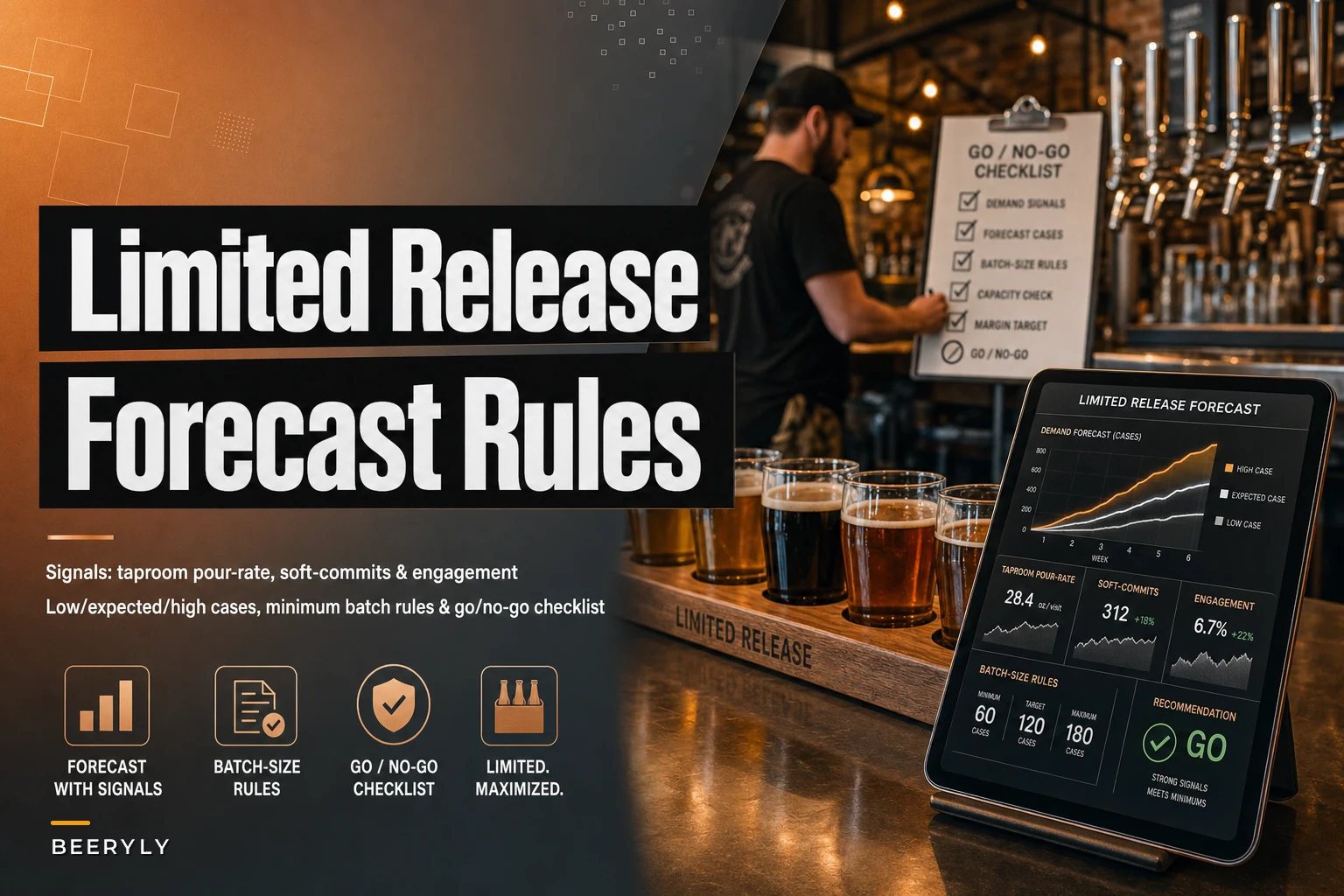
This is a template for doing the opposite: pulling a few cheap signals, checking them against your minimum batch-size reality, adding a buffer for the promo that may or may not land, and running the whole thing through a go/no-go gate before it touches the brewhouse.
The trap: your minimum batch size is bigger than your actual demand
Your brewhouse has a floor. Maybe it's a 15-bbl system and you're not going to fire it up for less than a full batch. So the smallest limited release you can physically make is already around 465 gallons — call it 200 cases of 16oz cans, give or take fill and loss.
Now ask the harder question: for this specific release, is there demand for 200 cases inside the window before the beer degrades or the hype dies?
For a lot of one-off releases, the honest answer is no. There's demand for maybe 90–120 cases in the first three weeks, and then it flattens hard. The remaining 80–100 cases become a slow drip through the taproom and a couple of on-premise accounts that take a case a month. That tail can run four or five months. For a hop-forward beer, that's a disaster — you're now selling a "fresh" IPA that's 90 days old.
The mistake isn't overbrewing. It's brewing at all on a system whose minimum batch exceeds the release's realistic sell-through. That's a structural mismatch, and no amount of marketing fixes it after the fact.
The signals worth ingesting (and the ones that lie)
You don't need a data science team. You need four or five inputs you can pull in under an hour, and the discipline to write them down before the decision gets emotional.
Take control of your brewery’s workflow.
Beeryly helps you schedule batches, track inventory, and monitor sales with ease.
- Production timeline management
- Inventory tracking & alerts
- Sales & distribution monitoring
No credit card required
-
Prior comparable release velocity. Not "how did the last special do" broadly — how did the closest analog do in its first 21 days. A barrel-aged stout tells you almost nothing about a fruited kettle sour.
-
Pre-orders or account soft-commits. If you have a distributor or key accounts, how many cases will they verbally take before you brew? Discount this number. Soft-commits evaporate.
-
Taproom pour-rate on similar styles. If a comparable pilot or one-off moved X pints a week on tap, that's a real, in-house demand signal that doesn't lie.
-
List/email engagement. Open and click rates on the announcement, or waitlist signups if you run them. Weak but directional.
-
Seasonality and calendar collisions. Are you dropping a heavy imperial stout in July? Is there a bigger local release the same weekend?
The signal that lies the most: social engagement. Likes and shares on the teaser post feel like demand and almost never convert at the rate people assume. A post can rack up 400 reactions and move 30 cases. Treat engagement as a tiebreaker, not a forecast input.
Building the lightweight forecast
You're not trying to predict the exact number. You're trying to bracket it — a low, expected, and high case — and then check whether even your low case clears your minimum batch.
| Input | Value |
|---|---|
| Minimum batch (15 bbl, after loss) | ~190 cases |
| Comparable sour, first 21 days | 105 cases |
| Account soft-commits (discounted 40%) | 33 cases |
| Taproom analog pour-rate (21 days, in cases) | 40 cases |
| Expected first-window demand | ~140–160 cases |
| Low case | ~110 cases |
| High case | ~185 cases |
Read that table honestly. Your expected demand of 140–160 doesn't even clear the 190-case minimum, and your low case leaves 80 cases hanging. That's a no-go at this batch size — or a signal to change the plan: split the batch across two SKUs, blend part of it, or move to your pilot system if you have one.
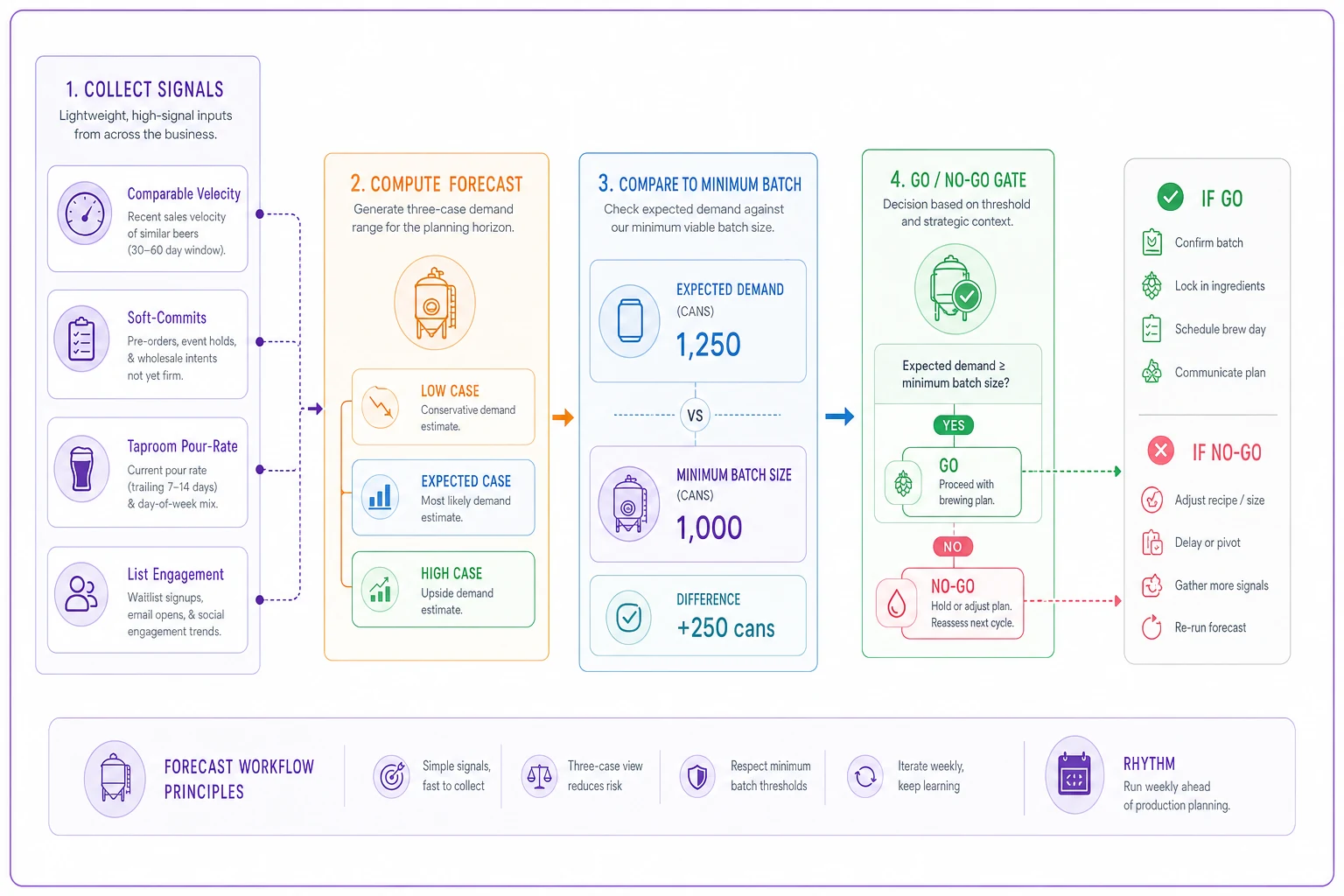
A quick workflow: gather the inputs, estimate low/expected/high, compare to the minimum batch, then decide before the brew date is scheduled.
Promotional buffers: plan the push before you count on it
A lot of forecasts get gamed right here. Someone says "well, we'll run a promo, so bump the number up." That's backwards. A promo isn't a reason to inflate the forecast — it's a lever with a known, limited lift.
Build the buffer as a separate line, not baked into the base demand. In practice, a coordinated push — email plus taproom feature plus one distributor incentive — tends to pull the timing forward more than it grows total volume. You sell the same 150 cases, but in 18 days instead of 35. That's genuinely valuable for a fresh-hopped beer, and close to meaningless for a barrel-aged one that's stable for a year.
So the rule: a promotional buffer should raise your expected case count only when the promo is (a) actually funded, (b) has an owner, and (c) has a defined mechanism. A vague "we'll post about it" adds zero cases to the forecast. This connects directly to keeping promotions and production in sync through change-control — the beer and the push have to be scheduled as one thing, not two separate afterthoughts.
If the promo is real, cap its contribution. A reasonable ceiling for most single-channel pushes is 15–25% acceleration of sell-through, not a 50% volume increase. When someone claims a promo will double demand, ask what specifically changed versus the comparable release. Usually nothing did.
The go/no-go checklist
Run this before the brew is scheduled. Every box needs a real answer. If two or more come back "no" or "unknown," the release goes back for a plan change — different size, different SKU split, different date.
-
Does the low case of the forecast clear the minimum batch, or do we have a plan for the overhang (blend, split, secondary package)?
-
Do we have a comparable release to anchor velocity, or are we guessing blind?
-
Are account soft-commits written down and discounted, not taken at face value?
-
Is the promo, if any, funded and owned — or are we removing its lift from the forecast?
-
Does the freshness window of this style survive our expected sell-through timeline?
-
Is there a calendar collision (bigger local drop, dead season) we're ignoring?
-
Do we have the package materials and label approval lined up, or is that a hidden delay?
-
Have we priced the downside — what a 25% overhang costs us in tied-up working capital and spoilage risk?
That last one matters more than people give it credit for. A limited release that half-sells doesn't just miss revenue — it locks cash in slow inventory and eats cellar space. The working-capital cost of perishable inventory is the real penalty for a bad limited-release call, and it's usually two or three times what people estimate. Worth running that number before you schedule anything.
A short real scenario
A production brewery sitting around 4,000 bbl annually kept losing money on their monthly "cellar series" one-offs. Not dramatically — just a steady drip. They'd brew a full 20-bbl batch of whatever sounded fun, sell strong for two weeks, then grind through the last third for months.
When they actually mapped it, the pattern was ugly: roughly 4 of every 10 releases left a 30–35% tail that took 90+ days to clear. On hoppy releases, a chunk of that got dumped or deep-discounted. The rough annual bleed — spoilage, discounts, cash tied up — landed somewhere in the $18k–$24k range. Not catastrophic, but real money for a shop that size.
The fix wasn't fancier forecasting. It was the go/no-go gate plus one hard rule: any release whose expected demand didn't clear the minimum batch either got split into two co-fermented SKUs or moved to their 3-bbl pilot system. Over the next couple of quarters, the 90-day tails dropped to about 1 in 10 releases. The releases they did run cleared faster because the sizing finally matched reality.
Nothing about the beer changed. The decision process did.
When this template makes sense — and when it doesn't
This is built for breweries running frequent limited or one-off releases where each drop carries real cost. If you do four seasonals a year and know them cold, this is overkill — your history already tells you the number.
When it makes sense:
-
You run monthly or more-frequent specials
-
Your minimum batch size is large relative to typical release demand
-
You've been eating slow tails or discount cycles on one-offs
-
You have at least a few comparable releases to anchor against
When it's a bad idea:
-
You have no comparable data at all and you're brand new — you'll just be guessing with a spreadsheet instead of guessing out loud. Build a couple of small pilots first, then start anchoring.
Who should skip it:
-
Nano operations where every batch is already tiny and the minimum-batch mismatch simply doesn't exist. If your smallest brew is 3 bbl and it always sells through, the gate is friction you don't need.
If your smallest brew is 3 bbl and it always sells through, the gate is friction you don't need.
Where software quietly helps
None of this requires a platform. A spreadsheet and discipline get you most of the way. Where it starts to matter is when the inputs live in five different places — pour-rates in your POS, account commits in someone's email, comparable-release history in an old sheet nobody updates.
Forecasts get skipped not because people are lazy, but because pulling the signals takes 40 minutes of hunting. So people just don't. Operational platforms that already hold your production, taproom, and inventory data can surface those comparables and pour-rates automatically, so the go/no-go gate takes five minutes instead of an afternoon.
Surface pour-rates and account commits into a single dashboard so the gate check takes five minutes, not forty.
That's the real unlock — not smarter math, just making the honest number cheap enough to actually check every time.
The one habit that changes everything
Size the release before you fall in love with it. The recipe conversation is fun and the marketing conversation is fun, and both of them will happily push you toward a batch size your demand can't support.
Write down the low case. Check it against the minimum batch. Keep the promo lift honest and separate.
Run the gate. Do that consistently and your limited releases stop being a coin flip — the winners still win, and the misses get caught while they're still just a spreadsheet, not 80 cases of aging beer taking up your cellar.
Ready to elevate your brewery operations?
Join 500+ craft breweries using Beeryly to increase production efficiency, reduce waste, and grow sales.