

Most breweries don't have a utility problem. They have a measurement problem. The electric bill was ugly last month, water keeps getting more expensive, but nobody can actually tell you what a barrel costs to make once you factor in kWh, therms, and gallons. When you can't see the number, you can't shrink it.
This playbook is built backwards from that gap. We start with a baseline audit you can finish in a weekend, move into cheap fixes that pay back in weeks, then get into equipment upgrades where the math gets serious. Real sample calculations included — because hand-wavy ROI estimates don't help anyone make a decision.
One thing upfront: brewery energy water optimization isn't about turning your operation into a science experiment. It's about knowing which three or four levers actually move your cost per barrel, and ignoring everything else.
Start with the number nobody tracks: utilities per barrel
Before any fix, you need a baseline. Not a gut feeling — an actual number.
Pull twelve months of utility bills: electric, gas, water, sewer. Then pull your production records for the same period in barrels. Divide.
-
Electricity 50–90 kWh per barrel
-
Natural gas 0.6–1.2 therms per barrel
-
Water 5–8 barrels of water per barrel of beer (yes, really)
If you're at the high end of any of those ranges, that's where your money is hiding. The water ratio surprises people most. A brewery running 6:1 water-to-beer that gets down to 4:1 isn't just saving on incoming water — they're cutting sewer charges too, which are often higher per gallon than the water itself.
The insight most owners miss: water and sewer are usually two separate line items, and sewer is frequently billed on assumed usage or a multiplier of your water meter. Some municipalities will install a deduct meter for water that goes into your product and never hits the sewer. That single administrative change saves some breweries a few thousand dollars a year with zero operational effort.
The baseline audit checklist
Walk your facility with this list. Don't fix anything yet — just record. The goal is a snapshot of where energy and water leave the building.
Take control of your brewery’s workflow.
Beeryly helps you schedule batches, track inventory, and monitor sales with ease.
- Production timeline management
- Inventory tracking & alerts
- Sales & distribution monitoring
No credit card required
Water
-
[ ] Meter your CIP water for one full cycle on your main tanks
-
[ ] Measure hose flow rates (time how long to fill a 5-gallon bucket)
-
[ ] Check for running toilets, dripping hose bibs, and leaking pump seals
-
[ ] Note whether rinse water is single-pass or recovered
-
[ ] Confirm whether you have a sewer deduct meter
Electricity
-
[ ] List every motor and its horsepower (pumps, compressors, fans)
-
[ ] Note glycol chiller run patterns — does it short-cycle?
-
[ ] Check walk-in cooler door seals and how long doors stay open
-
[ ] Log compressor pressure setpoint vs. what you actually need
-
[ ] Record lighting type and hours (still running metal halide or T12s?)
Thermal (gas/steam)
-
[ ] Time your boil and note evaporation rate
-
[ ] Check for uninsulated hot liquor tank, mash tun, and hot piping
-
[ ] Note steam trap condition if you run steam
-
[ ] Check flue temperature on your boiler or direct-fire kettle
Refrigeration
-
[ ] Record glycol supply temperature setpoint
-
[ ] Check condenser coils for dust and debris
-
[ ] Note whether the chiller has any free-cooling capability in winter
The single biggest surprise in most of these walkthroughs is almost always the glycol system running colder than it needs to — and compressed air leaking somewhere nobody's bothered to listen for.
Low-cost fixes that pay back before your next tax filing
Do these first. They cost a few hundred dollars or less and start saving immediately. None of them need capital approval or a contractor quote you'll wait three weeks to receive.
1. Fix compressed air leaks. A single 1/8-inch leak at 100 psi can waste roughly $700–$1,000 a year in electricity because your compressor runs constantly to compensate. Walk the lines during a quiet moment when nothing's cycling and just listen. Soapy water on fittings shows you the rest. Most breweries find three or four leaks in an afternoon.
Walk lines during a quiet period and use soapy water to quickly identify small compressed-air leaks.
2. Raise your glycol setpoint. A lot of systems run at 26–28°F when 30–32°F would still hit fermentation and cold-crash targets fine. Every degree you raise the setpoint cuts chiller energy by roughly 2–3%. Test it slowly and watch your crash times — but for most operations, this is free money.
3. Insulate hot surfaces. An uninsulated hot liquor tank bleeds heat constantly. Removable insulation jackets cost a few hundred dollars and cut standby gas use noticeably. This also makes your brewhouse less miserable in summer.
4. Cut boil vigor. A rolling boil evaporating 8–10% is wasting energy, and driving off DMS isn't linear above a certain point. Many beers hold quality at 4–6% evaporation. Dialing back saves gas and water.
5. Switch to trigger-nozzle hoses. Open hoses running while someone walks away is the classic water drain. A $30 nozzle plus a habit change often cuts hose water use 20–30%.
6. Clean condenser coils. Dirty coils force your chiller to work harder. A 20-minute cleaning can recover 5–10% of refrigeration efficiency. Put it on the maintenance calendar — this ties directly into a broader preventive maintenance and reliability framework so it doesn't slip between busy stretches.
The pattern: the cheapest fixes attack waste, not consumption. You're not brewing less beer or chilling it less. You're stopping energy from leaking out the sides of the process.
The equipment upgrade ROI table
Once the free fixes are done, you're into capital decisions. This is where owners either overspend on the wrong thing or freeze up entirely. The table below uses typical numbers for a brewery in the 2,000–4,000 bbl/year range. Adjust to your utility rates, but the ranking usually holds.
| Upgrade | Rough cost | Annual savings | Simple payback | Notes |
|---|---|---|---|---|
| VFD on glycol pump/compressor | $2,000–$4,000 | $1,200–$2,500 | 1.5–2.5 yrs | Best bang for buck for most |
| LED lighting retrofit | $1,500–$5,000 | $800–$2,000 | 1.5–3 yrs | Rebates often cut this in half |
| Heat recovery from wort chilling | $4,000–$12,000 | $2,000–$5,000 | 2–4 yrs | Preheats brewing water, cuts gas |
| Insulation jackets (brewhouse) | $500–$1,500 | $600–$1,200 | ~1 yr | Basically a no-brainer |
| Right-sized/new glycol chiller | $15,000–$40,000 | $3,000–$7,000 | 4–7 yrs | Only if current one is failing or way oversized |
| Rinse water recovery system | $3,000–$8,000 | $1,500–$3,500 | 2–4 yrs | Payback depends heavily on sewer rates |
| Solar PV | $30,000–$80,000 | $4,000–$9,000 | 7–12 yrs | Long horizon; depends on incentives |
Worth noticing: the projects with the fastest payback are almost never the ones owners get excited about. Everyone wants to talk solar. Meanwhile a $3,000 VFD on the glycol system quietly returns more per dollar in the first two years than a $60,000 solar array does in five.
A sample calculation, so the ROI isn't just a table
Scenario: A brewery brewing 20 batches a month, 15 bbl each. To chill wort from ~200°F down to pitching temp, they run city water through a plate chiller and dump the warm output to drain. That warm water could instead preheat the next batch's strike and sparge water.
The waste today:
-
Each batch uses roughly 2 barrels of cold water through the chiller
-
20 batches × 2 bbl = 40 bbl/month = ~1,240 gallons/month going to drain warm
With a hot liquor recovery tank:
-
Capturing that heat means the boiler heats water starting at ~120°F instead of ~55°F
-
That's roughly 65°F less to heat, per batch
-
Heating 15 bbl of water 65°F fewer degrees saves about 3 therms per batch
-
20 batches × 3 therms × $1.20/therm ≈ $72/month, or about $860/year in gas
-
Plus you're reusing the captured water instead of pulling fresh, saving maybe another $400–$700/year on water and sewer combined
Call it roughly $1,300–$1,500 a year on a system that might cost $5,000 to plumb in. Payback lands around 3.5 years, and it keeps paying every year after. That's how every upgrade decision should be sized — not "is this cool" but "what's the payback and what's the life of the equipment."
Seasonal behavior changes: the free lever most breweries ignore
Your utility profile isn't flat across the year, and your operating decisions shouldn't be either. This is behavior, not capital — so it costs nothing but attention.
Winter (free cooling): If ambient temperature drops below your glycol setpoint, your chiller is running to make cold when it's already cold outside. A glycol system with even a basic free-cooling loop or dry cooler can offload the compressor for weeks at a time. In colder climates this alone can cut winter refrigeration energy by 30–50%. Even without the hardware, scheduling cold-crashes overnight when it's coldest gives your chiller a lighter load.
Summer (peak demand): During heatwaves, your chiller and cooler both work hardest exactly when the grid is most strained and demand charges spike. Shifting energy-heavy tasks — big cold crashes, packaging runs — to early morning helps flatten that curve.
Shoulder seasons: These are your best windows for maintenance-heavy cleaning cycles, because thermal and refrigeration loads are lightest and you're not fighting the equipment.
The thing worth internalizing: your utility rate isn't just price-per-unit. Demand charges — the penalty for your single highest spike in a billing period — can be 30–40% of a commercial electric bill. Staggering when big motors start costs zero dollars and can meaningfully cut that spike.
A simple monthly workflow to keep the savings from eroding
Fixes decay. The glycol setpoint creeps back down, compressed air leaks come back, someone leaves a hose running. Without a rhythm, you'll do all this work and be back where you started in eighteen months.
-
On the 1st, log last month's electric kWh, gas therms, and water gallons.
-
Divide by barrels produced that month to get your cost-per-barrel utility number.
-
Compare to prior month and same month last year — seasonality matters, so year-over-year is the honest comparison.
-
If the number jumps more than ~10%, walk the audit checklist for that utility to find what slipped.
-
Log one action — even "checked air leaks, found none" counts as a data point.
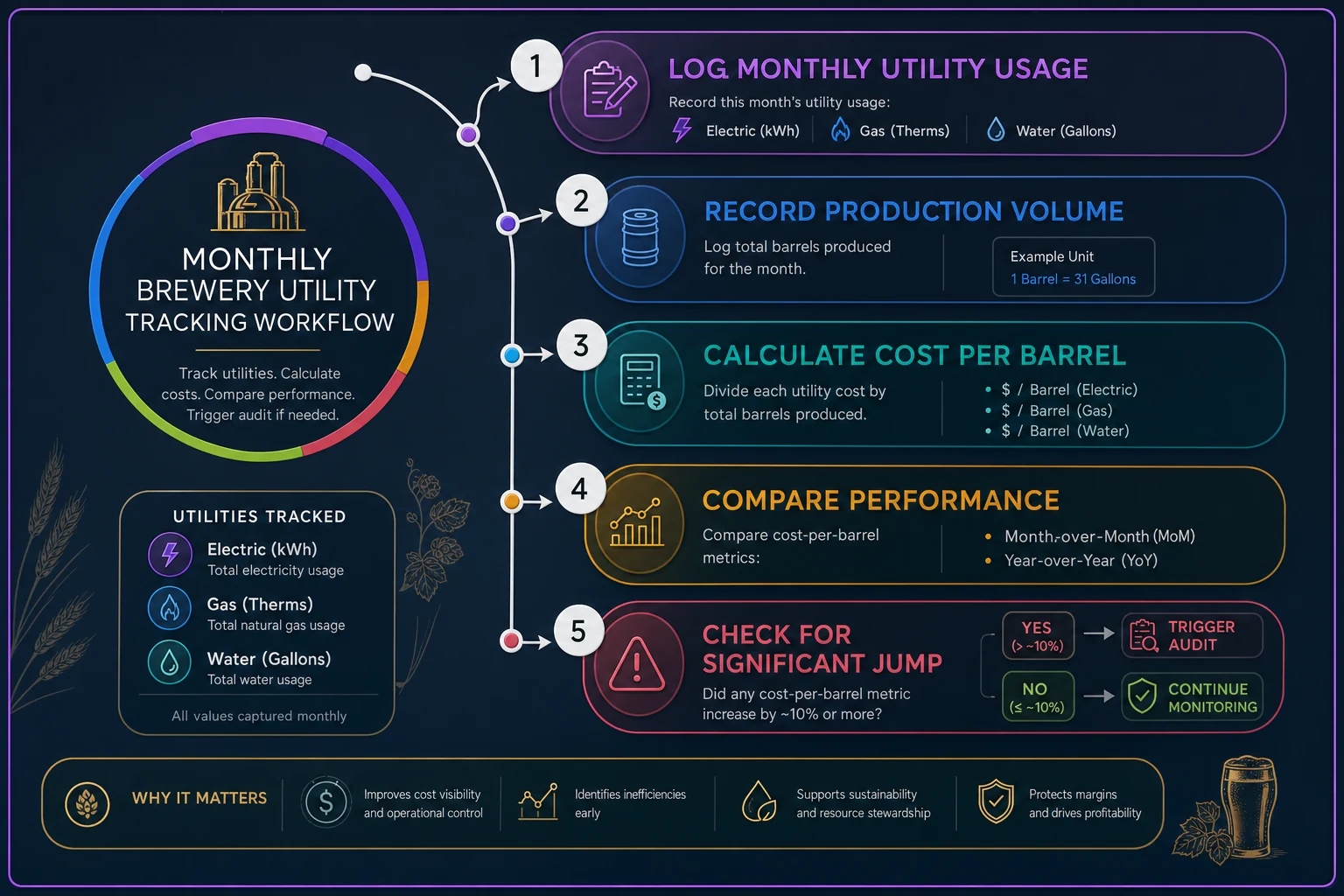
A quick visual of this monthly rhythm makes it easy for staff to follow and keeps the habit from slipping.
This is where having production and utility data in one place actually matters. When your barrels-produced number lives in the same system that tracks batches and inventory, the cost-per-barrel calculation stops being a monthly chore and just shows up. The same discipline that keeps you from losing money to spoilage and tied-up working capital applies here — visibility is what turns a one-time cleanup into a permanent gain.
When aggressive optimization is a bad idea
Not every brewery should chase every fix.
Skip the big capital upgrades if you're under 1,000 bbl/year. Your absolute utility spend is small enough that a 4-year payback on a $30k chiller might outlast your equipment or your lease. Stick to the cheap fixes and behavior changes — they scale down fine.
Don't over-tune your process for energy at the expense of beer quality. Cutting boil vigor too far, raising glycol too high, or under-rinsing to save water are exactly the kind of decisions that show up later as off-flavors, slow crashes, or microbial risk. Utility savings that cost you a batch aren't savings.
Be careful chasing solar first. It's the most exciting line item and usually the worst payback. Do it eventually if incentives are strong — but only after the sub-3-year projects are done.
Real scenario: a 2,800 bbl production brewery
A production-focused brewery running around 2,800 barrels a year was watching utilities eat into margin without knowing exactly where it was going. Starting numbers: roughly 78 kWh/bbl and a water ratio near 6.5:1.
They didn't buy anything for the first two months. They fixed four compressed-air leaks, raised the glycol setpoint from 27°F to 31°F, added insulation jackets to the hot liquor tank, and put trigger nozzles on every hose. Total spend under $600.
Then they added a small rinse-water recovery loop and a heat-recovery tank off the wort chiller — a combined outlay of roughly $9,000.
Over the following year, electricity dropped to about 66 kWh/bbl and the water ratio came down to roughly 5:1. On their volume, that worked out to somewhere around $9k–$11k a year in combined utility savings, with most of it coming from the free and cheap fixes. The capital projects paid for themselves inside three years.
The part that stuck with them wasn't the dollar figure — it was finally having a cost-per-barrel utility number they watched every month. Once you can see it, you defend it.
The breweries that win on utilities aren't the ones with the fanciest equipment. They're the ones who measured a baseline, killed the obvious waste for a few hundred bucks, made two or three smart capital bets with real payback math, and built a monthly habit of watching the number.
Do the audit. Fix the leaks and setpoints first. Run the ROI math before any purchase. Tune your behavior to the season. Track cost per barrel like the KPI it is. That's the whole playbook, and it works whether you're at 800 barrels or 8,000.
Ready to elevate your brewery operations?
Join 500+ craft breweries using Beeryly to increase production efficiency, reduce waste, and grow sales.