

Hops and yeast don't behave like other line items. You can't reorder them the way you reorder crowns or CO2. A hop contract you skipped in October is gone until next harvest. A yeast pitch that shows up warm because the courier sat on it over a long weekend can cost you a whole brew day. And the worst part is that these failures rarely announce themselves — you find out at the exact moment you can't fix it. The morning of a brew, tank already scheduled, water already heating.
This playbook is about building a procurement structure that absorbs those shocks before they hit your production calendar. Not a spreadsheet of reorder points. A tiered supplier system, rolling cover rules that account for lead time and shelf life, and a handful of contract clauses that actually protect you when a supplier slips.
Start by tiering suppliers, not by price
Most breweries rank hop and yeast suppliers by cost per pound or per pitch. That's the wrong first axis. What actually breaks your production is reliability under constraint — will this supplier deliver the right lot, on time, at the right temperature, during the exact window when you have no alternatives?
| Tier | What defines it | Typical use | Cover you should hold |
|---|---|---|---|
| Tier 1 – Anchor | Contract hops/yeast for core beers. Named varieties you can't substitute without changing the beer. | Your flagship IPA's Citra, your house lager yeast. | 100% contracted a year out + on-hand buffer |
| Tier 2 – Flexible | Varieties with acceptable substitutes. Multiple suppliers can fill. | Bittering hops, general American ale yeast. | Partial contract + spot fills |
| Tier 3 – Opportunistic | Seasonal, experimental, or one-off. | A pilot batch's Nelson, a collab yeast strain. | Spot only, no cover |
The mistake that keeps coming up: a brewery treats its flagship's signature hop as Tier 2 because "we can always find Citra." Then a short crop year hits, allocations tighten, and suddenly the hop that defines your best-selling beer is either unavailable or priced 40% higher. It was always a Tier 1 input — it just wasn't classified that way until it was too late.
A useful test for whether something belongs in Tier 1: if this input disappeared for six weeks, would a customer notice the beer changed? If yes, it's an anchor. Contract it, buffer it, and don't let it drift into the "we'll figure it out" pile.
Rolling cover rules that respect both lead time and shelf life
"Cover" is how many weeks of an input you have committed or on hand. The trick with brewery inputs is that the right cover number is a tug-of-war between two opposing forces:
Take control of your brewery’s workflow.
Beeryly helps you schedule batches, track inventory, and monitor sales with ease.
- Production timeline management
- Inventory tracking & alerts
- Sales & distribution monitoring
No credit card required
-
Lead time pushes cover up. If yeast propagation or a hop shipment takes three weeks, you need at least three weeks of cover just to survive a normal reorder cycle.
-
Shelf life and cash push cover down. Liquid yeast degrades. Hops lose oils even in cold storage. And every pound sitting in your freezer is working capital you can't use elsewhere.
The rolling cover rule sets a band, not a single number. Something like: hold between lead time plus one week (floor) and lead time plus a safety margin (ceiling), adjusted for how perishable the item is.
Rolling cover = supplier lead time + safety weeks − perishability penalty
-
Hops (pellets, cold-stored) long shelf life, so you can hold generously. Lead time ~2 weeks + 3 safety = ~5 weeks of cover on core varieties.
-
Liquid yeast (fresh pitch) short viable window, so you hold thin and lean on propagation instead. Lead time ~1 week + 1 safety = ~2 weeks max, and you plan to repitch or step up in-house rather than stockpile.
-
Dry yeast long shelf life, treat it closer to hops. You can carry several months without worry.
The pattern worth internalizing: you buffer against lead time with inventory only when shelf life allows it. When it doesn't, you buffer against lead time with process — house propagation, repitching schedules, a second qualified supplier who can turn around fast.
This is also where a lot of working-capital pain lives. If you're over-covering perishable inputs to feel safe, you're bleeding cash and probably dumping degraded product. The inventory side of this deserves its own treatment — there's a fuller breakdown in the perishable-inventory strategy for breweries that pairs directly with the cover rules here.
A quick numbers example
Say a 4,000 bbl brewery runs its flagship IPA at roughly 45% of volume and it's dry-hopped heavy — call it around 1.5 lbs of Citra per barrel across additions. That's a serious annual pull on a single contracted variety.
Now imagine they carried Citra as Tier 2 with a two-week reorder mindset. A short crop tightens supply in late summer. Their usual spot source is dry. Contract holders got their allocation; this brewery didn't lock enough. They end up buying the shortfall on the secondary market at somewhere between a 35–50% premium for two months, plus one panicked substitution that changed the beer enough that a few taproom regulars actually noticed.
The fix wasn't complicated. It was classification (Citra → Tier 1) and a rolling cover floor that never let contracted coverage drop below a full season. The premium spend and the beer drift both disappeared the following year.
Contract clauses that actually protect a brew day
Handshake agreements and generic POs don't help you at 6 a.m. when the yeast truck is late. You need specific clauses baked into supplier agreements. They don't have to be lawyer-heavy — the point is that expectations and remedies are written down before anything goes wrong.
Lead-time SLA clause (plain language):
> "Supplier commits to a maximum lead time of ___ business days from order confirmation to delivery for [named varieties/strains]. Orders confirmed by [cutoff time/day] ship within this window. If lead time exceeds the committed maximum on more than [X] occasions per quarter, Buyer may source the affected order elsewhere and invoice Supplier for the documented price difference."
That last sentence is what gives it teeth. A lead-time promise with no consequence is just a hope.
Partial delivery clause:
> "In the event Supplier can fulfill only part of a confirmed order, Supplier will notify Buyer within [X hours] of the shortfall and confirm the delivery date for the balance. Partial shipments of perishable inputs (liquid yeast, fresh hops) must meet the same temperature and freshness specs as full shipments. Buyer reserves the right to reject a partial delivery that falls below [Y%] of the order without penalty."
The reason this matters: partial deliveries are where a lot of brewers get quietly burned. You order enough Citra for two brews, get enough for one, and nobody flags it clearly. You find the gap when you're staging the second brew. A written partial-delivery clause forces early notification — which is the only thing that actually lets you replan in time.
Cold-chain / condition-on-arrival clause (critical for yeast):
> "Perishable inputs must arrive at or below [temperature spec]. Buyer will inspect and record temperature on receipt. Product arriving out of spec may be rejected and replaced at Supplier's cost, with replacement shipped within [X days]."
Lot and traceability clause:
> "Each shipment will include lot numbers, harvest year (hops) or propagation/pack date (yeast), and a certificate of analysis where applicable."
That last one ties directly into your record-keeping. If lot data lives in six different places, none of these clauses help you when you need to trace or dispute something. Getting the underlying records clean first is what makes every clause enforceable — the minimal data model for small breweries covers exactly the fields these clauses reference.
The emergency-buy SOP
Even a solid tiered system fails occasionally. A supplier goes down. A crop comes up short. A yeast pitch arrives dead. The difference between breweries that absorb it and breweries that lose a brew day is whether there's a pre-written emergency-buy procedure — worked out calmly in advance, not invented in a panic.
-
Trigger check. Confirm the shortfall is real and quantify it. How much are you short, of what, and by when? Distinguish "late but coming" from "not coming." A late Tier 1 delivery may not need an emergency buy if you have a cover buffer.
-
Tier response. Match the response to the input's tier. Tier 1 shortfall → activate backup supplier and escalate immediately. Tier 2 → check substitutes and spot market. Tier 3 → the brew probably just gets rescheduled; don't overpay to save a pilot batch.
-
Substitution decision. For hops, know your approved substitutions in advance — which varieties can stand in for a bittering charge without changing the beer's identity. For yeast, know whether you can repitch from a healthy fermenter or step up dry yeast. Pre-approve these swaps with your head brewer so nobody's guessing under pressure.
-
Spot-buy authorization. Set a price ceiling in advance. Something like "up to X% premium is pre-authorized without a second approval; above that requires owner sign-off." This is what lets a production manager act at 6 a.m. without waiting for a callback.
-
Cold-chain on emergency shipments. Rush orders skip normal handling. Explicitly require overnight cold shipping and temperature verification on arrival, even when you're desperate. A warm emergency yeast pitch is worse than no yeast — it fails mid-fermentation instead of never starting.
-
Log and review. Record what triggered the emergency, what it cost, and what tier or cover assumption failed. Emergency buys are data. Three emergencies on the same variety in a year means that variety's cover rule is wrong.
Emergency-buy checklist (keep this posted)
-
[ ] Shortfall quantified (amount, item, deadline)
-
[ ] Existing cover/buffer checked before buying
-
[ ] Backup supplier contacts current and reachable
-
[ ] Approved substitutions confirmed with brewer
-
[ ] Spot-buy price ceiling known
-
[ ] Cold-chain requirements stated on rush order
-
[ ] Temperature verified on receipt
-
[ ] Incident logged for cover-rule review
Emergency buys are data. Three emergencies on the same variety in a year means that variety's cover rule is wrong.
When this level of structure makes sense — and when it doesn't
When it's worth it: You're contracting hops a year ahead, running repeat flagships, or you've already eaten one bad harvest or one dead-pitch morning. Once a single input can take down a brew day, the tiering and clauses pay for themselves quickly.
When it's overkill: A tiny nano-brewery buying dry yeast and small hop lots as needed, with no contracts and flexible recipes, doesn't need a three-tier system. Pushing this framework onto that operation just adds admin. Keep it to a simple reorder list until seasonality or contract commitments actually start constraining you.
Who should skip most of this: Brewers who deliberately rotate recipes based on whatever hops are available and cheap. If your model is "we brew with what's in season," rigid Tier 1 contracts work against your own strategy. You still want the emergency-buy SOP and the cold-chain clause, but the tiering matters much less.
Keeping the whole thing coordinated
The part that quietly breaks even good procurement systems is coordination — cover levels living in one person's head, contract renewal dates nobody's watching, lead times that drifted longer over two years without anyone updating the cover rule.
Put contract renewal dates and cover-review reminders on a shared calendar so those windows don't live in a single person's head.
The framework only works if someone is actually tracking the moving pieces: what's contracted, what's covered, when renewals hit, and whether a supplier's real-world lead time still matches what's written down. That sounds obvious, but it's the piece that slips first when a head brewer leaves or production volume jumps and everyone gets busy.
Here's a simple workflow to centralize contract dates, cover bands, supplier tiers, and receiving records so emergency-buy triggers can fire on time.
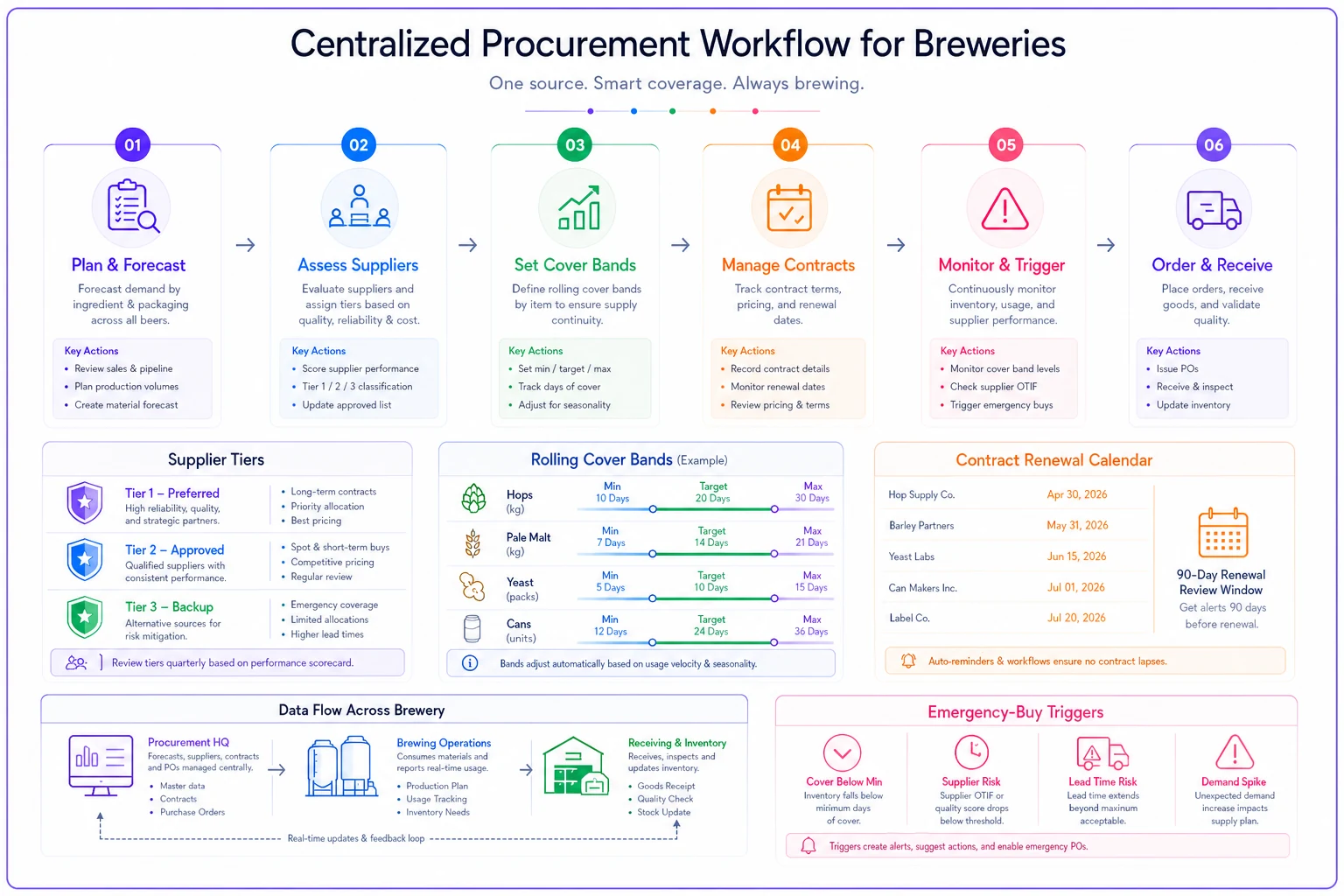
A shared operational view helps more than any single spreadsheet here. When contract dates, cover bands, supplier tiers, and receiving records sit in one place instead of scattered across inboxes and freezer notepads, the emergency-buy triggers can fire on time and cover-rule reviews actually happen. The tools matter less than the discipline of keeping those numbers current — but centralizing them is what makes that discipline sustainable when you're busy actually brewing.
Bringing it together
Hops and yeast will always carry more risk than the rest of your inputs because the calendar and the fridge are both working against you. You can't engineer that risk away entirely — but you can absorb most of it.
Tier suppliers by reliability, not just price. Set rolling cover bands that respect lead time on one side and shelf life on the other. Write the three or four clauses that give your agreements real teeth. And decide your emergency-buy moves before the emergency, not during it.
Do that, and the short crop year that wrecks other breweries' flagships becomes a minor line-item annoyance for yours. The whole point of a real procurement playbook isn't to predict every shortage — it's to make sure no single shortage ever costs you a brew day.
Hops and yeast will always carry more risk than the rest of your inputs because the calendar and the fridge are both working against you. You can't engineer that risk away entirely — but you can absorb most of it.
Tier suppliers by reliability, not just price. Set rolling cover bands that respect lead time on one side and shelf life on the other. Write the three or four clauses that give your agreements real teeth. And decide your emergency-buy moves before the emergency, not during it.
Do that, and the short crop year that wrecks other breweries' flagships becomes a minor line-item annoyance for yours. The whole point of a real procurement playbook isn't to predict every shortage — it's to make sure no single shortage ever costs you a brew day.
Ready to elevate your brewery operations?
Join 500+ craft breweries using Beeryly to increase production efficiency, reduce waste, and grow sales.