

Peak weeks don't fail gradually. They fail in a single afternoon when a brite tank finishes, packaging kicks out 180 cases, two distributor POs land for pickup Thursday, and someone opens the walk-in only to find room for maybe 40 cases if you stack things just right.
That moment — when cold storage demand exceeds cold storage supply — is where most of the real damage happens during a brewery's busiest stretch. Not in the brewhouse. Not in packaging. In the walk-in, where finished beer that cost real money to make starts warming up because nobody made a fast, defensible call about what gets priority.
This is about brewery cold storage triage: how to make those calls fast, how to keep the beer that matters cold, and how to bring on temporary capacity without panic-paying $2k for dry ice you didn't need.
Why cold storage becomes the bottleneck no one planned for
Tank capacity gets planned. Packaging throughput gets planned. Cold storage almost never does, because for 40 weeks a year it's fine. The walk-in absorbs the normal flow of beer in and out, and nobody thinks about it.
Then peak hits — a seasonal release, a festival run, three distributor orders stacking up in the same week — and suddenly inbound (fresh packaged beer) and outbound (shipments) are both running hot at the same time. Cold storage is the buffer between them, and buffers fail when both sides spike together.
A pattern that shows up constantly: a brewery running comfortably at around 60–70% walk-in utilization most of the year will blow past 100% for roughly 3–5 days during a peak window. That's it. The whole problem lives inside a handful of days, which is exactly why nobody fixes it — not painful often enough to justify a new walk-in, but painful enough during those days to cost real margin.
The second reason it sneaks up: cold storage demand isn't visible until it's physical. You can't see it in a spreadsheet the way you see tank schedules. You see it when a pallet jack can't get through because cases are stacked in the aisle. By then you're already improvising.
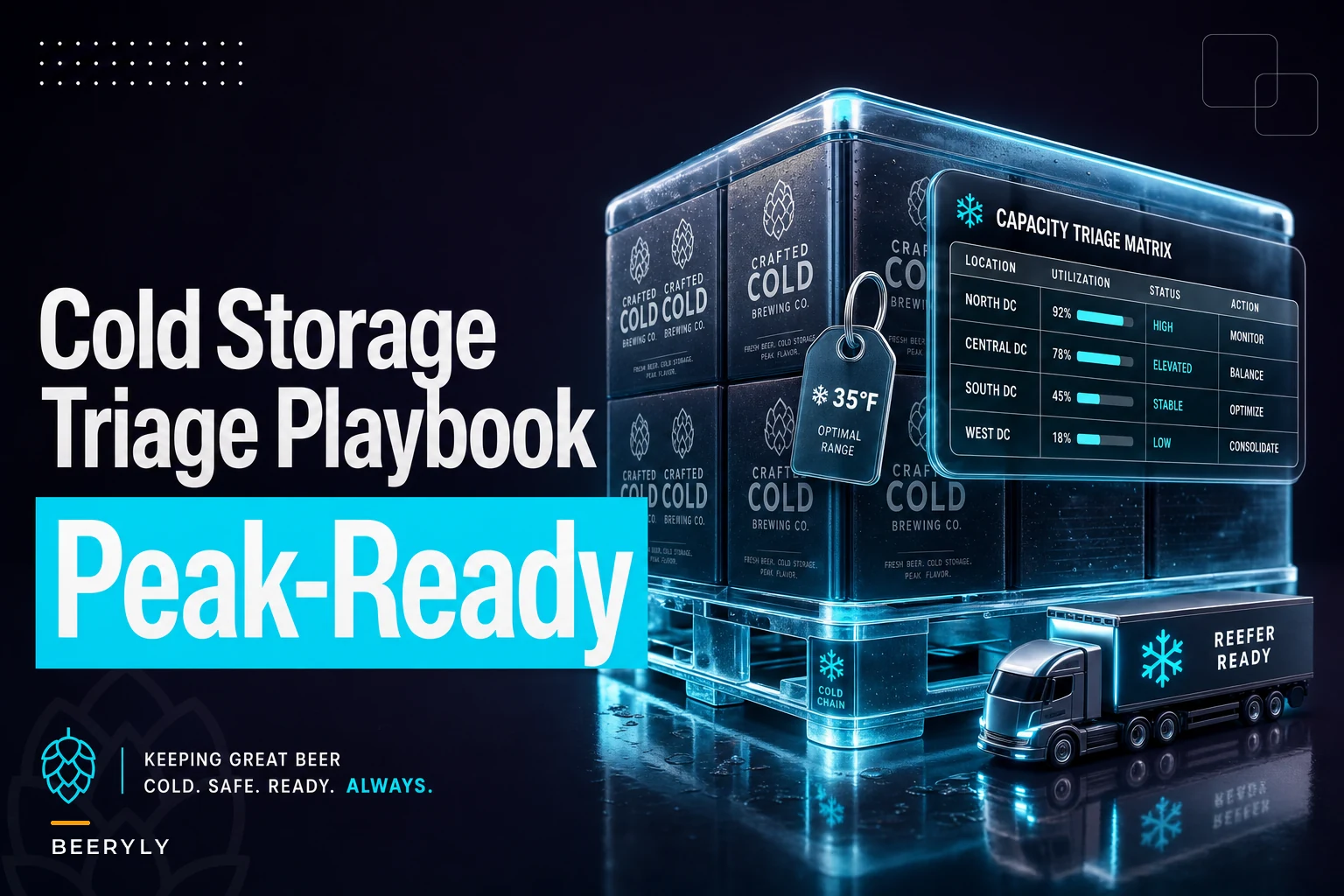
The capacity triage matrix: deciding what earns cold space
When you're over capacity, every SKU and every pallet is competing for the same cubic feet. The mistake is treating it as first-in-first-out, or worse, whatever's easiest to move. Triage means ranking by what actually loses value fastest if it warms up, and what has a hard outbound deadline.
Take control of your brewery’s workflow.
Beeryly helps you schedule batches, track inventory, and monitor sales with ease.
- Production timeline management
- Inventory tracking & alerts
- Sales & distribution monitoring
No credit card required
Two dimensions matter: perishability sensitivity (how fast quality degrades warm) and outbound urgency (how soon it has to leave). Everything else is noise.
Here's the matrix that works during a crunch:
| Sensitivity | Ships within 48 hrs | Ships 3–7 days | No firm ship date |
|---|---|---|---|
| High sensitivity (hazy IPA, unpasteurized, dry-hopped, low-ABV) | Tier 1 — cold, no exceptions | Tier 2 — cold, protect aggressively | Tier 2 — cold, flag for faster sell |
| Medium sensitivity (standard IPA, pale, lager in cans) | Tier 1 — cold | Tier 2 — cold | Tier 3 — cold if room, first to temp-storage |
| Low sensitivity (high-ABV, pasteurized, barrel-aged, packaged stable) | Tier 2 — cold | Tier 3 — ambient OK short-term | Tier 3 — ambient, lowest priority |
The point of the matrix isn't precision — it's speed. During a crunch you don't want a debate about whether the hazy or the stout gets the cold spot. A dry-hopped hazy IPA shipping Thursday wins over a barrel-aged stout with no ship date, every time, and you want that decision to be automatic, not negotiated at 4pm with a forklift idling.
One nuance people miss: a Tier 3 item with no ship date is often your best candidate to push to temporary storage, not your worst. Instinct says "protect the stuff with no deadline because it'll sit longest." Wrong. If it's low-sensitivity and has no deadline, it tolerates ambient or dry-ice buffering far better than a hazy that's leaving in two days. Triage the stable stuff out, keep the fragile deadline stuff in your controlled walk-in.
Priority-reflow rules: what to do the moment you tip over
Reflow is what happens when capacity changes mid-week — a tank finishes early, a shipment gets delayed, a distributor adds 40 cases to an existing PO. Your plan from Monday is now wrong, and you need to re-rank space in minutes, not reprint the whole schedule.
Reflow rules are a small set of if-then statements that let whoever's on the floor make the call without escalating. The goal is that your cellar lead can reflow correctly at 6am without texting you.
A workable set looks like this:
-
If walk-in utilization crosses ~85%, trigger triage ranking. Don't wait for 100%. At 85% you still have room to move things deliberately; at 100% you're stacking in aisles and blocking access to the beer you actually need.
-
If a Tier 1 item has no cold slot, bump the lowest-ranked Tier 3 item to temporary or ambient storage. Always bump down the tier ladder, never sideways.
-
If two Tier 1 items compete, the one with the earlier hard ship time wins. Ship time, not ship date — a 7am Thursday pickup beats a 4pm Thursday pickup when space is tight.
-
If a shipment delays, its beer drops one urgency column immediately. A delayed PO is no longer 48-hour urgent. Re-rank it and reclaim its priority for something actually leaving.
-
If temporary storage is already engaged, new low-sensitivity production goes there first — don't fill the walk-in and then scramble. Pre-stage overflow into the buffer you already paid for.
The rule that saves the most grief is #4. Breweries hold cold space for shipments that already slipped, "just in case it goes out tomorrow," and that phantom reservation chokes everything else. A delayed shipment is not an urgent shipment until there's a new confirmed time. Reflow it down the instant the delay is known.
This is where tight coordination between production, the cellar, and whoever manages distribution pickups matters — the same alignment discipline covered in the production cadence and cold-chain delivery framework. Reflow only works if ship-time changes actually reach the person managing the walk-in in real time.
A quick reflow workflow to visualize the decision steps:
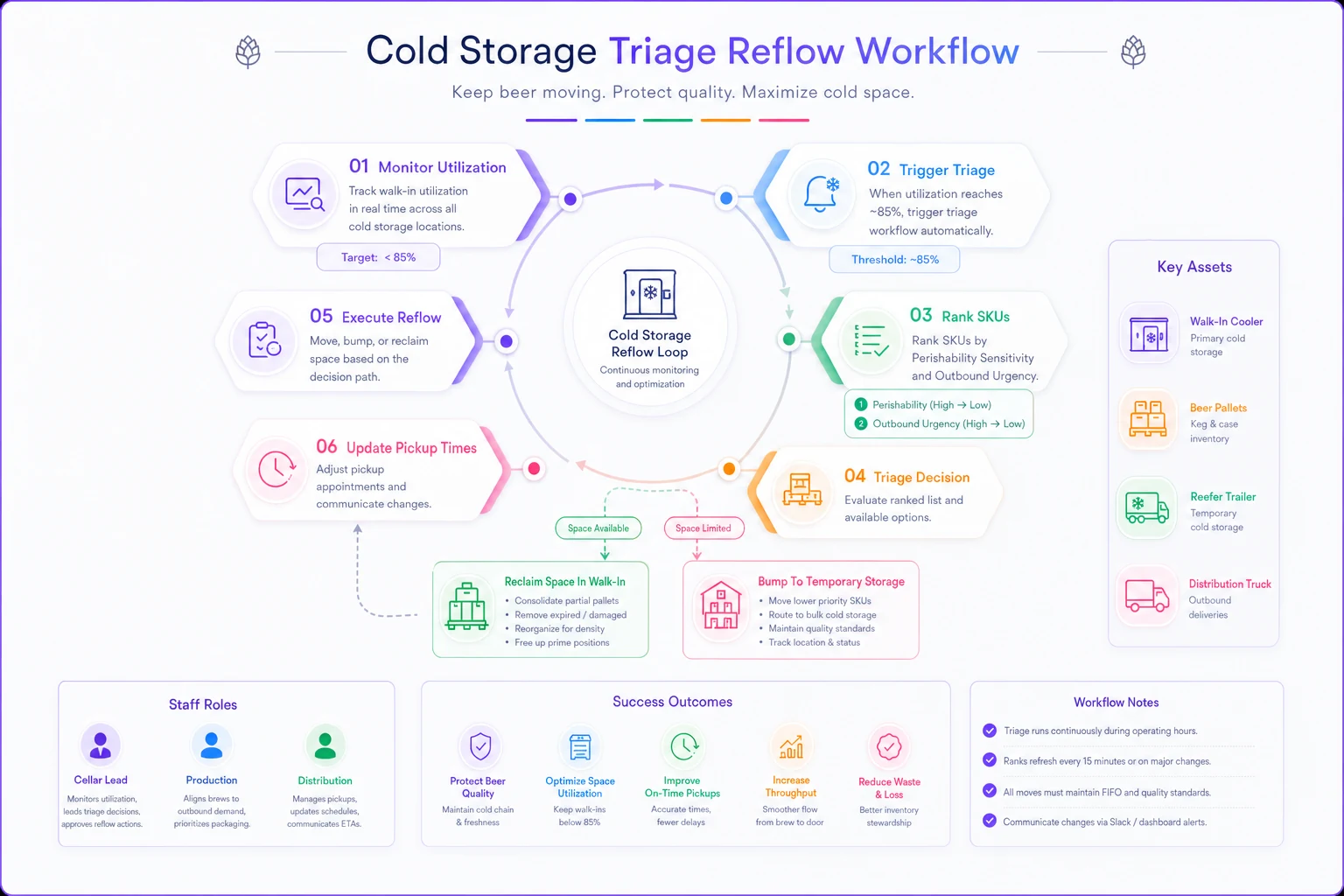
Use this as a simple guide for who does what during a reflow.
The temporary-storage checklist: rental units and dry ice
When triage and reflow still leave you short, you need temporary capacity. Two main options for short bursts: a rental refrigerated unit (reefer trailer or cold container) and dry ice to buffer existing or makeshift space. They solve different problems and the wrong choice wastes money fast.
A rental reefer makes sense when you need real, controlled cold storage for several days and you have forklift access and a power drop (or a genset-equipped unit). A dry ice buffer makes sense when you need to hold a limited amount of beer cold for a short window — overnight, a day or two — and renting a whole trailer is overkill.
Before committing to either, run through this checklist:
-
Volume honestly estimated. Count pallets or cases, don't eyeball. "We'll need a bit of space" turns into a half-empty $400/day trailer or not nearly enough dry ice.
-
Duration in days, not "a few days." Reefer rentals price by day and often have minimums. Dry ice sublimates — you'll resupply roughly every 24 hours, so a 4-day hold means 4 buys.
-
Power and placement confirmed. For a reefer
is there a drop, or do you need a diesel genset unit? Where does it park without blocking your loading dock or the beer you're actively shipping?
-
Access and material handling. Can a pallet jack or forklift reach it? A trailer at dock height is useless if you've only got a floor-level jack.
-
Temperature target and monitoring. Set the reefer to your actual target (not just "cold") and drop a logging thermometer inside. Dry ice can over-chill and freeze beer — keep product off direct contact and monitor.
-
Dry ice handling safety. Ventilation matters — CO₂ displaces oxygen in enclosed spaces. Never seal dry ice in a walk-in with people working inside without airflow. Gloves on, and no sealed airtight containers that can burst.
-
Cost ceiling decided in advance. Know your walk-away number before you call the rental company during a crunch. Panic pricing is real.
Check dock access and forklift reach before booking a reefer; an inaccessible trailer is functionally useless.
A quick sense of the economics, because this is where breweries get surprised: a refrigerated trailer rental often runs somewhere in the range of $150–$400 a day plus delivery and fuel, depending on market and size. Dry ice runs roughly $1–$3 per pound, and buffering a modest amount of beer overnight might take 50–100 lbs — so somewhere in the $75–$250 range a night, repeated daily. For a one-night hold of a dozen pallets, dry ice can be cheaper. For a 4–5 day peak window with real volume, the reefer almost always wins and is far less stressful to manage.
Trucking alignment: the step that makes or breaks all of it
Everything above assumes beer actually leaves on schedule. The single biggest lever on cold storage pressure isn't more storage — it's getting beer out on time, because every pallet that ships on schedule is cold space you get back.
The alignment problem usually looks like this: production and packaging are tracking tank-and-case timing, distribution is tracking pickups, and the two calendars don't talk. Beer finishes packaging Tuesday, but the truck isn't scheduled until Friday, so three days of walk-in space gets eaten for no reason other than scheduling drift.
A few concrete steps to tighten it during peak weeks:
-
Share a single peak-week outbound schedule across production, cellar, and whoever books trucks — one view, updated as things change, not three separate spreadsheets.
-
Confirm pickup times, not just days, by the morning of. "Thursday" is useless for reflow. "Thursday 7am" lets you stage and reclaim space on a real timeline.
-
Pre-stage outbound pallets the night before near the dock, which frees interior walk-in slots and speeds loading. Just make sure staged Tier 1 beer stays cold — pre-staged pallets warming for hours before a truck shows is a common and avoidable problem.
-
Build in a self-distribution fallback for overflow. If a distributor pickup slips and you've got cold space held hostage, a short run in your own refrigerated vehicle to clear 20–30 cases can be cheaper than holding capacity another two days during peak.
-
Flag at-risk shipments 24 hours out. If a pickup looks shaky, you want to know the day before so reflow rule #4 can kick in early, not the morning it was supposed to leave.
The broader thinking on matching production timing to delivery capacity is in the perishable-inventory strategy for breweries — worth reading if you keep finding cold space tied up by beer that should've already left.
A real scenario: the hazy release that nearly cooked itself
A small production brewery — around 4,500 bbl a year, single walk-in, self-distributing plus two wholesale accounts — ran a seasonal hazy IPA release the same week two distributor POs came due. Normal walk-in utilization sat around 65%. During the release week, inbound packaged beer plus the undelivered distributor orders pushed it to a hard 100% by Wednesday, with cases stacked in the aisle blocking the brite tank.
The specific failure: they'd held cold space for a distributor pickup that slipped from Wednesday to the following Monday — five extra days reserved for beer that wasn't leaving — while roughly 50 cases of fresh hazy had nowhere cold to go and sat near ambient for most of a day.
The fix wasn't complicated, just applied late. They reflowed the delayed PO out of urgent status, reclaiming those cold slots. Barrel-aged and high-ABV stock moved to a corner of ambient storage since it tolerated the conditions fine. Then they brought in dry ice overnight for about $180 to buffer the hazy until the next morning's self-distribution run cleared enough space. Total improvised cost under $250 — versus the alternative, which was a full day of warm dry-hopped IPA they'd likely have sold at a discount or dumped, easily several hundred dollars of beer plus the brand hit.
The real lesson: they had the capacity all along. It was locked up by a shipment that had already slipped and never got re-ranked. A reflow rule and a $180 dry-ice buffer would've prevented the whole scramble if either had been in place before the week started.
When temporary storage is the wrong move
When it makes sense: a true seasonal spike of 3–5 days, a delayed pickup you can't move, a one-off festival run that temporarily doubles finished inventory.
When it's a bad idea: if you're renting a reefer multiple times a year, every peak, that's not a triage problem — that's a sizing problem. The money spent on repeat rentals usually points better at permanent capacity or fixing outbound scheduling. And if beer is piling up because sales aren't moving it, no amount of cold storage fixes demand. You're just paying to keep slow beer cold.
Who should skip most of this: very small breweries that almost never cross ~85% utilization. Build the triage matrix and the reflow rules — they cost nothing and save you on the rare bad day — but don't over-invest in standing temporary-storage relationships you'll use once every two years.
Bringing it together
Cold storage triage during peak weeks comes down to three disciplines that most breweries only improvise under pressure: a matrix that ranks what earns cold space by sensitivity and ship urgency, reflow rules that let the floor re-rank space in minutes without escalating, and a temporary-storage checklist that keeps a panic reefer rental from becoming a panic reefer bill.
None of it requires new equipment. It requires deciding the rules before the week that breaks your walk-in, so that when a tank finishes early and a pickup slips on the same afternoon, the next call is obvious instead of frantic. The breweries that handle peak weeks calmly aren't the ones with the biggest walk-ins — they're the ones who stopped holding cold space hostage for shipments that already slipped, and who knew exactly which 50 cases to protect when the room filled up.
None of it requires new equipment. It requires deciding the rules before the week that breaks your walk-in, so that when a tank finishes early and a pickup slips on the same afternoon, the next call is obvious instead of frantic. The breweries that handle peak weeks calmly aren't the ones with the biggest walk-ins — they're the ones who stopped holding cold space hostage for shipments that already slipped, and who knew exactly which 50 cases to protect when the room filled up.
Ready to elevate your brewery operations?
Join 500+ craft breweries using Beeryly to increase production efficiency, reduce waste, and grow sales.