

Most breweries don't fail at digitization because they picked the wrong software. They fail because nobody actually owns the system after the vendor's onboarding calls end. The inventory tool goes live, everyone's excited for about three weeks, and then the head brewer gets slammed during a double batch week, stops updating counts, and within two months the digital inventory and the physical inventory have quietly divorced. The software still works fine. The governance around it collapsed.
This is the part almost nobody plans for. You spend weeks evaluating vendors and migrating data, then treat the "who keeps this accurate and who's allowed to change what" question as an afterthought. Governance isn't paperwork — it's the difference between a system that gets more valuable every quarter and one that becomes the thing everybody works around while a shadow spreadsheet quietly takes over.
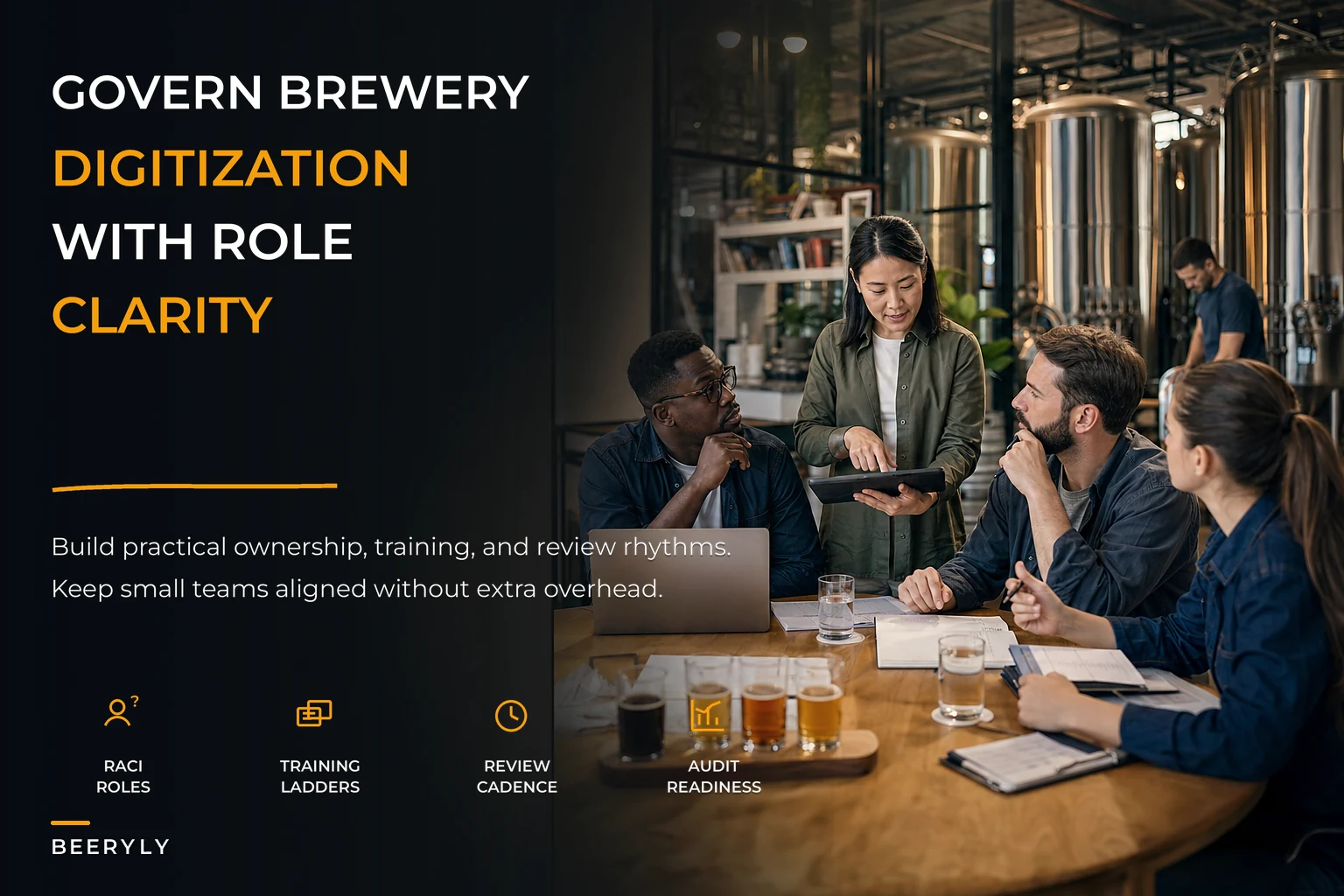
So this article is about the human operating layer: who's responsible for what, how people level up their skills over time, and the recurring routine that keeps your digitized operations honest. RACI matrices, a competency ladder, training agendas, and a governance cadence you can actually run without hiring a project manager.
The failure pattern: brewery digitization governance breaks at three predictable seams
Before the fix, it helps to understand where things actually snap. Across small and mid-sized breweries, the same three seams tear open again and again.
Seam one: the ownership gap. Software gets rolled out with a "we'll all keep it updated" mentality. When everyone owns it, no one does. Nobody's specifically accountable for whether the finished-goods count in the system matches the cooler, so when they diverge — and they always do — there's no clear person whose job it is to notice and fix it.
Seam two: the skill cliff. The one person who really understands the system leaves, goes on vacation, or gets promoted. Suddenly nobody can generate the production variance report or knows why the lab results aren't syncing. You didn't build depth. You built a single point of failure with a login.
Seam three: no feedback loop. The system drifts and nobody catches it until something expensive happens — a wrong lot ships, a keg gets double-billed, a QC hold gets missed. There's no scheduled moment where someone checks whether the data still reflects reality.
The common thread: these are all people-and-process problems, not software problems. You can't buy your way out of them. You have to design for them.
A brewery-scaled RACI: who actually owns what
RACI stands for Responsible, Accountable, Consulted, Informed. The one rule people forget: there can only be one "Accountable" per row. Responsible can be shared. Accountable cannot. The moment two people are accountable for inventory accuracy, zero people are.
Take control of your brewery’s workflow.
Beeryly helps you schedule batches, track inventory, and monitor sales with ease.
- Production timeline management
- Inventory tracking & alerts
- Sales & distribution monitoring
No credit card required
| Task / Decision | Owner (Accountable) | Responsible | Consulted | Informed |
|---|---|---|---|---|
| Daily finished-goods count accuracy | Cellar/Packaging Lead | Shift crew | Inventory Coordinator | Ops Manager |
| Raw material receiving & lot entry | Inventory Coordinator | Receiving crew | Purchasing | Head Brewer |
| Lab/QC result entry & holds | QC Lead | Lab tech | Head Brewer | Ops Manager |
| Batch/recipe data changes | Head Brewer | Brewers | QC Lead | Ops Manager |
| System user access & permissions | Ops Manager | IT/admin contact | Owner | All leads |
| Data validation rule changes | Ops Manager | Inventory Coordinator | Head Brewer, QC Lead | Owner |
| Monthly reconciliation sign-off | Ops Manager | Domain leads | Bookkeeper | Owner |
| Vendor/integration issues | Ops Manager | IT/admin contact | Affected lead | Owner |
The insight most breweries miss: the "Accountable" column should almost never be the owner or GM for daily operational tasks. If the owner is accountable for daily count accuracy, that's a sign the system has no real operational owner. Push accountability down to the person closest to the work. Keep the owner accountable for the governance routine itself, not the daily data.
If you haven't already defined named owners and validation rules for your records, this RACI won't stick. It's worth reading the deeper breakdown on brewery data governance and audit-ready record lifecycles alongside this, because the RACI is essentially the staffing layer on top of that record model.
The competency ladder: how people level up so the system doesn't depend on one hero
The RACI tells you who's accountable today. The competency ladder is how you make sure you're never one resignation away from losing your only capable operator. It defines skill levels for each domain so people can progress, cross-train, and cover for each other.
Inventory competency ladder
-
Level 1 – Basic user. Can log counts, scan/receive against a PO, and find a SKU. Knows the difference between a hold and available stock. Cannot change anything structural.
-
Level 2 – Confident operator. Runs daily reconciliation, spots and flags variances, handles lot assignment correctly, and understands why counts drift. Can train a Level 1.
-
Level 3 – Domain owner. Owns accuracy for their area, configures locations/bins, sets and reviews par levels, and investigates root causes of recurring variance. This is your "Accountable" person on the RACI.
-
Level 4 – System steward. Understands how inventory connects to purchasing, production, and the P&L. Can propose validation rule changes, evaluate vendor updates, and design training for lower levels.
One pattern worth stealing: require Level 3 people to be able to train Level 1 people as a condition of being Level 3. If someone can't teach it, they don't fully own it. This single rule quietly builds redundancy into your team, because every domain owner ends up producing their own backup as part of the job.
A realistic staffing target for a growing brewery: aim for at least two people at Level 2 or above per domain. You want no domain where losing one person drops you to zero capability. That's the whole point of the ladder — it turns tribal knowledge into a distributed capability you can actually rely on.
When a formal ladder makes sense — and when it's overkill
If you're a 5-person brewery where everyone does everything, a four-rung ladder per domain is theater. What you actually need is a simple cross-training checklist so at least two people can handle each critical task. The formal structure starts paying off around the point where you have distinct roles — usually somewhere past 3,000–4,000 barrels or when you're running 8–12 production and packaging staff. Below that, keep it lightweight. Above that, the ladder prevents the skill cliff from quietly taking you down.
Sample training agendas that don't waste a shift
The most common training mistake breweries make: a single marathon "here's the whole system" session on go-live day. People retain almost none of it because they're overwhelmed and there's no operational context yet. Better to run short, role-specific sessions spread over the first few weeks, then repeat the core ones quarterly for new hires and refreshers.
Session A — Inventory basics (Level 1 target, 45 min)
-
The physical-to-digital loop
why what you scan has to match what's on the rack (10 min)
-
Receiving against a PO, live demo, then each person does one (15 min)
-
Logging a count and reading available vs. held stock (10 min)
-
The three most common mistakes and how to avoid them (10 min)
Session B — Lab/QC entry and holds (Level 1–2 target, 50 min)
-
Where results live and why timing matters — a late entry can hold a shipment (10 min)
-
Entering a result and placing/releasing a hold, hands-on (20 min)
-
What happens downstream when a hold is missed (10 min)
-
Escalation
who to tell when a result is out of spec (10 min)
Session C — Reconciliation & variance (Level 2–3 target, 60 min)
-
Running the daily/weekly reconciliation report (15 min)
-
Reading variance
what's normal drift vs. what's a red flag (15 min)
-
Root-cause walkthrough on two real variances from last month (20 min)
-
How to document a fix so the next person understands it (10 min)
What makes training actually stick isn't the agenda — it's that people practice on your system with your data, not a demo environment. Every session should end with the trainee doing the task unassisted while you watch. Watching a demo builds zero muscle memory. Doing it once builds a little.
The 6-step governance routine: three cadences that keep everything honest
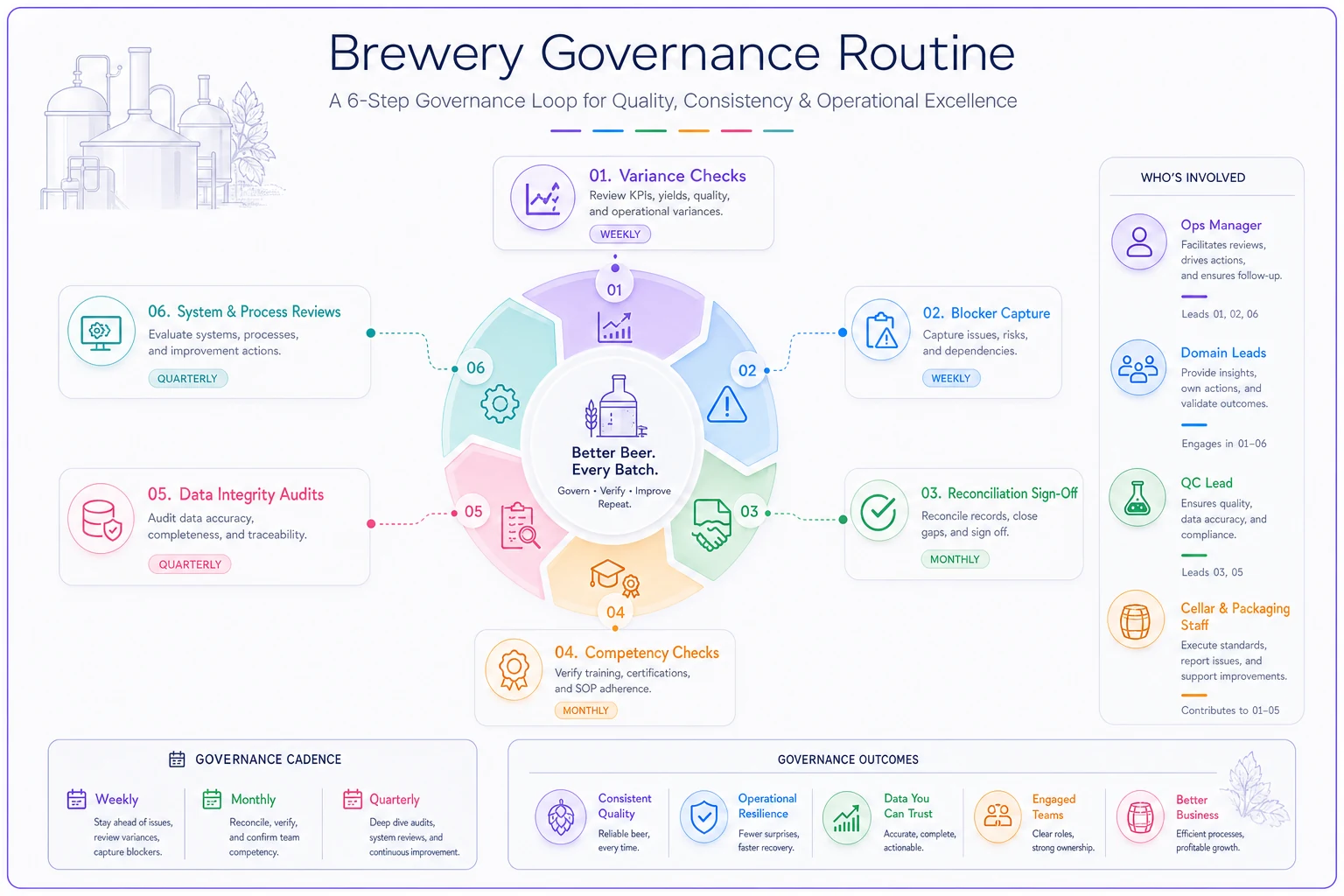
This is the engine. Governance isn't a document you write once; it's a recurring rhythm. Three cadences, six steps, no full-time PM required.
Weekly — the "Ops 15" (15 minutes, standing, same time every week)
-
Variance check. Each domain lead states their biggest inventory or lab discrepancy from the past week and whether it's resolved. No discussion of solutions here — just surface and assign.
-
Blockers. Anything preventing accurate data entry? A broken scanner, a confusing field, a workflow that doesn't match reality. Capture it, assign an owner.
That's it. Fifteen minutes. The discipline is keeping it to 15 — the moment it turns into an hour-long production meeting, people start skipping it. Its only job is early detection.
Monthly — the review (45–60 minutes)
-
Reconciliation sign-off. The Ops Manager confirms the monthly inventory-to-records reconciliation is done and signed. Any material variance gets a documented root cause.
-
Competency & coverage check. Quick look at the ladder
any domain now sitting at single-person coverage? Anyone ready to move up a rung? Schedule the training if so.
Quarterly — the audit (half a day)
-
Data integrity audit. Pull a sample — 15–20 lots or SKUs — and physically verify them against the system. Check that validation rules are still catching bad entries. Confirm user permissions still match roles (people change jobs; access rarely gets cleaned up automatically).
-
System & process review. What's drifted? Which workarounds have people quietly adopted? Which vendor updates need evaluating? This is where you decide whether a validation rule needs changing or a process needs re-documenting.
Here's a simple visualization of that routine.
Keep the Ops 15 to 15 minutes — if it stretches, people start skipping it.
Most brewery data problems are cheap to fix weekly and expensive to fix quarterly. A count drift caught in the Ops 15 is a two-minute correction. That same drift discovered in a quarterly audit means three months of downstream reports were slightly wrong, and now you're untangling which COGS numbers to trust. The weekly cadence exists purely to keep small problems small.
A short real scenario
A roughly 6,000-barrel brewery in the Midwest rolled out inventory and lab software but skipped the governance layer entirely. Within about four months, their finished-goods accuracy had drifted enough that monthly reconciliation was showing variances in the 6–9% range — enough that they stopped trusting the system for purchasing decisions and went back to a spreadsheet the cellar lead was maintaining on the side.
The fix wasn't new software. They assigned single-owner accountability using a RACI, put two people per domain on a basic competency ladder, and started running the Ops 15 every Monday. Within two quarters, reconciliation variance settled into the 1–2% range, the shadow spreadsheet disappeared, and — the part they didn't anticipate — purchasing stopped over-ordering "just in case" because they finally trusted their own numbers. That freed up a noticeable chunk of working capital.
Nothing about that outcome came from a feature. It came from someone being clearly accountable and a routine that caught drift before it compounded.
Where software fits — and where it doesn't
Good operational software makes governance easier by handling the parts humans are bad at: enforcing validation rules at the point of entry, logging who changed what and when, flagging variances automatically instead of waiting for someone to notice, and generating the reconciliation reports your monthly review depends on. When your platform can automatically surface the biggest variance of the week for your Ops 15, the meeting basically runs itself.
But software cannot decide who's accountable, cannot train your people, and cannot run your weekly rhythm for you. The tool is the enforcement layer on top of a governance model you design. Breweries that expect the software to supply the discipline are the ones back on spreadsheets within a quarter. The ones that treat software as the automation layer under a clear RACI and cadence are the ones whose data actually gets more reliable over time.
If you're still in the rollout phase, the governance model above pairs directly with the implementation sequence — worth walking through the 30/60/90-day implementation checklist and slotting the RACI and Ops 15 in at the 60-day mark, not as something you bolt on later.
Who should skip most of this
If you're a very small brewery — a couple of people, one production line, everyone within earshot — a full RACI and four-rung ladder will slow you down more than it helps. You still need the core idea: at least two people who can do each critical task, and some recurring moment where someone checks that the numbers match reality. But formalize it lightly. Governance overhead should scale with headcount and complexity, not with ambition.
The threshold to watch for is when you start hearing "I didn't know I was supposed to update that" or "only Dave knows how to run that report." Those two sentences are the signal that your operation has outgrown informal coordination. That's when the RACI, the ladder, and the three cadences stop being bureaucracy and start being the thing that lets you scale without everything running through one overloaded person's head.
Bringing it together
Digitizing a brewery is really two projects wearing one budget line. The first is the software — vendors, migration, features. The second, quieter one is the human operating system: who owns what, how people build and share skill, and the routine that keeps data honest as you grow. Almost everyone funds the first and neglects the second, then wonders why the shiny new system quietly rotted into another spreadsheet.
Start small. Assign one accountable owner per domain this week. Draft a two-page competency ladder for your most-used system. Put a 15-minute standing meeting on the calendar. Those three moves cost nothing and prevent the exact failures that sink most rollouts. The software you already picked is probably fine. What it's been missing is the governance layer that makes it trustworthy — and that part has always been yours to build.
Ready to elevate your brewery operations?
Join 500+ craft breweries using Beeryly to increase production efficiency, reduce waste, and grow sales.