

A minimal data model is a great start. But most breweries hit the same wall a few months after building one: the numbers exist, they're just not reliable. Someone logged a gravity reading in Plato when the tank sheet uses Brix. Two people entered the same batch under slightly different names. A packaging run got recorded a day late, so your inventory said you had 40 cases that physically weren't there yet.
None of these are dramatic failures. That's exactly why they're dangerous. They don't crash anything — they just quietly erode trust until people stop believing the data and go back to asking each other across the floor. Which is where you started.
Governance is the boring layer that keeps a shared data model honest. Not a compliance binder, not a policy nobody reads. In a brewery, good brewery data governance is really just four practical questions answered clearly: who owns each piece of data, what does a valid entry look like, how long does a record stay open before it's locked, and can you reconstruct who changed what. If you already built a minimal data model for your brewery, this is the part that makes it survive contact with a real production week.
Why shared data breaks without owners
The moment more than one person writes to the same record, you have a coordination problem. It's rarely obvious at first because in a small brewery everyone kind of knows everything. The head brewer remembers which batch is which. The cellar person has the tank map in their head. Data quality feels fine because human memory is filling the gaps.
Then you hire your fourth or fifth person, or add a second shift, or the head brewer takes a week off. Suddenly the memory layer is gone and all you have is what's actually written down. That's when you find out how much your "data" was really just tribal knowledge with a spreadsheet stapled to it.
The pattern across breweries is consistent — data doesn't fail because people are careless. It fails because nobody in particular is responsible for a given field. When everyone can edit the fermentation log but no one owns it, three things tend to happen:
-
Fields get filled in inconsistently because there's no single interpretation of "correct"
-
Nobody cleans up bad entries because it's not clearly their job
-
When a number looks wrong, there's no one to ask, so it just sits there being wrong
Ownership fixes this not by adding bureaucracy but by removing ambiguity. Every important field has exactly one domain that owns its definition and quality. Other people can read it, reference it, even enter it — but one team is accountable for whether it's right.
Named owners by domain
The cleanest way to assign ownership in a brewery is by physical domain, because your teams already organize around it. Cellar, packaging, lab, and sales aren't abstract categories — they're where different people spend their day and where the data actually originates.
Take control of your brewery’s workflow.
Beeryly helps you schedule batches, track inventory, and monitor sales with ease.
- Production timeline management
- Inventory tracking & alerts
- Sales & distribution monitoring
No credit card required
Here's a practical starting split. Adjust it to your org, but keep the principle: one owner per data domain, no overlaps.
| Data domain | Owner | Example fields owned | Who else reads it |
|---|---|---|---|
| Cellar / fermentation | Cellar lead | Batch ID, tank assignment, gravity readings, temp logs, transfer dates | Lab, packaging, brewer |
| Packaging | Packaging lead | Run date, package format, case/keg counts, lot codes applied, yield | Sales, inventory, cellar |
| Lab / QC | QC lead | DO readings, pH, micro results, sensory pass/fail, release approval | Cellar, packaging, ops |
| Sales / distribution | Sales manager | Customer records, order quantities, deposit tracking, delivery status | Packaging, finance |
The important nuance here is that a field has one owner even when multiple people touch the batch. Take lot codes as an example. The cellar creates the batch, but the lot code applied at packaging is packaging's field — because that's the moment it becomes real and traceable. If both teams think they own it, you get two lot codes for one product, which is a genuine problem when a traceability issue shows up and you need clean lineage.
A useful test: for any field, if someone asks "why does this say what it says?", you should be able to name one person who can answer without checking with anyone else. If you can't, that field has no owner.
The mistake people make with ownership
The common error is confusing who enters the data with who owns it. A brewer might type in a gravity reading, but if the cellar lead owns fermentation data, the cellar lead is accountable for making sure gravity gets logged in the right units, at the right cadence, with corrections when something's wrong. Entry is a task. Ownership is a standard. Mix them up and you've assigned accountability to whoever happened to be holding the tablet — which is effectively nobody.
Validation rules that catch the common brewery mistakes
Ownership tells you who's responsible. Validation rules stop the most common bad entries before they ever get saved. You don't need a hundred rules. Fifteen well-chosen ones will catch the vast majority of the garbage.
The mistakes worth catching are boringly predictable:
-
Gravity readings entered in the wrong unit (Plato vs Brix vs SG)
-
Batch IDs that don't match your naming format
-
Package counts that are physically impossible — negative, or wildly higher than tank volume allows
-
Dates out of order — a packaging date before the brew date
-
Micro results left blank on a batch that got released
-
Temperatures outside any plausible range, usually from a fat-fingered decimal
Lightweight validation means each field has a small set of rules attached to it. Not complex logic — just guardrails:
-
Type and range checks. Gravity must be a number within a believable window. Temperature can't be 450°F. Case counts can't be negative.
-
Format checks. Batch IDs follow one pattern, e.g.
2024-IPA-014. Anything that doesn't match gets flagged at entry, not discovered three weeks later. -
Cross-field logic. Packaging date must come after transfer date. A batch marked "released" must have a QC approval attached.
-
Required-before-close. Certain fields can't be empty when a record moves to the next stage — no releasing a batch without a micro result on file.
The reason to enforce these at entry rather than in cleanup is simple: a bad number that gets saved doesn't just sit there quietly. It flows downstream. A wrong yield figure corrupts your cost-per-barrel. A mislogged case count throws off inventory, which throws off what sales promises customers. Your operational KPIs quietly go wrong because they're calculated on top of data that was never validated.
This is one place where operational software earns its keep. A shared platform with validation rules built into the entry forms means those rules get applied every time, by every person, without anyone having to remember them. AI-assisted entry can also flag the suspicious-but-not-impossible stuff — a gravity reading that's technically in range but way off the trend for that style — which rigid rules miss and humans usually catch too late.
When strict validation becomes a bad idea
Worth saying plainly: you can over-govern. If your validation rules are so tight that people can't log a legitimate edge case — a weird experimental batch, an unusual package format, a one-off collaboration brew — they'll route around the system entirely. They'll keep a side spreadsheet, and now you've got shadow data, which is worse than loose data because you don't even know it exists.
Keep validation strict on fields that feed downstream decisions (counts, dates, release status) and lenient on descriptive fields where flexibility matters. Rules should prevent errors, not prevent work.
Short record lifecycles: open, verify, lock
This is the piece most breweries skip entirely, and it's the one that separates data you can audit from data you just hope is right.
Every record needs a lifecycle. A fermentation log or a packaging run isn't "true" the moment it's created — it's in progress. Readings get added, corrections get made, someone realizes they logged the wrong tank. That's normal. The problem is when records stay editable forever. If anyone can change last month's packaging run today, then no number is ever final, and no audit is ever trustworthy.
Short lifecycles fix this with three states:
-
Open the record is active, edits are expected and unrestricted. A batch mid-fermentation lives here.
-
Verify the batch is done, the owner reviews the record, confirms required fields are complete and sane, and signs off. Edits still possible but now they're deliberate.
-
Locked the record is closed. No more edits — corrections after this point require a documented amendment, not a silent overwrite.
The word "short" matters. A record that sits in "open" for six weeks is a record accumulating errors. A reasonable rule of thumb: a batch record should move to verify within a day or two of the batch physically completing, and lock within a week. The tighter the window between the event and the lock, the more accurate the record, because people actually remember what happened.
In practice, this works best when you tie lifecycle transitions to physical events rather than calendar reminders. Packaging finishes a run — that's the trigger to verify the run record. Lab releases a batch — that's the trigger to lock the QC record. Tie it to the floor, not to a Friday reminder, and it actually happens.
Tie lifecycle transitions to physical events on the floor rather than calendar reminders.
Here's a simple workflow illustration.
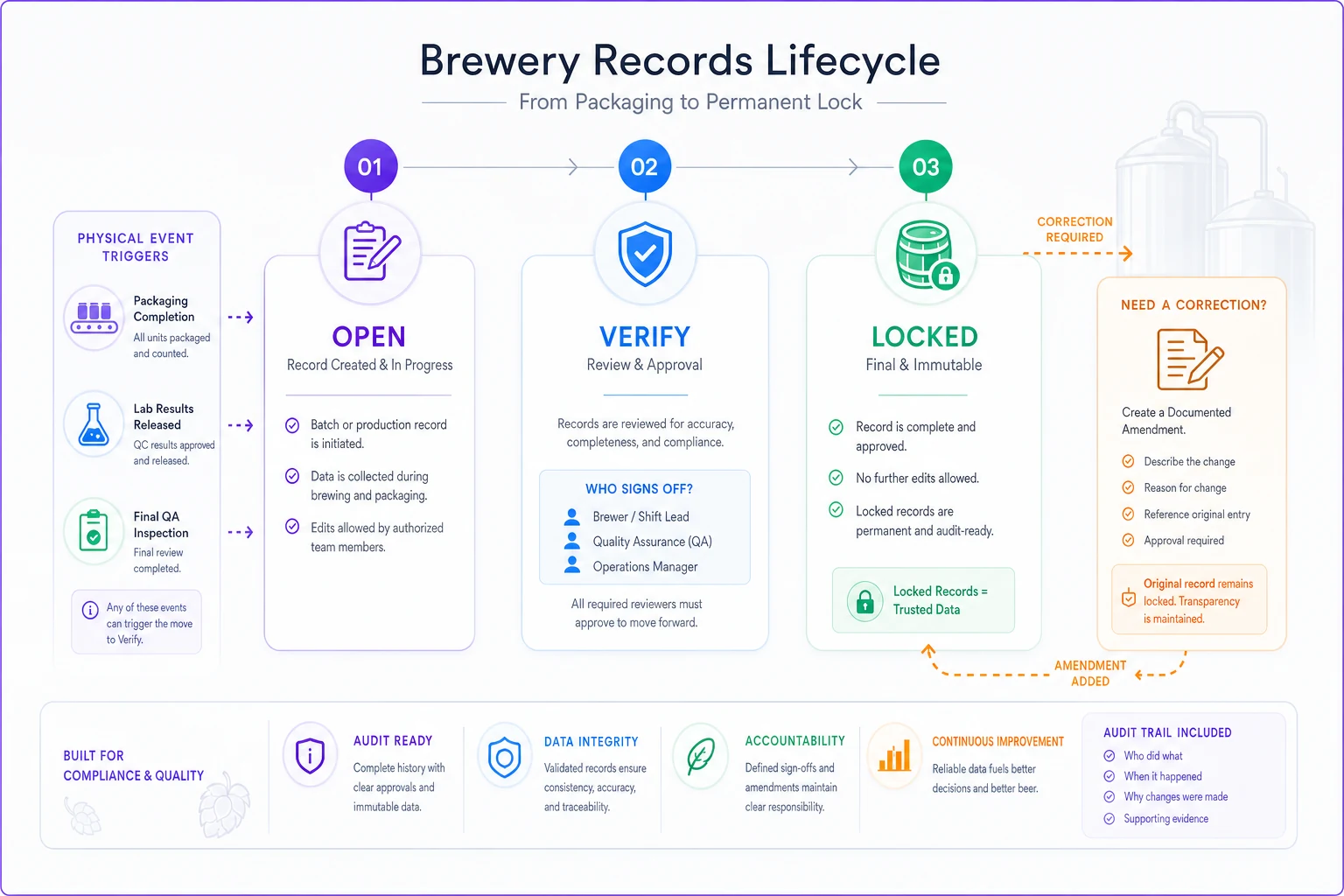
Tie lifecycle transitions to the floor, and you'll see the record move quickly from fuzzy to reliable.
Small-team audit trails without the enterprise overhead
The phrase "audit trail" makes small brewery owners nervous because it sounds like something built for a company with a compliance department. You don't need that. You need to be able to answer one question when a number looks wrong or a customer disputes a delivery: who entered or changed this, and when?
That's it. A usable audit trail for a small team captures four things per change: what field, old value, new value, who changed it and when. That's enough to reconstruct almost any dispute and enough to satisfy a recall investigator without scrambling.
Without a change history, every disagreement becomes a memory contest. Sales says the order was for 30 cases, packaging says the record always said 24. With no trail, you're guessing. With a trail, you look at who changed the number and when, and the conversation takes ten seconds.
Manual audit trails don't work — nobody logs their own edits by hand. This has to be automatic, which is the honest case for using a shared operational platform rather than spreadsheets. When the system records every change as it happens, the audit trail builds itself. AI automation can also surface patterns worth noticing — the same field getting corrected repeatedly, or entries consistently made hours after the fact — which usually points to a broken process, not a careless person.
A real scenario
A production-focused brewery doing around 5,000 barrels a year — six people — had built a decent shared spreadsheet for batch and packaging data. On paper it looked organized. In practice, roughly one in eight batches had a data discrepancy someone had to chase down: a mismatched lot code, a case count that didn't reconcile with inventory, a gravity reading nobody could explain.
They weren't losing product, but they were losing time. The head brewer estimated four to six hours a week just reconciling what the sheet said against what was physically on the floor. And twice that year they'd shipped orders with case counts that didn't match the invoice, which meant awkward credit-back conversations with accounts.
The fix wasn't more software features. It was governance. They assigned clear domain owners, added about a dozen validation rules on the fields that mattered — unit-checked gravity, format-checked batch IDs, required micro result before release, packaging date after transfer date — and set a hard rule that batch records lock within five days.
The reconciliation time dropped to under an hour a week within a couple months. Not because the data was magically perfect, but because bad entries got caught at the source and locked records stopped drifting. Invoice mismatches basically stopped, because packaging counts were validated and owned. The head brewer's line was that the data finally felt like something you could plan against instead of something you had to double-check.
Who should hold off on this
Not every brewery needs formal governance yet. If you're one or two people running a handful of batches, the memory layer still works and adding lifecycle states and ownership rules is overhead you'll resent. Governance earns its cost when you have enough people that no single person sees all the data anymore — usually around four to six employees, or when you add a second shift, or when you start distributing seriously and errors become customer-facing.
The other trap is building governance before you have a data model to govern. Ownership and validation sit on top of a shared, minimal data model. If your records are still scattered across five spreadsheets and a whiteboard, sort that out first. Governance on top of chaos just makes the chaos more formal.
Bringing it together
The four pieces reinforce each other, and that's the point. Named owners make it clear who's accountable for quality. Validation rules stop predictable errors before they spread. Short lifecycles keep records accurate and eventually final. Audit trails make the whole thing defensible when something's disputed or a regulator asks.
Miss one and the others weaken. Ownership without validation means owners are constantly cleaning up. Validation without lifecycles means clean data slowly rots as people edit old records. Lifecycles without audit trails mean you can't explain why a locked record says what it says.
None of this is glamorous, and none of it shows up in a tasting review. But it's the difference between a data model that looks organized and one your whole team actually trusts enough to make decisions on. Build the ownership map first, add the handful of validation rules that catch your real mistakes, tie your lifecycle locks to physical events on the floor, and let the audit trail run itself. That's governance that fits a brewery instead of fighting it.
Ready to elevate your brewery operations?
Join 500+ craft breweries using Beeryly to increase production efficiency, reduce waste, and grow sales.