



Your keg fleet probably looks like a battlefield. Some kegs are pristine, barely showing their age. Others have dents deep enough to hide a golf ball, handles bent at weird angles, and valve threads so damaged you need a pipe wrench just to connect them. Most breweries just keep patching them up until they literally can't hold beer anymore.
Most operations have zero actual policy for when a keg should get refurbished versus scrapped. They're either fixing kegs that should've been recycled two years ago, or they're tossing containers with five more years of profitable life left in them.
Your deposit structure might actually be encouraging distributors to abuse your kegs. Standard deposits of $30-50 barely cover replacement costs anymore, and definitely don't incentivize proper handling. Meanwhile, you're spending thousands on unnecessary refurbishments because nobody's tracking the actual economics of keg lifecycle management.
The Hidden Math of Keg Refurbishment Economics
A stainless half-barrel keg costs somewhere between $150-180 new these days. Basic refurbishment (new valve, handle replacement, pressure testing) runs about $35-45. Major refurbishment with body work pushes $65-85. Those numbers seem straightforward until you realize most breweries never calculate the break-even points.
Production notices a keg leaking during fill. They pull it aside, send it for valve replacement. Three months later, same keg needs handle repair. Six months after that, the chime's damaged. Each time, maintenance approves the fix because "it's cheaper than buying new." Except nobody's tracking cumulative repair costs per asset.
The economics shift dramatically based on keg age and condition history. A five-year-old keg with its first major issue? Obviously worth fixing. But that same repair on a twelve-year-old keg with three previous refurbishments becomes questionable. The decision point isn't just repair cost versus replacement cost—it's about expected remaining lifespan and future repair probability.
Container condition degrades non-linearly. Once structural issues start (dented chimes, weakened welds, severe body damage), failure rates accelerate. A keg that needs major work at year eight probably won't make it to year fifteen without multiple additional repairs. Meanwhile, a well-maintained keg can easily hit twenty years with just routine valve replacements.
Why Standard Deposit Structures Actually Encourage Keg Abuse
Most craft breweries set keg deposits between $30-50, basically unchanged since 2010. Problem is, replacement costs have nearly doubled while deposits stayed flat. This creates a perverse incentive where distributors and accounts treat kegs as semi-disposable.
Take control of your brewery’s workflow.
Beeryly helps you schedule batches, track inventory, and monitor sales with ease.
- Production timeline management
- Inventory tracking & alerts
- Sales & distribution monitoring
No credit card required
Consider the distributor's perspective. They're holding thousands in keg deposits across dozens of brewery partners. When a keg gets damaged during delivery or sits outside a bar for six months getting destroyed by weather, the financial hit for losing that deposit barely registers. Cheaper to forfeit $40 than implement proper keg handling protocols.
The damage patterns tell the story. Kegs coming back from certain distributors consistently show forklift damage at the same height—clear evidence of systematic mishandling during warehouse operations. Others return with chemical residue suggesting improper storage near corrosives. These aren't random accidents; they're predictable outcomes of deposit structures that don't create real accountability.
Some breweries tried raising deposits to $75-100, but discovered another problem: cash flow pressure on smaller accounts. Suddenly bars need $5,000 tied up in keg deposits, which kills relationships with emerging venues. The solution isn't just higher deposits—it's tiered structures based on account history and volume.
Building a Refurbishment Decision Matrix That Actually Works
Forget generic "repair if under X dollars" policies. Real keg refurbishment economics require evaluating multiple variables simultaneously. Age, repair history, damage type, and expected remaining life all factor into the calculation.
Years 0-5: Repair anything under 60% of replacement cost Years 6-10: Repair if under 40% of replacement cost Years 11-15: Repair if under 25% of replacement cost Years 15+: Only routine valve maintenance, scrap if structural damage
Age alone doesn't capture the full picture. Cumulative repair costs matter more. Once total lifetime repairs exceed 50% of replacement cost, future refurbishments rarely make sense. The probability of additional failures increases exponentially after multiple major repairs.
Damage type creates another decision layer. Valve issues on otherwise solid kegs? Almost always worth fixing. Chime damage affecting stacking stability? Depends on severity and age. Body dents near bottom? Often indicates dropping damage that weakened the entire structure—high probability of future issues.
Track cumulative repair costs per keg so decisions consider total lifetime investment, not just the immediate repair.
The evaluation process needs to capture several key factors. Original purchase price and date matter for age calculations. All previous repair dates and costs show cumulative investment. Current damage assessment and repair quotes provide immediate decision inputs. Expected remaining lifespan based on condition drives long-term value projections.
Running these numbers, most breweries discover they're over-maintaining old kegs while under-maintaining middle-aged ones. The sweet spot for refurbishment investment sits around years 4-8, when kegs have proven durability but still have significant life ahead.
The Deposit Structure That Changed Everything
One regional brewery completely restructured their deposit system after tracking repair costs by account for eighteen months. The data showed clear patterns—certain distributors averaged 3x higher damage rates, while others maintained near-perfect return conditions.
Tier 1 (Proven partners): $35 per keg, based on sub-2% damage rates Tier 2 (Standard accounts): $55 per keg, industry-average damage rates Tier 3 (Problem accounts): $85 per keg, historically high damage New accounts: Start at Tier 2, adjust after 6 months based on performance
The controversial part? They added damage penalty invoicing. Kegs returned with specific damage types (forklift punctures, chemical contamination, missing components) triggered additional charges beyond deposit forfeiture. Suddenly, distributors started training warehouse staff on proper keg handling.
Results after one year: Overall damage rates dropped 42%, refurbishment costs decreased by $47,000, and they hadn't lost a single account over the new structure. Distributors prefer clear accountability over vague relationships where nobody tracks anything.
The system required detailed tracking, which connected naturally with their existing keg tracking systems. Every keg return got condition-scored, damage photographed, and logged against the account. Monthly reports showed each distributor their damage rates versus average.
Governance Touchpoints Beyond Basic Tracking
Setting policies means nothing without enforcement mechanisms. Most breweries create refurbishment guidelines then wonder why warehouse staff still fix everything or nothing randomly.
The workflow needs mandatory review points. When production flags a damaged keg, it shouldn't go straight to maintenance for repair. There's a quick assessment against refurbishment thresholds first. If repair costs exceed limits for that keg's age and history, it goes to scrap pile, not repair queue.
Monthly refurbishment reviews catch policy drift. Pull repair records, calculate actual costs versus thresholds, identify patterns. Are certain damage types getting approved outside guidelines? Is maintenance overriding policies for "favorite" kegs? These reviews take maybe two hours monthly but save thousands in unnecessary repairs.
Quarterly deposit reconciliation keeps account classifications honest. That distributor you moved to Tier 1 for good behavior—still maintaining those low damage rates? The new account showing consistently clean returns—ready for reduced deposits? Without regular review, deposit structures become outdated within months.
Annual fleet analysis drives strategic decisions. What percentage of your fleet falls into each age bracket? How many kegs are approaching refurbishment thresholds? When will you need major capital for fleet replacement?
The governance structure also needs escalation paths. Warehouse staff can approve routine valve replacements under $40. Anything structural requires production manager sign-off. Multiple repairs on the same keg within six months triggers finance review. These aren't bureaucratic hurdles—they're financial controls that prevent repair spirals.
Creating Your Financial Evaluation Worksheet
The worksheet that actually gets used isn't some complex spreadsheet with twenty tabs. It's a simple decision tool that warehouse staff can complete in under two minutes per damaged keg.
| Input Category | Required Fields | Auto-Calculated |
|---|---|---|
| Asset Information | Keg ID, Purchase Date, Original Cost | Current Age, Age Bracket |
| Repair History | Previous Repair Count, Total Repair Costs | Cumulative Investment % |
| Current Assessment | Damage Type, Repair Quote | Repair vs. Replace Threshold |
| Financial Metrics | Annual Revenue per Keg | Total Lifecycle Value (TLV) |
Use this simple workflow to run the worksheet quickly.
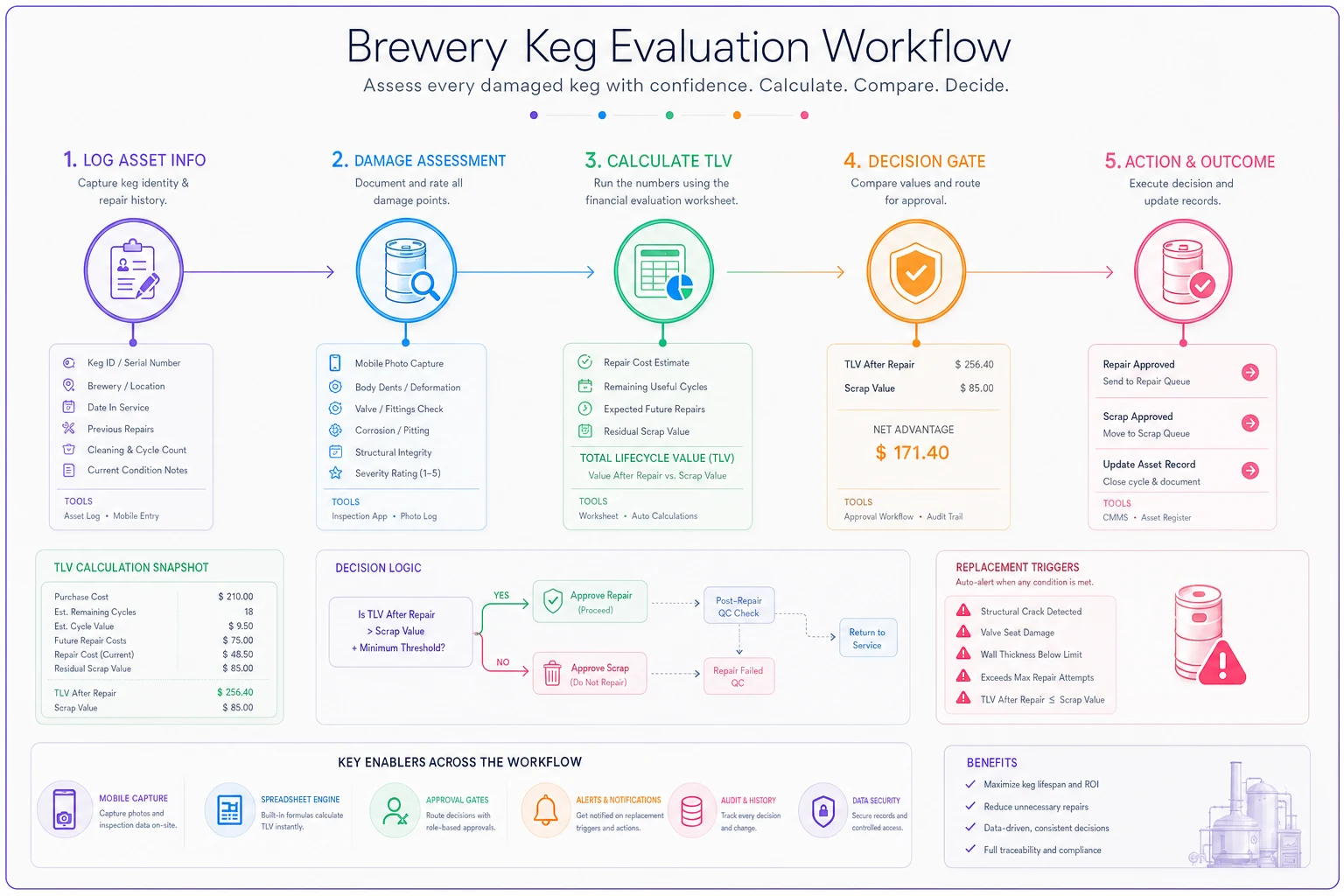
The key calculation: Total Lifecycle Value (TLV). This equals expected remaining years multiplied by annual revenue per keg, minus projected repair costs. When TLV goes negative, the keg gets scrapped regardless of individual repair cost.
For a typical half-barrel keg turning twelve times annually at $165 per fill, that's roughly $2,000 annual revenue. A ten-year-old keg might have five years left, so $10,000 potential revenue. If projected repairs exceed even $2,000 over those five years (based on condition and history), the TLV math says scrap it.
The worksheet also needs replacement trigger alerts. When scrapped keg counts hit certain thresholds, it automatically flags for capital planning. No more discovering you need fifty new kegs with two weeks notice because nobody tracked retirement rates.
Built into operational software, these calculations happen automatically as damage gets logged. The system already knows keg age, repair history, and revenue contribution. Add damage assessment, and it immediately recommends repair versus scrap based on your configured thresholds.
Managing Deposit Structures Without Killing Relationships
The conversation about raising deposits or adding damage penalties makes every brewery nervous. Accounts threaten to switch suppliers, distributors complain about cash flow, sales teams predict disaster.
Professional operations respect professional policies. That distributor complaining loudest about higher deposits probably damages the most kegs. The account threatening to leave over accountability measures wasn't a great partner anyway.
-
Announce changes 3 months in advance
-
Provide detailed economic justification
-
Offer transition period with current deposits
-
Train distributor warehouse teams on handling
-
Create performance-based incentive programs
-
Document all policies and procedures clearly
Document everything clearly. Deposit structures, damage definitions, assessment criteria, appeal processes—all written, signed, and stored. When disputes arise (and they will), clear documentation ends arguments quickly. Photos of forklift punctures speak louder than verbal complaints.
Some accounts genuinely can't handle higher deposits due to cash constraints. Consider alternatives like damage insurance, where they pay monthly premiums instead of upfront deposits. Or implement graduated deposits where amounts increase only for kegs held beyond normal turn times.
The Compound Effect on Brewery Operations
Getting keg lifecycle economics right cascades through your entire operation. Production stops dealing with surprise keg shortages when damaged units queue for weeks awaiting repair decisions. Finance can accurately forecast capital needs instead of emergency-approving new keg purchases. Warehouse staff spend less time shuttling damaged kegs back and forth between assessment, repair, and re-assessment.
The data from proper lifecycle tracking reveals optimization opportunities everywhere. Maybe certain beer styles correlate with higher keg damage (looking at you, fruit sours with their acidic residues). Perhaps specific routes or regions show unusual wear patterns suggesting environmental factors.
Quality improves too. Properly maintained kegs hold carbonation better, reduce contamination risks, and present your brand professionally at accounts. That beaten-up keg with three different weld repairs and a crooked valve doesn't exactly scream "premium craft beer" when it shows up at an upscale restaurant.
AI-powered operational platforms make this tracking seamless. Instead of manual spreadsheets and paper assessment forms, damage gets logged through mobile apps with photo capture. The system automatically calculates repair versus replacement recommendations, tracks cumulative costs per asset, and triggers governance reviews when thresholds get exceeded. Deposit structures adjust automatically based on account performance metrics.
Making Lifecycle Policies Stick Long-Term
The best policies fail without consistent execution. Six months after implementation, most breweries drift back toward ad-hoc decision-making unless systems enforce discipline.
Build refurbishment decisions into daily workflows. When kegs return from distribution, condition assessment happens immediately, not "when we get around to it." Damage documentation includes photos, specific defect codes, and repair estimates—not just "damaged" scribbled on a tag.
Monthly reporting keeps everyone aligned. Track metrics like repair costs per keg-year, percentage of fleet under refurbishment thresholds, and deposit recovery rates. When numbers drift, investigate why. Did maintenance start approving repairs outside policy? Are damage rates increasing from specific accounts?
Train new staff extensively on policies. Every warehouse worker should understand refurbishment thresholds, know how to complete assessment worksheets, and recognize when to escalate decisions. This isn't complex—it just requires consistent training and reference materials.
Review and adjust thresholds annually based on actual data. Maybe your initial age brackets proved too conservative, and you're scrapping kegs with profitable years remaining. Or perhaps repair costs in your market run higher than expected, requiring tighter thresholds. Use real numbers to refine policies, don't just set and forget.
The ultimate goal isn't perfection—it's consistency and financial discipline. Every unnecessary refurbishment wastes money that could buy new kegs. Every premature scrap decision throws away revenue-generating assets. Finding the economic sweet spot requires systematic evaluation, not gut feelings.
When your keg fleet runs smoothly, everything else follows. Production has containers when needed, quality stays consistent, and relationships with distributors improve through clear expectations. Most importantly, you stop hemorrhaging money on containers that should've been retired years ago while maximizing value from assets worth maintaining.
The economics are straightforward once you track the right numbers and enforce rational policies. The challenge isn't understanding what to do—it's maintaining discipline when daily operations create pressure for quick decisions. Build the systems, train the team, and stick to the math.
Ready to elevate your brewery operations?
Join 500+ craft breweries using Beeryly to increase production efficiency, reduce waste, and grow sales.