

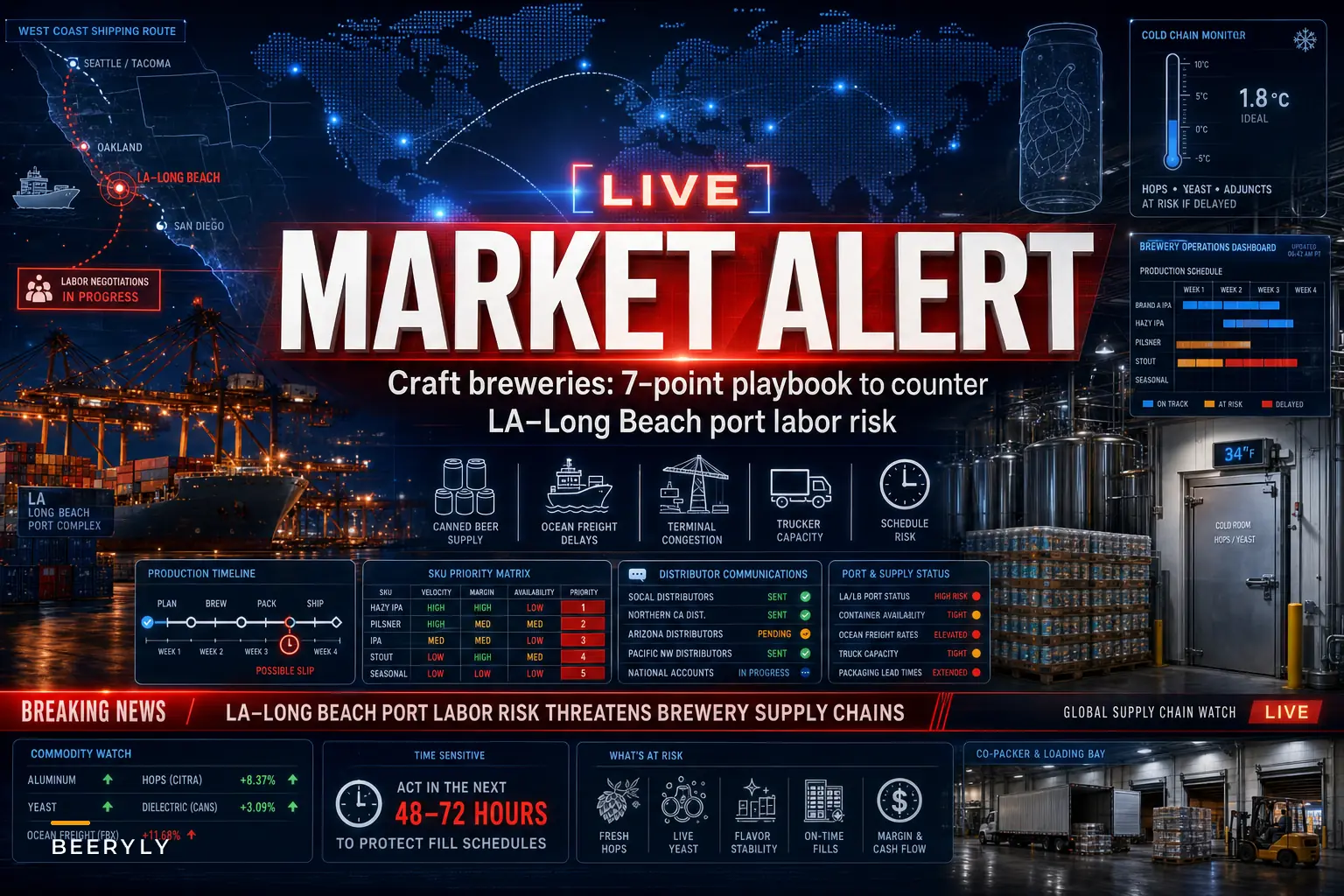

The talks between the Pacific Maritime Association and the union representing port security officers at Los Angeles and Long Beach got pushed into early November — close enough to the busy season to make anyone running a packaging line a little nervous. The short version, as Reuters reported, is that a threatened work stoppage was postponed, not resolved. Local coverage from the Daily Breeze put the extension through Wednesday, November 4.
That window matters because the LA–Long Beach complex moves a massive share of U.S. container imports, and a lot of what breweries depend on comes through there or gets rerouted around it: cans, end stock, labels, cartons, imported specialty malts, refrigerated yeast and hop shipments, co-packer inbound/outbound freight. Even if nothing actually stops, the threat alone already changes carrier behavior, spot rates, and vessel scheduling. By the time a disruption is confirmed, your options have already narrowed.
So this isn't a "watch the news" post. If you're running production, the news is a trigger, not the plan. What follows is a seven-point operational response for when a West Coast port disruption becomes a real possibility — ordered roughly by how fast you need to act.
First, understand what actually breaks (it's not what most people assume)
The instinct is to panic about ingredients. The real exposure for most packaging-heavy breweries isn't the beer inputs — it's the cans and the cartons.
Hops and specialty malt usually have some domestic buffer in the system, and a lot of breweries already carry rolling cover on them. Packaging doesn't get the same respect. Aluminum can bodies — especially printed cans and anything with imported end stock or custom shrink sleeves — tend to run lean because they're bulky, expensive to hold, and nobody wants a pallet of obsolete printed cans when a recipe changes.
What a port labor disruption really exposes is the lie of just-in-time packaging. A brewery can have six weeks of malt and still get stopped dead by a two-week delay on a printed can order. You can't package what you can't put beer into.
A quick way to see your actual exposure: for every active SKU, write down the single input with the longest replenishment lead time and the lowest days-of-cover. Nine times out of ten it's a packaging component, not an ingredient. That one column tells you where a port slowdown hits you first.
The 7-point playbook
1. Freeze your SKU list and rank by on-hand coverage
Take control of your brewery’s workflow.
Beeryly helps you schedule batches, track inventory, and monitor sales with ease.
- Production timeline management
- Inventory tracking & alerts
- Sales & distribution monitoring
No credit card required
Before you reroute a single shipment, get clear on what you can still make right now with what's already in the building.
Build a simple coverage ranking:
| SKU | Finished goods on hand (days) | Limiting input | Days of cover on limiting input | Action |
|---|---|---|---|---|
| Flagship IPA 12oz | 9 | Printed cans | 11 | Protect — keep running |
| Seasonal Hazy 16oz | 4 | Shrink sleeves | 6 | At risk — pre-stage next run |
| Pilsner 12oz | 22 | Can ends | 30+ | Deprioritize |
| Barrel series | 60+ | Bottles (import) | 8 | Pause packaging, hold in tank |
The limiting input is the whole point. A SKU with 22 days of finished goods isn't the problem. A SKU with 4 days of finished goods and 6 days of sleeves is where a port delay turns into an empty shelf at your distributor.
2. Re-sequence production toward what you already have inputs for
Once you know your coverage, flip your schedule. Push runs that depend on at-risk imported packaging later, and pull forward runs where you're fully covered on-hand.
In practice, this usually means temporarily over-producing your most protected SKU while you still can, even if demand is only average for it. A warehouse full of your flagship is a far better position than idle tanks waiting on cans stuck in a container yard.
One mistake to avoid: don't re-sequence based on sales velocity alone. During a supply scare, you sequence by input certainty, not demand. The highest-demand SKU is worthless on the schedule if its packaging is sitting on a vessel waiting for a berth.
3. Consolidate and pull forward packaging orders — carefully
If you've got open POs for cans, ends, or cartons, this is the moment to consolidate them into fewer, larger, earlier orders rather than your normal drip of weekly replenishment. Larger consolidated orders are easier to prioritize with suppliers and cheaper per unit to expedite if it comes to that.
-
Only pull forward packaging you're confident you'll run in the next 60–90 days. Printed, SKU-specific packaging that outlives a recipe change becomes dead inventory and locked-up cash.
-
Protect your flexibility. Blank or silver cans with digital or applied labeling give you far more room than fully printed cans when you can't predict which SKU you'll need to run.
A typical approach: a mid-size brewery carrying roughly four weeks of printed cans across five SKUs pulls a single consolidated order forward to build to eight weeks — but only on their top two SKUs, not all five. That targets the cash at the SKUs that actually can't afford a gap, instead of spreading a big spend thin.
4. Activate your secondary suppliers and alternate routes now
The ports story is really a single-point-of-failure story. Breweries that route everything through one distributor-of-record, one packaging broker, and one inbound lane are the ones that get hurt.
-
Call your packaging supplier and ask directly which of your components ship through LA–Long Beach versus alternate ports (Oakland, Tacoma, Houston, East Coast). Get this written down per component.
-
Identify a backup supplier for your two most at-risk inputs and get a quote and lead time on file — even if you don't order.
-
For perishable inbound like yeast, liquid adjuncts, or refrigerated hops, confirm which lane the shipment is on and whether cold-chain handling changes if it gets rerouted.
This is where procurement discipline gets tested. If you've already built supplier tiers and rolling-cover rules, you're just activating a plan. If you haven't, the port scare is a loud reminder to build one — our hops and yeast procurement playbook covers the supplier tiering and contract language that makes rerouting a decision instead of a scramble.
5. Tighten lot tracking and QC on anything rerouted
Rerouted and expedited shipments break your normal receiving assumptions, and this part doesn't get talked about enough.
-
Log the actual transit path and any temperature excursions on arrival.
-
Pull an extra QC check on perishable inputs that were delayed or rerouted before they go into a batch.
-
Keep lot numbers tied to the specific batches they feed, so if something's off you can trace it to one or two runs instead of a week of production.
The quiet failure mode is using a heat-stressed yeast pitch or oxidized hops because the receiving team treated a rerouted shipment like a normal one. One bad pitch into a flagship batch can cost more than the entire freight premium you were trying to avoid.
6. Recalculate per-SKU cost-to-serve with the new freight reality
Expedited freight, longer lanes, and emergency packaging buys don't hit your P&L evenly. They land hardest on specific SKUs, and if you don't update your numbers you'll keep selling your most freight-exposed products at the old margin.
Run a quick pass on each active SKU: add the realistic expedited or rerouted freight premium per unit, plus any price difference from a backup supplier, and see what your margin actually becomes. Some SKUs will absorb it fine. Others — usually the imported-packaging, lower-volume ones — can flip from thin to negative.
That recalculation drives real decisions: which SKUs you keep pushing, which you quietly pause, and which ones justify paying up for air or expedited ground versus waiting out the delay. Paying a steep premium to keep a low-margin seasonal alive rarely makes sense. Paying it to protect your flagship's shelf presence at a key account usually does.
7. Communicate down the chain before anyone has to ask
This is the one breweries skip most often and regret most reliably. Distributors and key accounts hate surprises more than they hate bad news.
If a SKU is going to get tight, tell your distributor early with a specific picture: which SKUs are solid, which might gap, and roughly when. A distributor who knows your Hazy might run short in three weeks can manage their accounts around it. A distributor who finds out when the order doesn't arrive loses shelf space and remembers it.
Internally, make sure production, receiving, and whoever handles purchasing are all looking at the same coverage picture. Most of the worst decisions during a supply scare come from two people acting on different information — purchasing building safety stock on a SKU that production already decided to pause.
Here's a quick visual of the 7-step operational workflow.
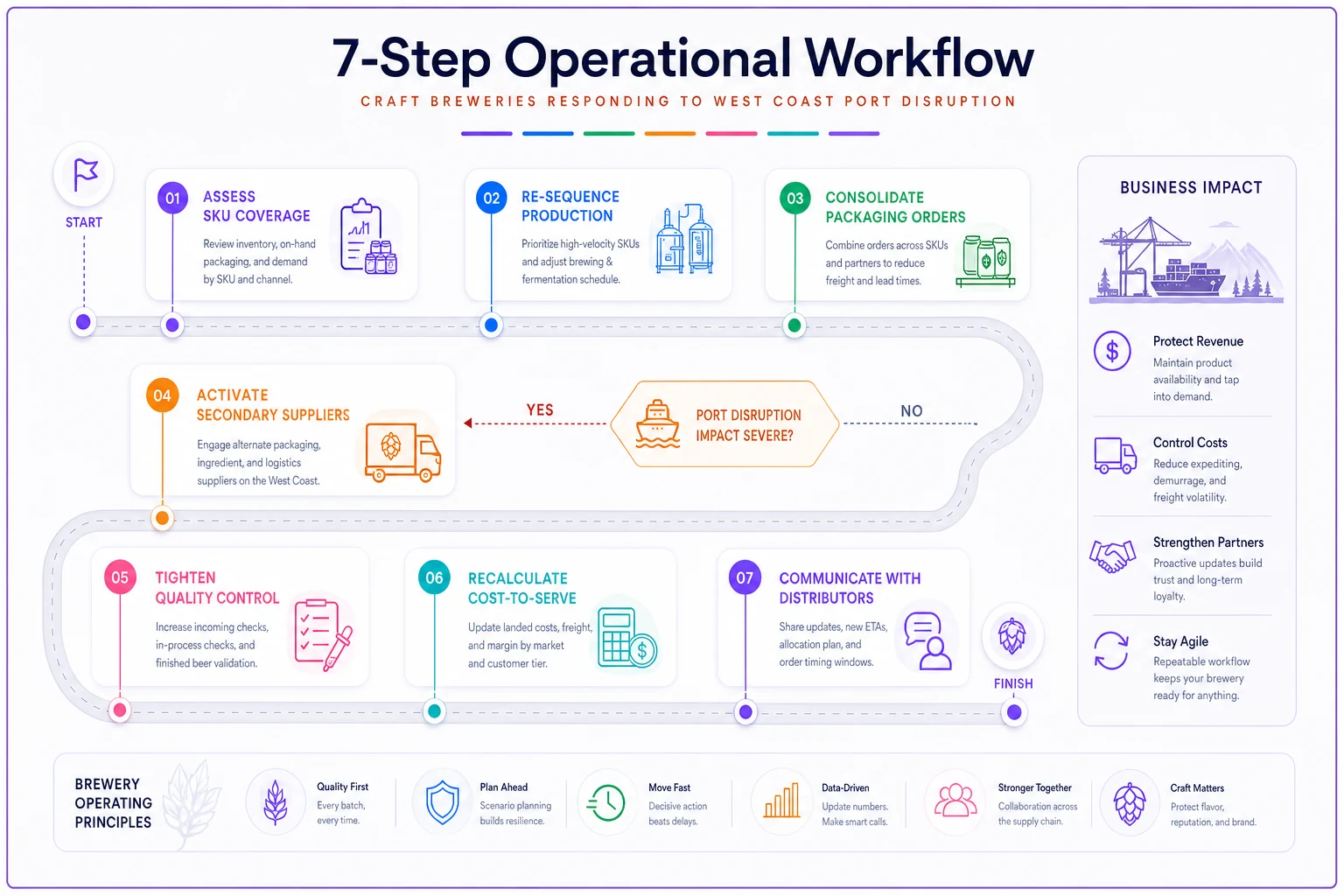
The playbook above is ordered roughly by how fast you need to act: freeze SKUs and rank coverage, re-sequence production, consolidate packaging, activate backups, tighten QC, recalc margins, and communicate.
When to actually act — and when to sit tight
Not every port headline deserves a full response. Over-reacting to a disruption that resolves in a week can cost you more in dead packaging and premium freight than the disruption itself would have.
When this playbook makes sense:
-
You carry under roughly three weeks of cover on imported or printed packaging.
-
A meaningful share of your SKUs depend on a single inbound lane through LA–Long Beach.
-
You have a seasonal or high-volume window landing in the next 6–8 weeks.
-
You rely on refrigerated inbound shipments that can't absorb a cold-chain detour.
When to stay calm and just monitor:
-
You already carry healthy cover on your limiting inputs.
-
Your packaging is mostly domestic or sourced through non-West-Coast lanes.
-
The at-risk SKUs are low-volume and easy to pause without hurting key accounts.
The point isn't to react to every negotiation extension. It's to know your exposure well enough to respond proportionally.
A short real scenario
A regional brewery running around 18,000 barrels a year, with five core SKUs, got nervous during a prior West Coast slowdown. Two of their SKUs used printed cans with end stock that came through LA–Long Beach, and they were sitting at about three weeks of cover.
Instead of blanket-buying, they ranked coverage, found the two exposed SKUs, and did three things: pulled forward a single consolidated can order on just those two SKUs to reach roughly seven weeks, re-sequenced the schedule to run their fully-covered flagship first, and got a backup end-stock quote on file from a supplier shipping through a different port.
The disruption ended up being milder than feared. But when one of their end-stock shipments slipped by about ten days, they had the cover to ride it out without expediting a single pallet. Their estimate afterward: the targeted approach cost them maybe a couple thousand in extra carrying cost, versus the $9k–$12k in air freight and spot premiums they'd budgeted for if they'd waited and scrambled.
The lesson wasn't "buy more." It was "know exactly which two SKUs to protect, and leave the rest alone."
Keeping this from being a fire drill every time
The breweries that handle port scares calmly aren't lucky — they already have the underlying information organized. They can pull up days-of-cover by limiting input, see which lane each component ships through, and reroute to a known backup supplier without hunting through email threads and people's heads.
That's less about any single event and more about having your inventory, lead times, and supplier data in one place instead of scattered across spreadsheets and people's heads.
This particular negotiation may well resolve quietly. Most do. But the LA–Long Beach complex will be a chokepoint again, and the next one might not get extended. Building the coverage visibility and secondary-supplier relationships now means the next headline is a five-minute check instead of a week of firefighting — and that's the difference between a brewery that protects its margins through a disruption and one that just hopes the talks go well.
Ready to elevate your brewery operations?
Join 500+ craft breweries using Beeryly to increase production efficiency, reduce waste, and grow sales.