

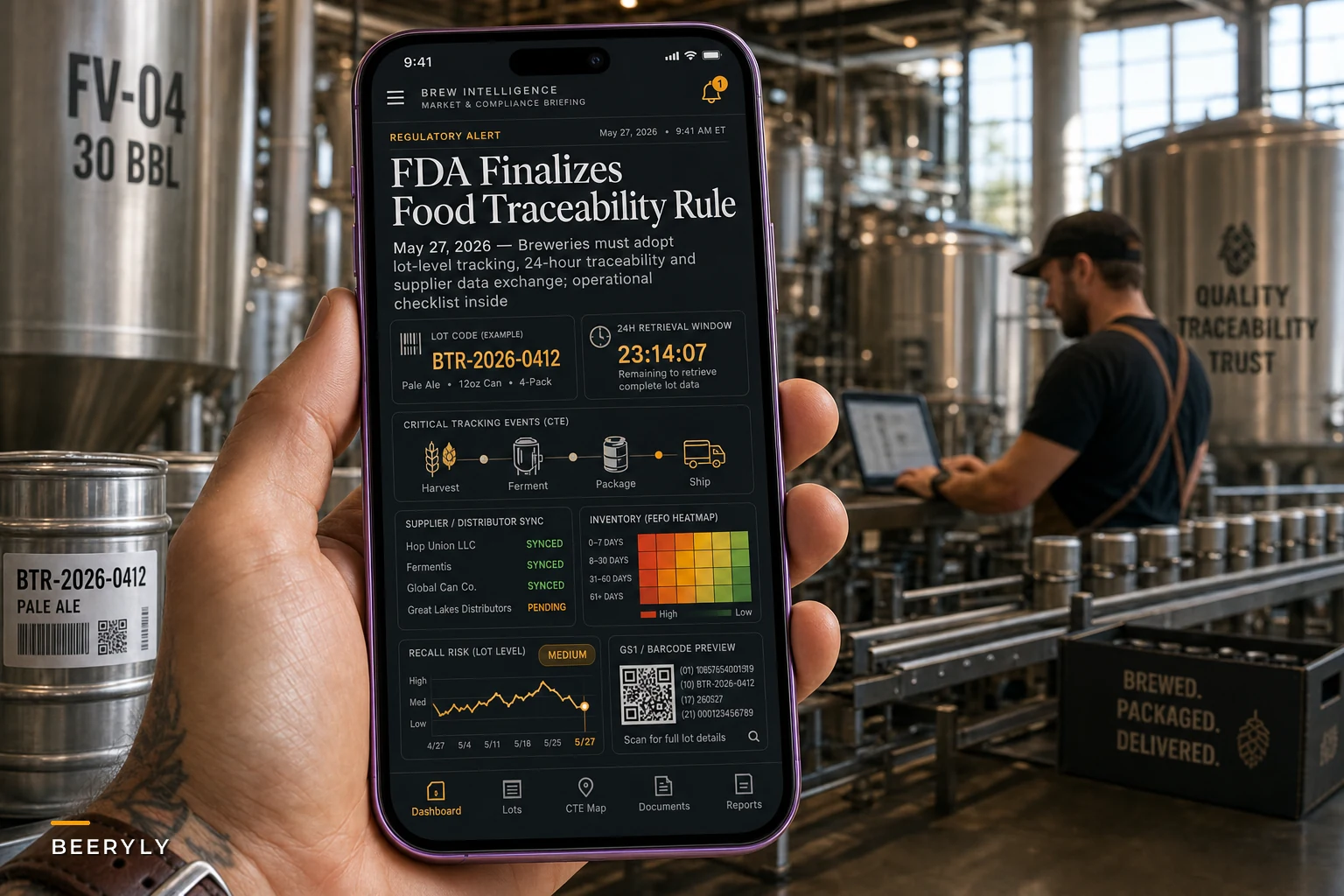

The clock started ticking when the FDA published its final Food Traceability Rule under FSMA Section 204. Breweries have until July 2028 to implement lot-level tracking systems that can produce detailed records within 24 hours of an FDA request.
Most brewery owners think this is just more compliance paperwork. It's not. The rule fundamentally changes how you track ingredients from receiving dock through distribution. Every batch of hops, every malt delivery, every tank transfer needs documented Key Data Elements tied to specific lot codes.
Take Three Floyds—they thought their existing batch tracking covered the basics. But when they started digging into their hop supply chain, they realized their supplier sends mixed lots in single deliveries. Their canning line combines partial batches when topping off bright tanks. Their distributor breaks cases for mixed pallets. None of these movements had proper documentation.
The real problem isn't collecting data—it's maintaining production efficiency while adding tracking steps. Cellar operators already juggle multiple tasks during busy shifts. Adding detailed lot documentation at every Critical Tracking Event either slows production or requires more staff. Neither works for breweries running on tight margins.
Supplier coordination is messier than you think
Getting your internal tracking sorted represents maybe half the battle. The other half involves convincing every supplier to provide standardized Key Data Elements in a format you can actually use.
Your typical mid-size brewery works with 20-30 ingredient suppliers. Each sends information differently—some email PDFs, others use proprietary portals, many still fax certificates of analysis. Under the new rule, you need consistent lot codes, harvest dates, processing locations, and previous handler information from everyone.
| Key Data Element |
|---|
| lot codes |
| harvest dates |
| processing locations |
| previous handler information |
Founders Brewing discovered their main hop supplier aggregates lots from multiple farms before packaging. The supplier's current invoices show internal lot numbers but not the farm-level detail FDA requires for traceback. This problem compounds across every ingredient supplier.
The timing makes coordination worse. Smaller suppliers who don't hit FDA thresholds might not implement formal traceability systems. But you still need their data for compliance. That means finding new suppliers who provide proper documentation or building workarounds to capture required data from non-compliant vendors.
Consider what happens during harvest season when you're buying fresh hops from small farms. These suppliers barely have time to process orders, let alone maintain detailed electronic records. Yet you need their KDEs in your system before using their ingredients.
Your current batch tracking won't cut it
Most breweries already track batches through production. You assign batch numbers, record brew dates, track tank transfers for quality control. But FDA's traceability requirements go deeper.
Take control of your brewery’s workflow.
Beeryly helps you schedule batches, track inventory, and monitor sales with ease.
- Production timeline management
- Inventory tracking & alerts
- Sales & distribution monitoring
No credit card required
The rule requires documenting specific data elements at every Critical Tracking Event. When you receive malt, you need the lot code, quantity, supplier details, receipt date, and storage location. When you use that malt in a brew, you need to link it to your production batch with timestamps and quantities. When you package, transfer, or ship product, each movement needs similar documentation.
Partial lot usage creates complexity. Say you open a 55-pound bag of Centennial hops for dry hopping. You use 30 pounds today, store the rest, then use the remaining 25 pounds next week in a different batch. Your system needs to track both uses separately while maintaining the original lot information.
Tank blending creates another tracking challenge. Many breweries blend partial batches to optimize tank utilization. You might have 7 barrels of IPA from Monday's brew and 8 barrels from Wednesday's brew in the same bright tank. That blended batch needs documentation showing both source lots with proportions and timestamps.
The canning line presents similar problems. When you switch between beers, there's mixing in the filler bowl. Your next beer might have 12 ounces of the previous batch mixed into the first few cases. FDA wants to know about that cross-contact for allergen tracking and recall purposes.
When kegs come back from accounts, can you trace which batch they contained? If a distributor reports quality issues with specific cases, can you identify the exact production lot and all other locations that received the same batch?
Building recall readiness into daily operations
The 24-hour response requirement changes everything about recall preparation. FDA can request your traceability records at any time, and you have one day to compile everything. Not one business day—one actual day including weekends and holidays.
During a real recall scenario, those 24 hours disappear fast. You need to identify affected lots, trace forward to every shipment, trace backward to ingredient sources, compile all documentation, and format it for FDA review. If your records live in disconnected spreadsheets, brewing software, and filing cabinets, you're not making that deadline.
Here's a simple workflow visualization to keep the team aligned before you run a mock recall.
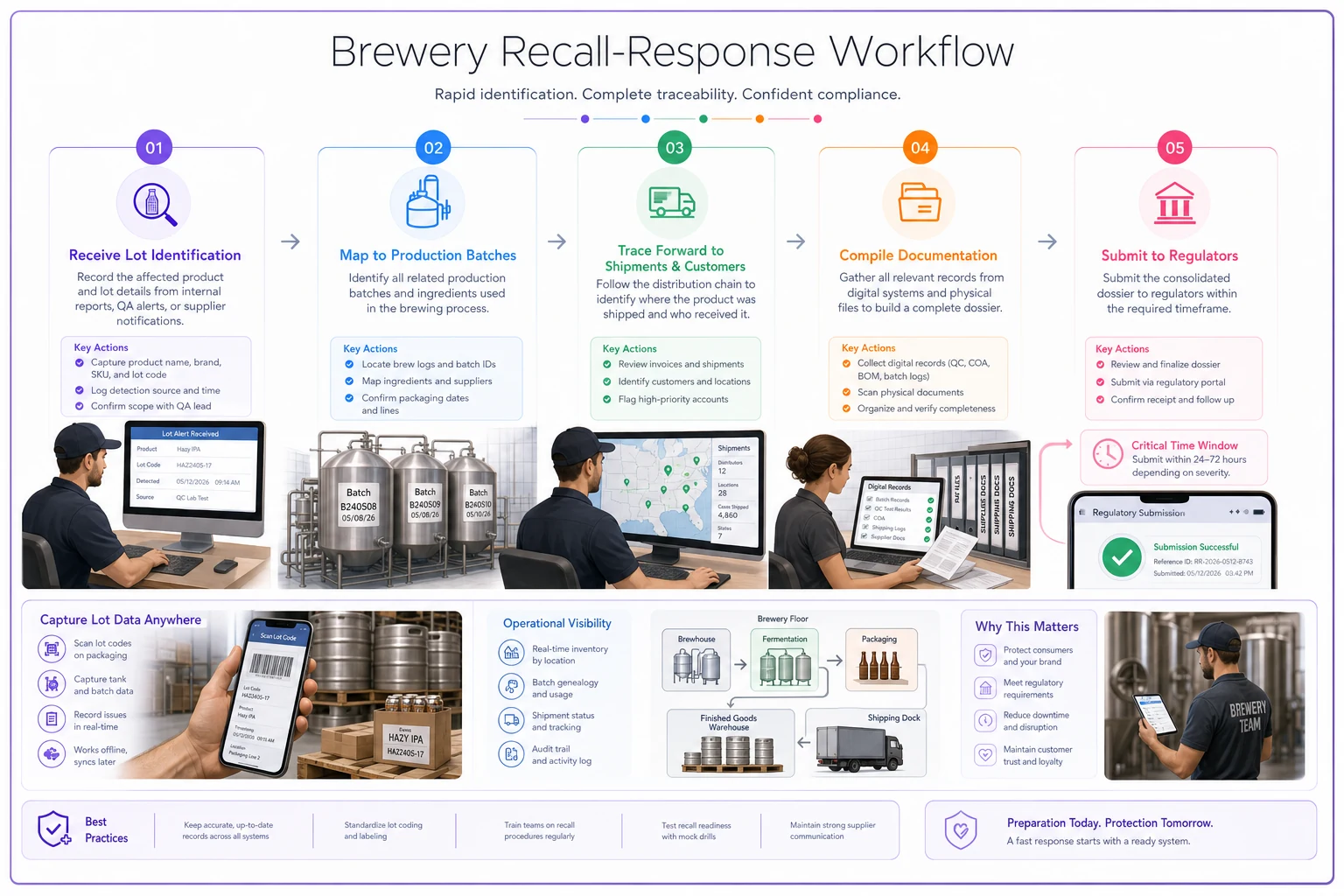
A practical recall system starts with standardized data capture at each tracking event. Create simple forms for receiving, production, and shipping that capture all required elements. Train every employee who handles these events. The midnight shift needs to record the same information as day shift, using the same format, stored in the same location.
Label opened partial lots immediately with the lot code and date so tracebacks don't rely on memory.
Mock recalls expose the gaps. Pick a random ingredient lot from three months ago. Can you identify every batch that used it? Can you find every customer who received those batches? Time yourself—if it takes more than 4 hours to compile this information, your system needs work.
Partial lot tracking represents the biggest recall vulnerability for most breweries. When you can't definitively say which cases went to which accounts, FDA assumes the worst case—every account received affected product. That turns a 50-case issue into a 5,000-case recall.
The inventory workflow overhaul
Implementing traceability means redesigning how inventory moves through your brewery. Every touchpoint needs documentation without creating bottlenecks that slow production.
Receiving changes significantly. Currently, your cellar operator probably checks deliveries against purchase orders and moves ingredients to storage. Now they need to capture lot codes, verify supplier KDEs, update your tracking system, and properly label storage locations—all before the delivery truck leaves.
Storage becomes more complex too. You can't just stack bags of grain anywhere space exists. Each lot needs designated storage with clear labeling. When you pull inventory for production, you need to follow strict FIFO rotation while documenting which lots you're using. That beautiful wall of grain bags needs reorganization so older lots stay accessible.
The brewhouse workflow changes significantly. Your brewers need to record every ingredient addition with lot numbers and exact quantities. That casual practice of eyeballing specialty grain additions? Not anymore. The half-bag of crystal malt from last week's brew? Document it or toss it.
Cellar operations need the most adjustment. Every transfer, every sample, every adjustment needs lot-level documentation. When you harvest yeast for repitching, that's a new lot requiring its own tracking. When you blend tanks for packaging, both source lots need recording with proportions.
Packaging lines require pre-staging to maintain tracking. You can't grab ingredients as needed anymore. Each packaging run needs planned ingredient lots with documentation ready before starting. Date code systems need expansion to encode full lot information for downstream traceability.
The hidden costs hitting your working capital
Compliance costs extend beyond software and training. The operational changes required for traceability directly impact your working capital needs and cash flow patterns.
Strict lot separation means carrying more inventory. Instead of one partial bag of Cascade hops, you might have three partial bags from different lots. Instead of topping off tanks with compatible batches, you maintain separation. Your overall inventory investment could increase 15-20% just from lot separation requirements.
FIFO enforcement accelerates ingredient turnover but might force non-optimal brewing schedules. That special release using aged hops? You need to use older standard lots first, even if fresher lots would work better. This rigid rotation can impact product quality and consistency.
Supplier minimum orders become problematic when you need maintain lot consistency. If you typically order monthly but a batch runs three months, you either carry excess inventory or risk lot changes mid-production. Many breweries find themselves ordering larger quantities less frequently, tying up more cash in raw materials.
The documentation burden slows production throughput. Tasks that took 30 minutes might take 45 minutes with proper tracking. Over a full production day, those small delays compound. A brewery running two shifts might lose the equivalent of two hours of production time daily just to documentation.
Labor costs increase even with good systems. You need someone managing traceability compliance, conducting mock recalls, training staff, and coordinating with suppliers. For most craft breweries, that's at least a half-time position that didn't exist before.
Picking technology that scales with growth
The software decision you make now will affect operations for the next decade. Choose wrong and you'll either outgrow the system quickly or struggle with overcomplicated features that slow down daily work.
Avoid building elaborate spreadsheet systems. They work initially but become unwieldy as complexity grows. Bissell Brothers showed me their "master tracking spreadsheet"—65 tabs, 400,000 rows, 20-minute load time. It technically captured all required data but was practically unusable during the 24-hour recall window.
Standalone traceability software often creates double-entry nightmares. Your brewers enter batch data in brewing software, then re-enter it in traceability software. Besides wasting time, this duplication creates synchronization errors that undermine the entire system.
The most practical approach integrates traceability into existing operational workflows. When receiving clerks scan deliveries, the system should automatically capture KDEs. When brewers log batch starts, ingredient lots should flow from inventory without manual entry. When packaging runs complete, the system should generate all required distribution records.
Modern operational platforms use AI automation to reduce manual tracking burden. They can extract lot codes from supplier documents, flag missing KDEs before production starts, and automatically compile recall documentation. This automation becomes critical when you're racing against FDA's 24-hour deadline.
Consider how the system handles exceptions and corrections. Real operations are messy—suppliers send wrong lot codes, employees forget documentation, systems go offline during production. Your technology needs graceful ways to capture missing data and correct errors without stopping production.
Training your team without disrupting production
Rolling out new traceability procedures across all shifts requires careful choreography. You can't shut down for a week of training, but you also can't have inconsistent implementation that creates compliance gaps.
Start with your leads and supervisors. They need deep understanding of both requirements and reasoning. When a cellar operator questions why they're documenting a routine transfer, the supervisor needs to explain the recall implications. This knowledge cascade prevents the "because FDA says so" mentality that leads to corner-cutting.
-
Start with receiving where mistakes are easily caught.
-
Add brewhouse tracking once receiving runs smoothly.
-
Layer in packaging after production flows are stable.
-
Create role-specific training modules.
-
Build verification into daily routines with audits and mock recalls.
Create role-specific training modules. Receiving clerks don't need to understand packaging line traceability. Brewers don't need supplier KDE details. Focused training gets employees operational faster while avoiding information overload.
Use real scenarios from your operation. Generic training examples don't stick. Show what happens when someone forgets to document hop additions using actual recipes and actual consequences. Calculate the cost of recalling three weeks of flagship beer because lot codes weren't captured.
Phase implementation by area rather than going live everywhere simultaneously. Start with receiving where mistakes are easily caught. Add brewhouse tracking once receiving runs smoothly. Layer in packaging after production flows are stable. This graduated approach maintains quality while building competency.
Document everything in simple, visual guides posted at workstations. The midnight shift can't call supervisors about lot code formats. They need clear references showing exactly what to record and where. Pictures of correctly completed forms work better than written procedures.
Build verification into daily routines. End-of-shift reports should flag missing data. Weekly audits should catch systematic problems before they compound. Monthly mock recalls should test the entire system.
Making traceability work in craft brewing's reality
The biggest challenge isn't understanding FDA requirements—it's implementing them within craft brewing's operational constraints. You're not running a Fortune 500 operation with dedicated compliance teams. You're juggling production, sales, and quality with minimal staff.
Success requires embedding traceability into existing workflows rather than bolting it on top. When procedures feel like extra work, they get skipped during busy periods. When they're part of natural workflow, compliance becomes automatic.
Some breweries try to maintain perfect data from day one. That's unrealistic and unnecessary. Focus on capturing critical elements accurately, then improve completeness over time. Better to have 80% of data consistently than 100% occasionally.
The rule provides flexibility in how you maintain records. FDA doesn't mandate specific systems or formats. They care about retrievability and accuracy. A simple but consistent system beats a complex but unreliable one.
Traceability serves your business beyond compliance. The same systems that enable rapid recalls also improve inventory management, reduce waste, and identify quality issues faster. When you frame it as operational improvement rather than regulatory burden, you'll find more opportunities for efficiency gains.
FDA's Food Traceability Rule for brewery compliance isn't optional, and the July 2028 deadline will arrive faster than expected. The breweries that start building systems now will have time to refine procedures, train staff properly, and identify efficient workflows. Those that wait will scramble to implement half-baked solutions that disrupt operations and risk compliance failures.
The real work isn't installing software or writing procedures. It's fundamentally rethinking how data flows through your operation from grain to glass. Every ingredient lot needs tracking through every transformation until it reaches consumers. That's a massive operational shift for breweries used to focusing on quality and flavor rather than documentation.
But done right, traceability infrastructure improves far more than just compliance readiness. You'll catch quality issues faster, reduce inventory waste, and respond to customer concerns with confidence. The same systems that enable 24-hour FDA responses also provide real-time visibility into your entire operation.
Start small but start now. Map your current tracking against FDA requirements. Identify the biggest gaps. Begin conversations with suppliers about data standardization. Run a mock recall to understand your current response time. Each step builds toward a comprehensive system that protects both your business and your customers.
The breweries that view this as an opportunity to modernize operations will emerge stronger. Those that treat it as a compliance checkbox will struggle with inefficient systems that barely meet requirements. The choice you make now determines which group you'll join.
Ready to elevate your brewery operations?
Join 500+ craft breweries using Beeryly to increase production efficiency, reduce waste, and grow sales.