

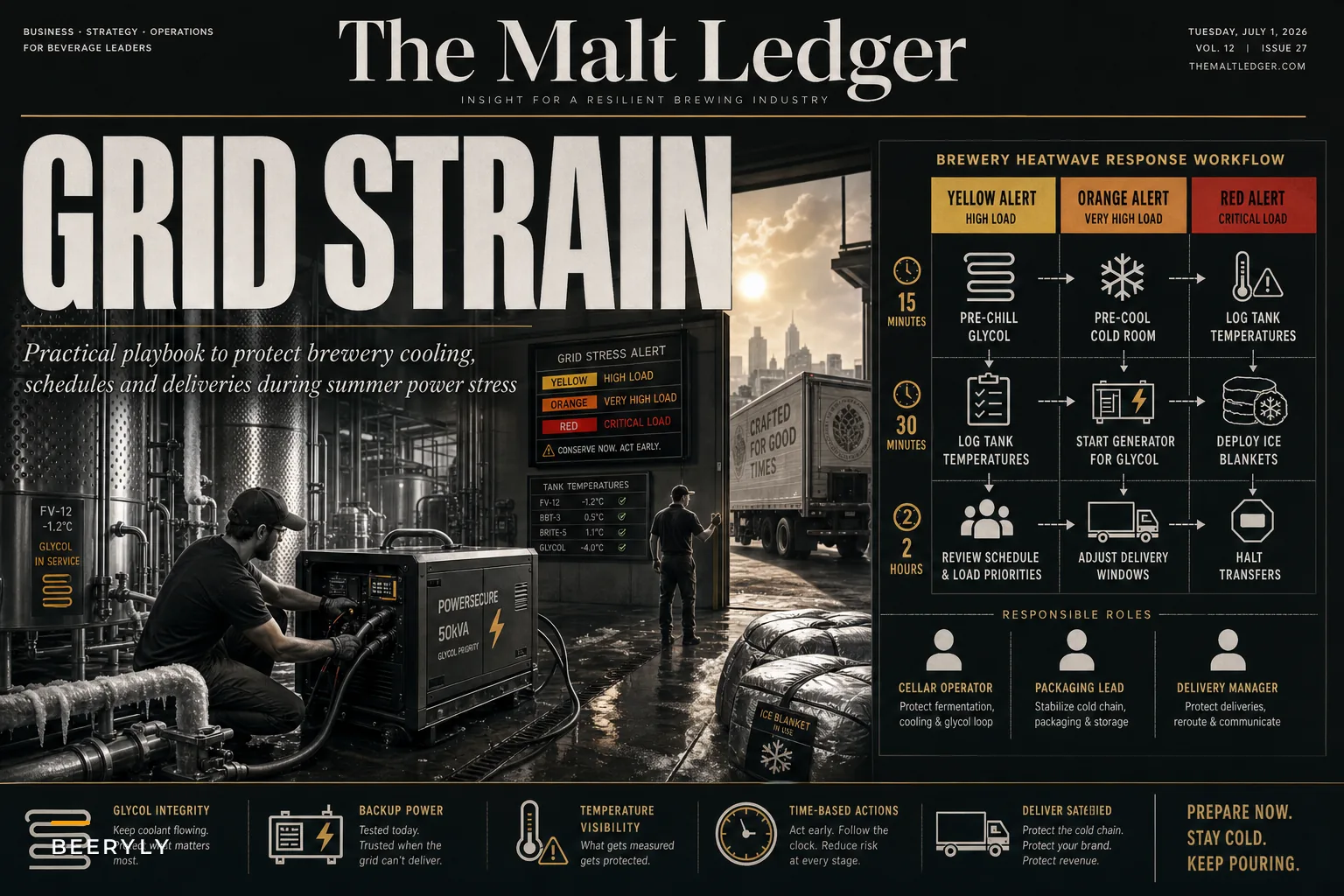

Late June brought warnings from grid operators that extreme heat across the central and eastern U.S. could push electricity demand to dangerous peaks, right as Fourth of July beer demand hits its seasonal high. The timing is brutal—peak sales colliding with the very real possibility of rolling blackouts, voltage drops, and cooling failures.
For craft breweries, this isn't just uncomfortable taproom temperatures. When power gets unreliable during a heatwave, you're looking at stuck fermentations, broken cold chains, and potentially thousands of gallons at risk. A four-hour outage during active fermentation can mean dumping an entire tank. A voltage dip mid-CIP can leave tanks partially sanitized and out of rotation for days.
What makes it worse is how brewery cooling systems fail in sequence rather than all at once. Your glycol chiller draws the most power exactly when the grid is most stressed. When it trips—even briefly—fermentation temps spike within 30 minutes. By the time power comes back, you might be dealing with off-flavors that won't show up until packaging. Meanwhile, your cold room compressor is cycling hard trying to recover, pulling more current, and possibly triggering another trip.
The hidden vulnerability most breweries discover too late
Every brewery owner knows cooling is critical, but the actual failure pattern during grid stress looks different than you'd expect. It's rarely a dramatic blackout that kills operations. More often it's voltage sags, brownouts lasting a few seconds, and rapid cycling that grinds equipment down over weeks.
A 15-BBL brewery in Arizona learned this the hard way a couple summers ago. Their glycol system would kick offline whenever grid voltage dropped below 208V—a system designed to run at 240V. The chiller's control board would reset and default to a higher setpoint. Nobody caught it for six hours because the temp creep was gradual. By evening, three fermenters had climbed from 68°F to 74°F. The Belgian wit survived, but the pilsner developed enough diacetyl to trigger a full dump—roughly $4,800 in lost product, not counting tank downtime.
The expensive part came two weeks later. The scroll compressor failed completely from the constant short-cycling. Replacement cost $11,000 and took eight days to source. During those eight days they ran two fermenters instead of six, cutting production capacity by 65% during peak season.
-
Compressor windings overheat from sustained low-voltage operation
-
Control boards corrupt from rapid power cycling
-
Solenoid valves stick halfway open
-
VFD drives throw errors and refuse to restart
The typical response is to buy a generator. But that only solves total blackouts. Voltage instability, frequency variations, and rapid load changes still cause damage unless you've built in proper conditioning and transfer switching.
Mapping your actual vulnerability (not the one you think you have)
Before you can protect anything, you need to understand where failures actually cascade from. Most brewery heatwave contingency plans focus on the wrong vulnerabilities because they assume single-point failures rather than chain reactions.
Take control of your brewery’s workflow.
Beeryly helps you schedule batches, track inventory, and monitor sales with ease.
- Production timeline management
- Inventory tracking & alerts
- Sales & distribution monitoring
No credit card required
| System | Failure Impact (per hour) | Recovery Time | Cascade Risk |
|---|---|---|---|
| Glycol cooling | 3-5°F temp rise in active fermenters | 30-45 min to restabilize | Triggers fermentation issues, CIP delays |
| Cold room refrigeration | 1-2°F rise if sealed | 2-3 hours to re-chill | Affects packaging schedule, distribution |
| Fermentation control | Immediate temp drift | 15-20 min per tank | Creates bottlenecks in tank scheduling |
| CIP pump/heating | Incomplete sanitization | Full re-clean required (2+ hours) | Delays next batch, contamination risk |
| Canning/bottling line | Production stop | 30-45 min restart + QC | Missed delivery windows |
| Brewhouse (if mid-batch) | Stuck mash/boil | 2-4 hours recovery | Potential total loss of batch |
The cascade risk column is the one that matters most. A glycol failure doesn't just warm fermenters—it forces delayed transfers, which backs up brite tanks, which prevents packaging, which misses delivery windows. One failure becomes five problems within 24 hours.
Operational readiness means knowing which systems tolerate brief interruptions (usually packaging), which need immediate backup (always glycol), and which require manual intervention to restart safely (typically CIP and fermentation control). You need to know exactly how long each system can stay offline before the damage becomes irreversible.
Building graduated response protocols that actually work
Generic disaster plans tell you to "monitor temperatures" and "have backup power ready." That's not a plan. Real contingency planning means specific trigger points and pre-staged responses your team can execute without stopping to think.
The 15-minute rule changes how you build everything else: if you detect and respond to cooling loss within 15 minutes, most fermentation problems stay correctable. Past 30 minutes, you're doing damage control. Past 2 hours, you're probably losing a batch. That timeline should drive every decision downstream.
Pre-chill glycol reservoirs during heat warnings to create a thermal buffer you can rely on.
Set up graduated triggers based on conditions, not just failures:
Yellow Alert (Grid warning issued or ambient temp above 95°F):
-
Pre-chill glycol reservoir 3-4°F below normal setpoint
-
Drop cold room temp by 2°F as thermal buffer
-
Postpone non-critical CIP cycles to off-peak hours
-
Stage portable glycol unit connections if available
-
Verify generator fuel and do a test start
Orange Alert (Voltage drops below 215V or frequency variations detected):
-
Log tank temperatures every 15 minutes
-
Pre-cool beer scheduled for packaging within 48 hours
-
Lock out non-essential loads—taproom AC, office equipment
-
Start ice production for emergency cooling
-
Alert distribution partners about potential delays
Red Alert (Power loss or voltage below 200V):
-
Immediate switch to generator or backup power for glycol only
-
Deploy ice blankets on critical fermenters
-
Halt all transfers and packaging
-
Shift staff to manual temperature monitoring
-
Initiate emergency transfer protocols if needed
Quick visual of the alert-to-action workflow.
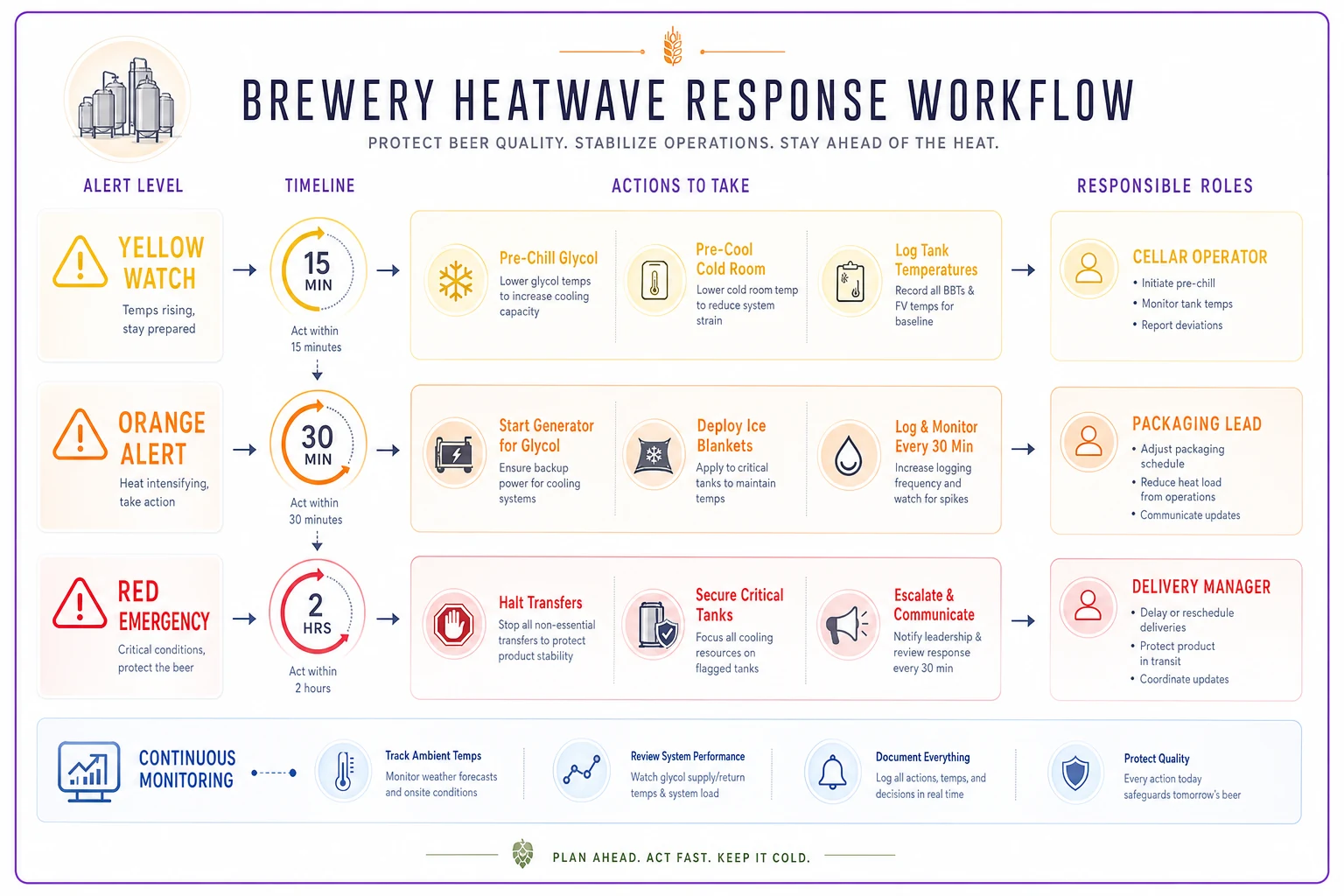
Each level has specific, executable actions—not vague preparations. Your cellar operator knows when to start making ice. Your packaging lead knows when to accelerate morning runs. Your delivery manager knows when to warn customers.
Emergency cooling hacks that won't destroy your beer
When cooling fails during peak fermentation, you have roughly 2-4 hours before temperature spikes cause permanent damage. The standard advice—"add ice"—doesn't go far enough.
The glycol bypass method works when your chiller dies but pumps still run. Drain 30-40% of your glycol reservoir and replace it with a slurry of ice and rock salt (not table salt). This can drop glycol temp by 10-15°F temporarily. Run pumps at maximum flow to prevent ice crystallization in lines. You'll buy 4-6 hours—enough time to source dry ice or get someone in to fix the chiller.
For individual tank emergencies, the wrapped coil technique is the most effective field fix I've seen. Take 50-100 feet of 3/8" copper tubing, wrap it around the tank cone with zip ties, and circulate ice water through it using a submersible pump in a trash can. One setup can drop a 7-BBL fermenter by 3-4°F per hour. It's not pretty, but it works.
The sacrifice play sometimes makes sense too: if you're facing system-wide failure, deliberately crash-cooling non-critical beers to 32-34°F turns them into thermal batteries. They'll warm slowly over 24-48 hours while you protect active fermentations. It might affect flavor stability in hoppy beers, but it beats losing everything.
What doesn't work, despite what forums say: wrapping tanks in wet towels (evaporative cooling is too slow), adding ice directly to beer (contamination risk plus dilution), or trying to move full fermenters to a cooler spot (disturbs yeast and risks oxidation).
Protecting your cold chain when everything else fails
Distribution during grid emergencies requires completely different thinking. Your refrigerated truck becomes useless if your customer's cooler is also down. Kegs warm up at the distributor. The entire cold chain gets unreliable exactly when demand peaks.
The pre-position strategy works: 24 hours before predicted grid stress, move an extra 20-30% of inventory to accounts that have backup power—usually large grocery chains or bigger restaurant groups. Even if it sits there a few extra days, that's better than losing it in your own cooler.
Thermal mass matters for keg deliveries. A full half-barrel keg at 38°F takes around 8-10 hours to hit 50°F in 90°F ambient heat. A sixth-barrel gets there in 3-4 hours. During grid stress, prioritize full kegs even if it means fewer SKUs per route. The thermal mass protects quality through delays you can't always avoid.
Document everything obsessively during emergency operations. When a Mexican lager comes back with oxidation complaints three weeks later, you need records showing it held cold chain despite the power situation. Track:
-
Departure and arrival temperatures
-
Time outside refrigeration
-
Which specific lots were affected
-
Any temperature excursions above 45°F
Some distributors won't accept deliveries during extreme heat events. Know this beforehand and have written agreements about who absorbs the loss if beer spoils in their warehouse during an outage.
Load shedding strategies that preserve critical operations
When you can't run everything, you need predetermined priorities. Breweries that try to save everything usually end up losing the most critical systems. Smart load shedding means deliberately sacrificing certain operations to protect the ones that matter most.
Most brewery panels weren't set up with selective shutdown in mind, but you can build manual load shedding capability for under $2,000 with strategically placed disconnect switches and clear labeling. The goal: shed 30-40% of your load within two minutes to keep critical systems alive.
Stage 1 shedding (saves roughly 15-20% load):
-
Taproom AC and lighting
-
Office equipment and computers
-
Non-critical ventilation fans
-
Hot liquor tank heating elements
Stage 2 shedding (saves an additional 20-25%):
-
Packaging equipment
-
Keg washer
-
Air compressors if you have backup CO2
-
Brewhouse panels if not mid-batch
Never shed:
-
Glycol system
-
Fermentation control
-
Cold room refrigeration
-
Critical monitoring systems
The restart sequence matters as much as the shedding order. Your canning line might need 45 minutes to recalibrate after power loss, while the keg washer comes back instantly. Know these differences before you start flipping breakers.
Turning manual chaos into systematic response
When power problems hit, the difference between losing one tank versus six usually comes down to response speed. Expecting perfect manual execution during a crisis is unrealistic.
The simplest improvement most breweries can make: wireless temperature sensors that alert multiple phones simultaneously. For under $500, you have redundant monitoring that doesn't depend on your facility's power. When the glycol chiller trips at 2 AM on a Saturday, you know within minutes—not when someone walks in Monday morning to 75°F fermenters.
But monitoring alone isn't the full answer. A proper reliability framework extends beyond emergency response to preventing cascade failures before they start. When you're tracking compressor amp draws, glycol pressure differentials, and temperature recovery rates over time, you spot problems weeks before they become failures. That overheating compressor shows declining efficiency long before it dies during a heatwave.
Modern operational platforms can coordinate responses automatically—triggering alerts, adjusting schedules, and flagging distribution risks based on real-time conditions. When the system detects voltage instability, it can automatically postpone that afternoon's CIP cycle, flag the packaging team to accelerate morning runs, and notify distribution about potential delays. No manual phone trees, no forgotten steps.
The real value isn't the automation itself—it's preserving operational knowledge when the people who carry it aren't available. When your experienced cellar manager who just knows when something's off isn't there, a well-configured system maintains that same vigilance. It remembers that Tank 3 always runs warm, that voltage below 210V means you have about 20 minutes before the chiller trips, that the glycol pump starts making a specific sound before it fails.
The actual cost of being unprepared
A mid-sized brewery producing around 3,000 BBL annually faces somewhere between $15,000 and $40,000 in direct losses from a single significant cooling failure during peak season. But the damage compounds over months:
-
Lost production capacity during repairs (typically 2-3 weeks)
$25,000-$35,000
-
Emergency equipment rental and overtime
$8,000-$12,000
-
Brand damage from missed deliveries
harder to quantify but lasting
-
Expedited shipping for replacement parts
$3,000-$5,000
-
Potential contamination requiring full tank cleaning
$5,000-$8,000
Against that, basic preparedness costs look minimal. A portable glycol unit rental contract might run $800 per month through summer. Battery backup for critical controls costs under $3,000. Proper voltage monitoring and protection adds maybe $5,000 to your electrical setup. You're looking at $15,000-$20,000 total investment to prevent $40,000+ in losses—not counting the operational chaos.
The insurance angle matters too. Many policies exclude spoilage coverage from power issues unless you can demonstrate reasonable precautions. "Reasonable" increasingly means documented contingency plans, backup cooling capacity, and monitoring systems. Without them, that $30,000 tank dump might not be covered.
Beyond surviving: building resilient operations
The breweries that handle grid stress well aren't just the ones with the biggest generators. They're the ones that adapted their entire operation around uncertainty.
Consider seasonal scheduling adjustments. If July and August reliably bring grid instability, why schedule your most temperature-sensitive lagers then? Shift them to shoulder seasons. Run more forgiving ales during peak heat. Build finished goods inventory in May and June instead of brewing hand-to-mouth through summer.
The buddy system works well for small breweries. Partner with another brewery 10-15 miles away, often on a different grid section. Share emergency cooling capacity, split generator costs, create mutual aid agreements. When one facility loses power, the other can take critical transfers or provide emergency cold storage. Geographic separation usually means you won't both lose power at the same time.
Some breweries have started treating grid stress like harvest season—a predictable operational surge that just requires different procedures. They bring in seasonal staff specifically to monitor temperatures. They pre-negotiate with refrigerated truck rental companies. They stockpile the parts that typically fail under heat stress: capacitors, contactors, compressor oil.
The mindset shift matters most. Stop treating power issues as unexpected emergencies and start treating them as predictable operational challenges. When you plan for instability, it's manageable. When you assume stability, every disruption becomes a crisis.
Making contingency planning stick
A well-written contingency plan sitting in a binder in the manager's office might as well not exist. What actually works is response protocols that are practiced, embedded, and continuously updated as part of normal operations.
Run actual drills—not tabletop exercises. Once a quarter, kill power to your glycol system for 30 minutes and practice the emergency cooling procedures. Time how long it takes to deploy backup systems. You'll find that your "15-minute response time" is actually closer to 35 when someone has to hunt down the generator key.
Drills also reveal the hidden failures. Your temperature logs might not be accessible when the server's down. That emergency contact list might have three disconnected numbers. The portable glycol unit connections might be corroded from sitting unused. You only find these gaps through actual practice.
The best contingency plans evolve continuously. After every power event—even minor ones—do a quick debrief. What worked? What didn't? What took longer than expected? Update procedures immediately while the details are fresh. This living document approach means your plan reflects operational reality, not theoretical scenarios.
Train everyone, not just management. Your weekend cellar operator needs to know emergency protocols as well as your head brewer. The delivery driver should understand cold chain protection. Even taproom staff can help with load shedding. When everyone knows their role, response time drops significantly.
Power instability isn't going away. The convergence of extreme weather, aging infrastructure, and growing electrical demand—including surging AI-driven energy consumption—means grid stress during peak summer is increasingly the baseline, not the exception. The breweries that come through it won't be the ones hoping for stable power. They'll be the ones who already decided what to do when it isn't.
The question isn't whether you'll face cooling failures during peak season. It's whether you'll be dumping tanks or working through protocols you've already practiced.
Ready to elevate your brewery operations?
Join 500+ craft breweries using Beeryly to increase production efficiency, reduce waste, and grow sales.