


Most keg-tracking demos go the same way. The sales rep logs in, scans a sticker, shows you a map with glowing dots. Everyone nods. Six months later you're staring at a deposit ledger that doesn't reconcile, a pile of kegs with cracked spears that nobody flagged, and no clear way to tell whether that 1/6 bbl sitting in the yard is worth refurbishing or scrapping.
The gap isn't the tracking. It's everything underneath it — serialized histories that actually mean something, deposit ledgers that tie back to customers, refurb workflows that get logged instead of scribbled on a whiteboard, and data you can export to answer a real question. This guide is built to help you evaluate keg lifecycle management vendors on those operational layers, not the map demo. If you haven't already worked out your deposit structure and lifecycle economics, start with lifecycle economics and deposit policies for container reuse — this guide assumes you've got the policy side roughly figured out and now need to pick a system to run it.
Start with the questions you'll need answered a year from now
Before any demo, write down the decisions you'll actually have to make. Not features — decisions. Here are the ones that separate a system that pays for itself from one that becomes a glorified GPS:
-
Should I refurbish keg #4471 or scrap it, given it's had 3 repairs in 18 months?
-
Which customer accounts are sitting on kegs past 120 days, and what's the dollar exposure?
-
When a distributor disputes a deposit charge, can I pull a clean event history to settle it?
-
What's my real cost per fill across the fleet, including partial refurbs?
-
Which cohort of kegs (by purchase year or supplier) is failing early?
If a vendor can't show you how their system answers these — live, with real-looking data — the rest is noise. Every section below maps back to one of these questions.
The capability matrix: what to actually compare
Vendors cluster into a few tiers, and the marketing language blurs them on purpose. "Full lifecycle tracking" can mean anything from a scan log to a serialized history with deposit reconciliation and refurb costing. Here's the breakdown worth using to score them side by side.
Take control of your brewery’s workflow.
Beeryly helps you schedule batches, track inventory, and monitor sales with ease.
- Production timeline management
- Inventory tracking & alerts
- Sales & distribution monitoring
No credit card required
| Capability | What "basic" looks like | What "strong" looks like | Why it matters |
|---|---|---|---|
| Serialized event history | Last-scanned location only | Full timeline per keg: fills, ships, returns, repairs, inspections, with timestamps + user | You can't cost a keg's life without its full history |
| Deposit ledger integration | Separate spreadsheet you reconcile manually | Deposits tied to serialized kegs + customer accounts, aged automatically | Aged deposits = real cash exposure |
| Refurbishment workflow | A notes field | Structured repair log: defect type, parts, labor cost, partial vs full, salvage flag | Needed for refurbish-vs-replace math |
| Alerts | None, or email digest | Configurable: dwell time, aged deposit, repeat-repair, missing return | Catches problems before they age |
| IoT / sensor support | Not supported | Optional BLE/NFC tag ingestion with clear data governance | Useful at scale, overkill for most small fleets |
| API / exports | CSV download only | Documented REST API + bulk CSV/JSON export with schema | You will need to pull this data into COGS or BI later |
| Partial-refurb costing | Lumps all repairs together | Tracks component-level cost + remaining-life estimate | Changes the scrap decision materially |
When you fill this out during demos, score each row 0–2. A vendor can win on the map and still fail on the three rows that determine whether you make money: serialized history, deposit ledger, and refurb costing.
One pattern worth flagging
A lot of systems log repairs as a single line item — "refurbished — $18." That's useless for the decision you actually care about. You want to know what was replaced. A new spear versus a reseal versus a full valve rebuild tells you something completely different about the keg's remaining life. If the refurb workflow doesn't capture component-level detail, you can't build repair-frequency cohorts later, and you're back to gut feel.
The per-keg TCO worksheet (build it yourself, make them fill it in)
Bring your own total-cost-of-ownership math to the demo. If the vendor's reporting can't reproduce these numbers from their own data, that's your answer.
Here's the worksheet structure with reproducible formulas. Plug in your own fleet numbers.
-
Purchase price
P(e.g., $135 for a 1/2 bbl) -
Expected total fills over life
F_total(e.g., 120) -
Fills completed so far
F_done(e.g., 74) -
Cumulative repair cost to date
R(e.g., $46 across two repairs) -
Annual deposit float cost (capital tied up)
small but real
-
Salvage/scrap value
S(e.g., $12 for stainless scrap)
Core formulas: Remaining fills = Ftotal - Fdone Cost per fill (to date) = (P + R) / Fdone Projected lifetime cost/fill = (P + Rprojected + handling) / Ftotal Breakeven remaining fills = (refurb cost) / (margin per fill) Net scrap value now = S - costtotransportscrap
Worked example — the partial-refurb decision: Keg #4471, a 1/6 bbl. Purchase price was $95. It's done 74 fills, had two repairs totaling $46. A distributor just returned it with a leaking spear. Quote for repair:
-
Full valve + spear rebuild
$34, estimated +40 fills of life
-
Partial (spear reseal only)
$11, estimated +12 fills of life
-
Scrap now
salvage ~$9
-
Full refurb $34 cost ÷ $7/fill = breakeven at ~5 fills. You expect 40. Easy yes.
-
Partial $11 ÷ $7 = breakeven at ~2 fills. You expect 12. Also fine, but you're re-handling the keg sooner.
-
Scrap you recover $9 but give up ~$280 of future margin if the keg's otherwise healthy.
The insight most owners miss: the partial looks cheaper per dollar but loses on re-handling cost. Every time a keg comes back into the repair queue, you pay labor to inspect, log, and route it — often $4–$6 of hidden handling. So the "cheap" $11 reseal that lasts 12 fills can quietly cost more than the $34 rebuild that lasts 40. Your worksheet should include a re-handling line so partials don't look artificially good.
Below is a visual workflow to help apply the worksheet during a demo.
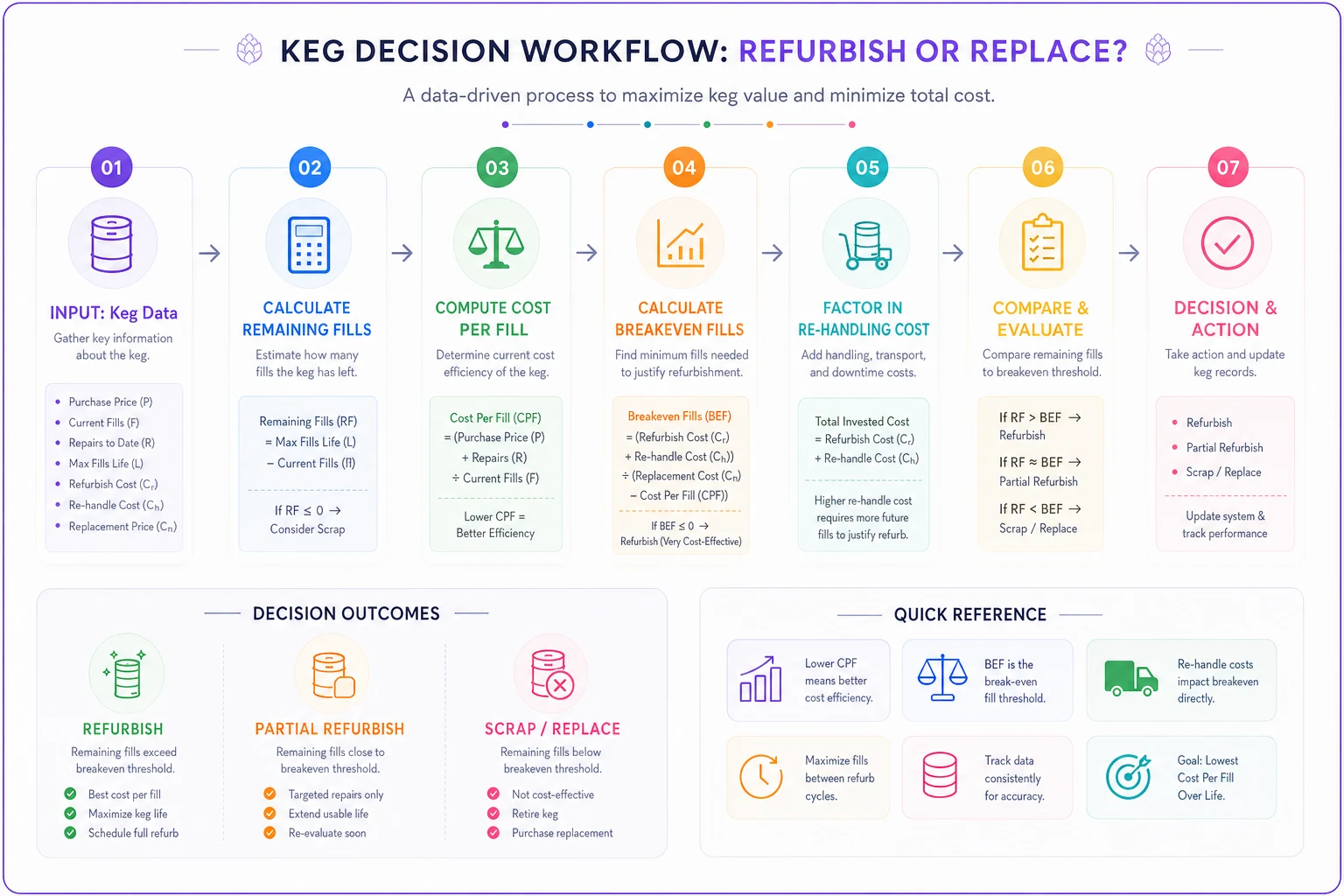
Hand this worksheet to the vendor and say: "Show me where each of these numbers lives in your system, and export me a report that reproduces this per-keg." Strong vendors will do it. Weak ones will say they're "working on reporting."
Mock report templates to request in every demo
Don't ask "do you have reporting?" Ask for specific reports by name and watch them build it live — or admit they can't. Request these five:
-
Per-keg lifetime cost report — one row per serial, columns for purchase price, cumulative repair cost, fills completed, cost-per-fill, projected remaining life.
-
Repair-frequency cohorts — kegs grouped by purchase year or supplier batch, showing repair rate per 100 fills. This is how you catch a bad supplier lot.
-
Breakeven remaining-fills report — flags kegs whose remaining expected fills are below the breakeven threshold for their last refurb. Your scrap shortlist.
-
Aged deposit ledger — deposits outstanding by customer, bucketed 0–30 / 31–60 / 61–90 / 90+ days, with dollar totals.
-
Dispute packet — for a single keg or deposit charge, a clean printable/exportable timeline: every scan, ship, return, and charge with timestamps and user IDs.
The dispute packet is the sleeper. Deposit disputes with distributors are where small breweries quietly bleed cash, because without a clean event trail you tend to just credit the account to keep the peace. A system that generates a one-click dispute packet changes those conversations entirely.
What the data actually looks like (ask for schema examples)
A vendor that's serious about lifecycle will hand you a sample event-history export without flinching. Ask for both JSON and CSV. You're checking that the data is granular enough to rebuild your TCO math outside their system if you ever need to.
{ "kegserial": "4471", "format": "1/6bbl", "purchasedate": "2021-03-14", "events": [ {"type": "fill", "date": "2024-02-02", "batch": "IPA-240", "user": "cellar02"}, {"type": "ship", "date": "2024-02-05", "account": "DIST-118"}, {"type": "return", "date": "2024-03-01", "condition": "leakspear"}, {"type": "inspection", "date": "2024-03-02", "defect": "spearseal", "photoid": "img9921"}, {"type": "repair", "date": "2024-03-03", "component": "spear", "repairtype": "partial", "laborcost": 6, "partscost": 5, "salvage_flag": false} ] }
The equivalent CSV should be one row per event with the same fields flattened. Red flag: if their export only gives you current status and last location, you can never reconstruct history. Ask directly — "Can I export the full event log per keg, not just current state?"
Inspection checklist + defect taxonomy
Your refurb data is only as good as the inspection that feeds it. Standardize the defect names before you buy anything, because if inspectors type free-text ("kinda dented," "spear weird") your cohort reports turn to mush.
A defect taxonomy worth adopting:
-
Spear/valve seal leak, stuck valve, bent spear, O-ring failure
-
Shell dent (minor/major), puncture, weld crack, chime damage
-
Coating/finish heavy oxidation, label residue, rust spotting
-
Hygiene off-odor, biofilm suspected, residual pressure
-
Identity missing/unreadable serial, damaged tag
Photo scoring rubric — require a photo for anything above "minor," and score severity 1–3:
-
1 (cosmetic) return to service, log only
-
2 (functional) route to refurb queue
-
3 (critical) quarantine, decide scrap vs full rebuild
Make sure the vendor's inspection step can attach photos to the serialized record and tie them to a defect code from your taxonomy. A photo floating in a separate app that nobody links back to is worthless in a dispute.
Require the photo attachment step to be mandatory for severity 2 and 3 defects so your dispute packets always include visual evidence.
A photo floating in a separate app that nobody links back to is worthless in a dispute.
Refurb SLA and warranty language to ask for
If you use a third-party refurbisher or the vendor offers refurb services, pin down the service terms before signing. Ask for:
-
Turnaround SLA days from receipt to return-to-service, with a penalty or credit if missed.
-
Pass/fail criteria pressure test spec, leak-down threshold, documented.
-
Warranty on repairs e.g., re-sealed spears warrantied for X fills or Y months — get the unit right (fills vs time matters).
-
Scrap handling who keeps salvage value, and is it credited back to you?
The warranty-unit detail trips people up. A "90-day warranty" on a keg that only gets filled twice in 90 days is nearly meaningless. "Warrantied for 25 fills" is the number that actually protects you.
IoT data-governance checklist (only if you're going sensor-based)
Most small fleets don't need IoT tags — barcode/NFC scanning plus good workflow discipline covers it. But if you're scaling past a few thousand kegs and considering sensors, govern the data before you drown in it:
-
Who owns the sensor data — you or the vendor?
-
Can you export raw sensor readings, or only vendor-processed summaries?
-
Retention period and deletion policy
-
What happens to your data if you leave the vendor?
-
Battery/replacement cost per tag per year (this quietly becomes a real line item)
For most readers: skip IoT until manual scanning genuinely can't keep up. The data-governance headache rarely pays off below a certain fleet size.
RFP / demo question checklist
Print this and run it against every vendor:
-
Can you export the full serialized event history per keg, in JSON and CSV?
-
Does the deposit ledger tie each deposit to a specific keg serial and customer account?
-
Can you auto-age outstanding deposits and alert on 60/90-day buckets?
-
Does the refurb workflow capture component-level repair cost (parts + labor) and a partial/full flag?
-
Can you generate a per-keg lifetime cost report live, right now, from this demo data?
-
Can you produce a dispute packet for a single keg's full history?
-
What's your API rate limit and is the schema documented publicly?
-
If we cancel, how do we get our data out, and in what format?
-
Who owns inspection photos, and are they tied to the serialized record?
The last two questions matter more than any feature. Data portability is what protects you from getting locked in.
A realistic before/after
A regional brewery running around 2,800 kegs was reconciling deposits in a spreadsheet and logging repairs on a clipboard. Their aged-deposit exposure was unknown — they estimated "maybe $15k" floating out there. After moving to a serialized system with deposit integration and a structured refurb log, the first clean aged-deposit report showed closer to $31k outstanding, with roughly $9k sitting past 90 days against two distributor accounts.
Nothing magic happened — they just finally had the dispute packets to go collect. Over the following two quarters they recovered most of the 90-day bucket and cut their scrap rate because the cohort report flagged a bad 2021 supplier batch they'd been refurbishing over and over instead of writing off.
That's the real value. Not the map. The map is table stakes.
When a heavier system makes sense (and when it doesn't)
If your fleet is under a few hundred kegs and mostly cycles through your own taproom and a couple of local accounts, you probably don't need deposit-ledger integration or refurb cohorts yet — disciplined scanning and a decent spreadsheet will do. The overhead of configuring a full lifecycle system won't pay back at that scale.
The heavier keg lifecycle management vendors earn their keep once you're distributing across multiple accounts, your deposit float is into five figures, and you're making real refurbish-vs-replace decisions every month. That's the point where per-keg history and dispute packets stop being nice-to-haves and start directly protecting cash.
Score vendors on the three rows that actually move money — serialized history, deposit reconciliation, and component-level refurb costing — bring your own TCO worksheet, and make them reproduce your numbers live. The vendor who can do that on the first demo is the one worth a pilot.
Ready to elevate your brewery operations?
Join 500+ craft breweries using Beeryly to increase production efficiency, reduce waste, and grow sales.