

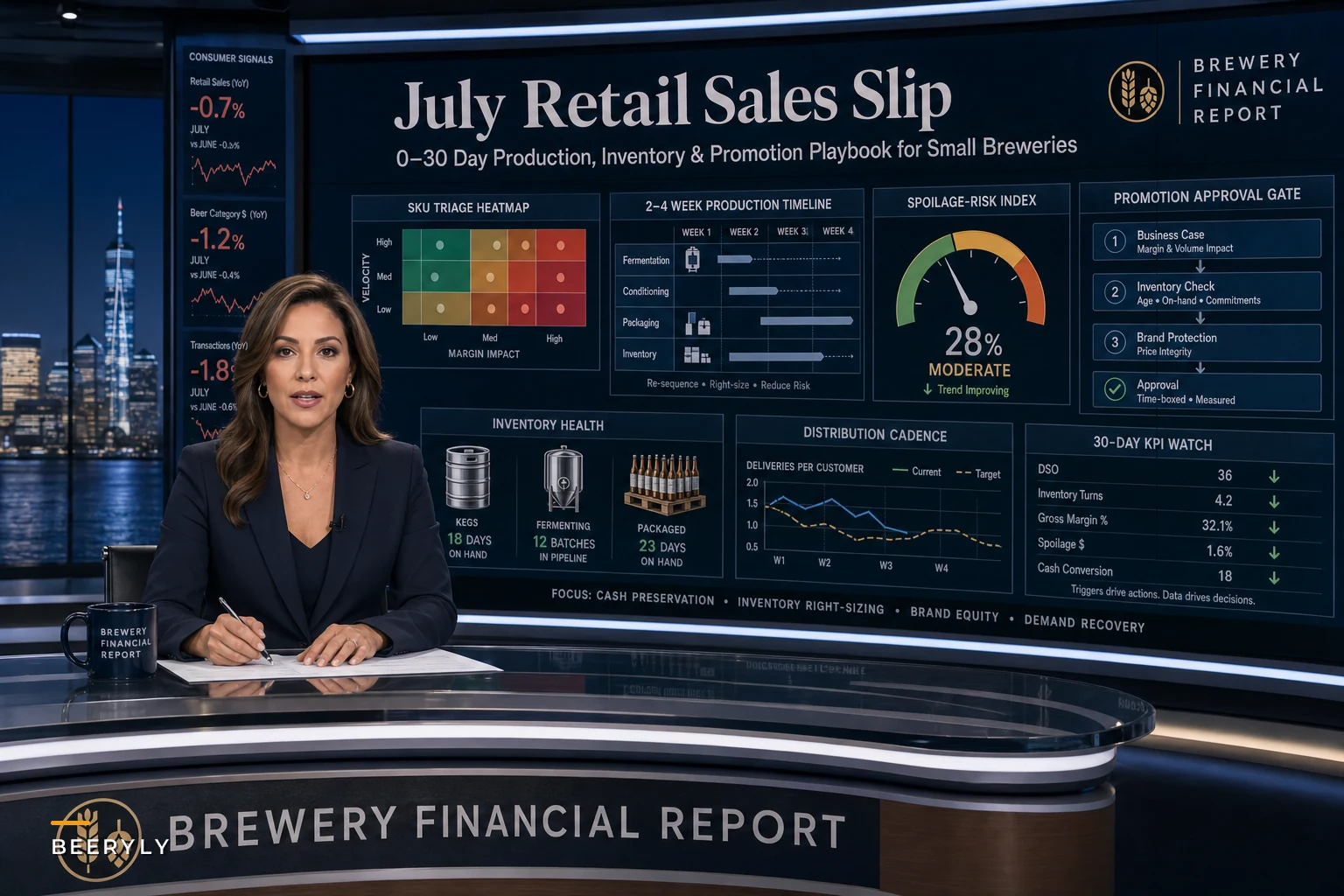

When U.S. retail sales slipped 0.6% in July 2026 — the first monthly drop in nine months, according to Reuters — most breweries didn't feel it right away. That's the trap. Retail softness shows up in your numbers on a delay. The taproom feels a little quieter, the distributor's reorder comes in a touch smaller, and then three weeks later you're staring at a cooler full of packaged seasonal beer brewed against a forecast that no longer exists.
The timing is what makes this one sting. A demand dip in February is annoying. A demand dip in the middle of peak selling season — when you've already committed to seasonal SKUs, locked in packaging orders, and staffed up your delivery routes — is a working-capital problem waiting to happen.
This isn't a piece about riding out the storm. It's about the specific, unglamorous production and inventory moves that separate breweries that come out of a slowdown lean from the ones that come out of it with a warehouse full of dated cans.
Read the signal correctly before you touch the schedule
The biggest mistake breweries make during a spending dip isn't overreacting. It's reacting to the wrong number.
A single soft week in the taproom is noise. A distributor pulling their weekly reorder down two weeks in a row while consumer sentiment also weakens — that's a pattern. Consumer confidence deteriorated in early August too, and Reuters noted the sentiment slide coincided with the retail pullback. When both the hard sales data and the mood are moving the same direction, you're not looking at a blip.
The practical distinction that matters operationally:
-
Volume decline that's evenly spread across SKUs usually means broad belt-tightening. People are still drinking, just less, or trading down. Your core lineup will hold up better than premium limited runs.
-
Volume decline concentrated in higher-price SKUs means consumers are trading down. Your $18 four-pack of the barrel-aged thing takes the hit first; your flagship pale ale barely moves.
-
Volume decline concentrated in on-premise pours while packaged holds steady means people are staying home. That's a taproom staffing and hours problem, not a production problem.
Diagnosing which of these you're in should happen before you cancel a single brew. Breweries that skip this step tend to slash flagship production alongside everything else, then get caught short when the flagship keeps selling and only the specialties collapsed.
Re-sequence, don't just cut
Once you know demand is genuinely softening, the instinct is to cancel runs. That's often the wrong first move — you've already got yeast propagated, hops on the floor, and tank time scheduled. Cancellation creates its own problems.
Take control of your brewery’s workflow.
Beeryly helps you schedule batches, track inventory, and monitor sales with ease.
- Production timeline management
- Inventory tracking & alerts
- Sales & distribution monitoring
No credit card required
The better early lever is re-sequencing: changing what you brew and when, not just how much.
A typical re-sequencing move looks like this. Say you had a seasonal fruited sour scheduled for a two-week window, followed by a flagship IPA run. The sour is exactly the kind of SKU that gets hit first in a trade-down environment. Instead of brewing both and hoping, you push the sour back three or four weeks and pull the flagship forward. You keep tanks full, keep cash cycling on beer that reliably sells, and buy yourself a month of real data before committing to the riskier SKU.
Re-sequencing also protects your packaging. Flagship beer goes into standard cans you'll always use. That fruited sour probably had custom-printed cans on order. Delaying the run gives you room to delay or trim that packaging PO instead of eating it.
A quick decision frame for each scheduled run
-
How fast does this SKU actually turn? Pull the last 8–12 weeks of depletion data, not last year's.
-
What's the shelf life vs. the realistic sell-through window? A hazy IPA with a 90-day quality window and a slowing sell rate is your highest-risk brew.
-
What committed costs are already sunk into it? Custom packaging, specialty ingredients, contract obligations.
-
Can it be delayed without losing the ingredients? Fresh hops and propagated yeast have their own clocks.
The runs that turn slowly, spoil quickly, and haven't burned committed cash yet are your first candidates to shrink or delay.
This diagram shows the typical decision flow for re-sequencing and delaying runs.
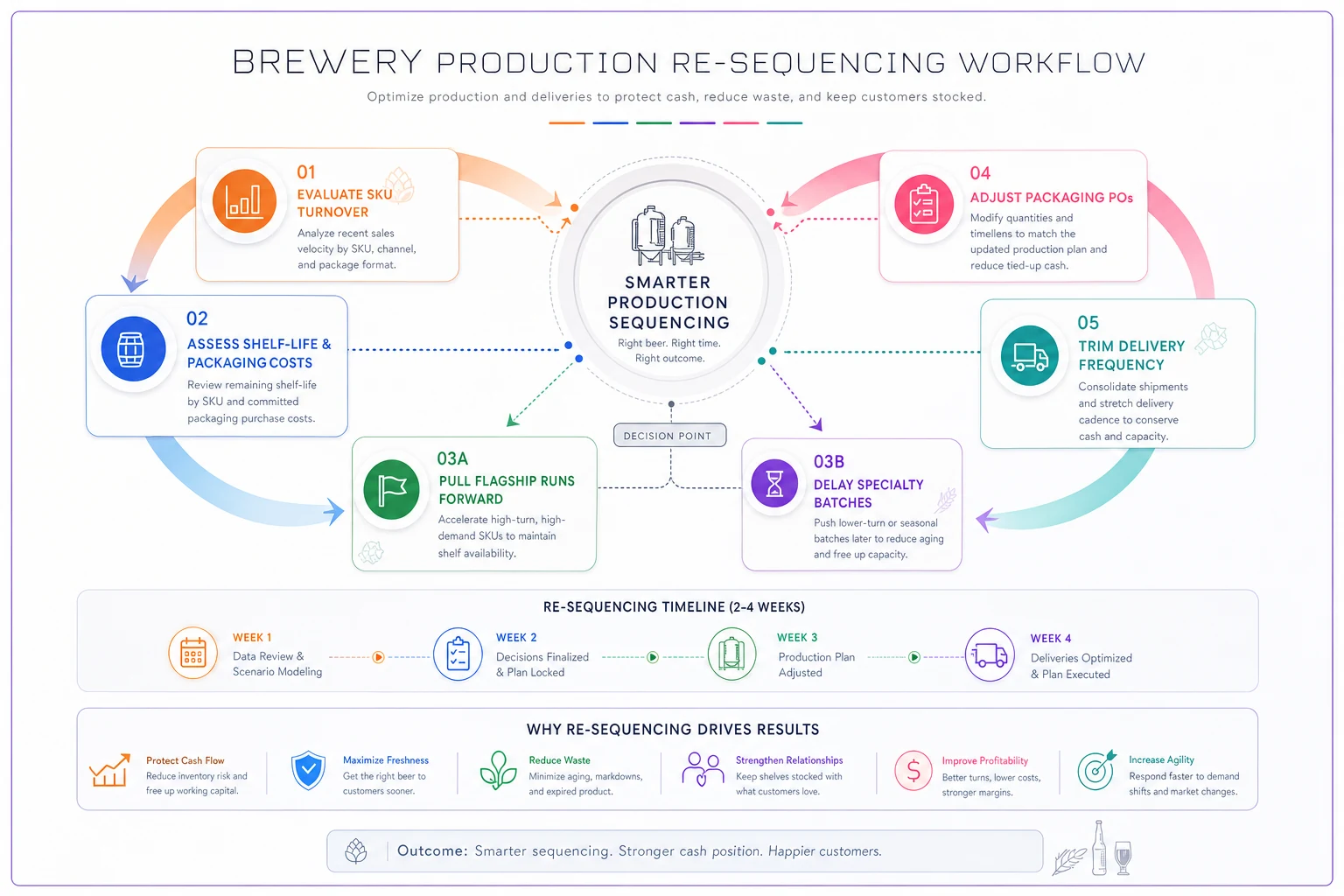
Re-sequencing also gives you breathing room to see if the softness is a blip or a trend before you commit to expensive packaging.
Where the money actually leaks during a slowdown
The visible cost of a demand dip is lost sales. The expensive cost is what happens to the beer and inputs you already committed to. Here's how those leaks compare:
| Leak point | How it shows up | Rough impact on a small brewery | How fast you can fix it |
|---|---|---|---|
| Over-packaged finished goods | Cans/bottles filled against a dead forecast | Product dated out before it sells; markdowns or dumps | Slow — it's already packaged |
| Excess perishable inputs | Hops, yeast, adjuncts ordered for canceled volume | Tied-up cash, some spoilage | Medium — depends on supplier flexibility |
| Cold-chain overcapacity | Delivery routes run at half-full | Fuel and labor per case climbs | Fast — adjust frequency |
| Unsold promotional SKUs | Limited runs made for a promo that underperforms | Deep discounts to clear | Slow — hard to reverse |
The pattern worth noticing: the leaks that hit hardest are the ones you can't fix quickly. That's why the real work happens upstream — in what you decide to brew and package — not downstream in discounting.
Packaged finished goods are the worst offender because they're the most committed form your inventory can take. Liquid in a tank still has options. You can hold it, blend it, repurpose it. Once it's in a printed can with a date code, your choices narrow to "sell it or lose it."
Tighten reorder rules on perishable inputs — carefully
When sales soften, the natural move is to slam the brakes on purchasing. But breweries that cut too aggressively on inputs end up whipsawed: they stock out on flagship ingredients right when demand stabilizes, then pay rush premiums to catch back up.
The smarter adjustment is to recalculate safety stock against your revised demand, not zero it out. If your flagship was moving 40 barrels a week and it's now doing 32, your reorder points should reflect 32 — not the panic assumption that everything's collapsing.
A few specific moves that hold up during a dip:
-
Shorten your forecast window. During stable periods you might plan four to six weeks out. During volatility, tighten to two to three weeks so you're never committing far ahead of real data.
-
Split large POs into smaller, more frequent orders where suppliers allow it — even if the per-unit cost ticks up slightly. The flexibility is usually worth more than the volume discount when demand is uncertain.
-
Prioritize inputs by spoilage risk, not cost. A cheap bag of specialty malt that keeps for a year is lower risk than expensive fresh yeast you have to use now.
Split large POs where possible — a small per-unit premium is often cheaper than rush fees and spoilage when demand rebounds.
This is really an extension of getting perishable inventory right in general. If your reorder logic and shelf-life tracking aren't already tight, a slowdown is the moment those weaknesses cost you cash. We went deeper on the mechanics in our guide on cutting spoilage and working capital with a perishable-inventory strategy — a demand dip just raises the stakes on all of it.
Pulling back promotions without killing momentum
Promotions are the fastest thing to cut and usually the first thing breweries slash. Done bluntly, that's a mistake.
There's a real difference between promotions that move volume you already have and promotions that require you to produce new SKUs. During a slowdown, the first type can actually be useful — a taproom flight special or a case discount on flagship beer helps you cycle inventory and cash. The second type — a limited-run collaboration you have to brew and package specifically for the promo — is exactly what you should pause.
The trap is committing production to a promotion whose demand assumption just evaporated. You planned a summer release around foot traffic that isn't showing up. Now you've got a specialty batch with custom packaging and no audience.
When cutting a promotion makes sense:
-
It requires a dedicated production run
-
It targets premium or specialty price points in a trade-down environment
-
It has custom packaging with committed lead times
-
The sell-through assumption depended on strong foot traffic or discretionary spending
When you should keep it:
-
It moves existing inventory you're already holding
-
It's low-cost to execute (taproom-only, no new production)
-
It protects a distributor relationship or shelf position
-
It clears aging finished goods before they date out
That last point is underrated. A well-timed discount on beer that's approaching the edge of its quality window is cash recovery, not a promotion. You're choosing partial revenue over a total loss.
Real scenario: a 4,000-barrel brewery caught mid-season
A regional brewery running around 4,000 barrels a year had built its summer schedule around three seasonal SKUs and an aggressive taproom promo calendar. When their distributor's reorders came in soft two weeks running and taproom traffic dropped noticeably, they had two seasonal runs and a batch of custom-canned specialty beer already committed.
What they did, roughly in order:
-
Delayed the second seasonal run by about a month and pulled a flagship batch forward to keep tanks productive.
-
Canceled a custom can PO for one specialty SKU that hadn't shipped yet — ate a small deposit but avoided roughly $5k–$6k in printed cans they'd have been stuck with.
-
Cut cold-chain delivery frequency on their two slowest routes from weekly to every other week, since trucks were running well under capacity.
-
Ran a taproom-only flight and case-discount promo to move existing packaged inventory instead of launching the new specialty release.
The specialty beer they'd already packaged still needed clearing, and they discounted it to move it before it dated — not ideal, but better than dumping it. Over roughly two months, the combination of delayed runs, trimmed delivery frequency, and the canceled packaging PO saved them somewhere in the range of $12k–$16k in avoided spoilage, unused packaging, and delivery cost. Not a dramatic rescue. But for a brewery that size, that's the difference between a stressful quarter and a genuinely painful one.
None of these were heroic moves. They were fast, unsentimental decisions made because someone was actually watching the right signals.
The underlying problem a slowdown exposes
A demand dip doesn't create new problems in a brewery. It exposes the ones that were already there — the loose handoff between sales and production, the forecast nobody updates, the reorder points set on last season's numbers and never revisited.
Breweries that navigate a slowdown well usually aren't smarter about the market. They just have tighter feedback loops. When sales-versus-plan, inventory days, and spoilage are visible and updated frequently, a soft two weeks triggers a schedule review automatically instead of getting noticed a month too late when the cooler's already full.
That's really a data and coordination problem. When your depletion data, tank schedule, packaging POs, and delivery routes live in separate spreadsheets updated by different people, you can't react in the two-to-three-week window that actually matters. The breweries that respond fastest are the ones where a dip in one number visibly moves the others — a slowing SKU flags the upcoming run and the packaging order tied to it, all in one place. Whether that's a disciplined set of connected spreadsheets or an operations platform pulling it together, the goal is the same: see the change early enough to still have options.
The takeaway
A retail slump mid-season is uncomfortable, but it's survivable. The breweries that handle it best treat it as a re-sequencing exercise, not a fire sale. Diagnose which kind of decline you're actually in before touching the schedule. Delay and shrink the riskiest runs before you cut your reliable ones. Recalculate safety stock instead of zeroing it out. Pause promotions that require new production, keep the ones that clear what you already have.
The demand will come back. What you don't want is to enter the recovery with your cash tied up in dated cans and inputs you bought against a forecast the market already abandoned. The moves are boring, and that's exactly why they work.
Ready to elevate your brewery operations?
Join 500+ craft breweries using Beeryly to increase production efficiency, reduce waste, and grow sales.