

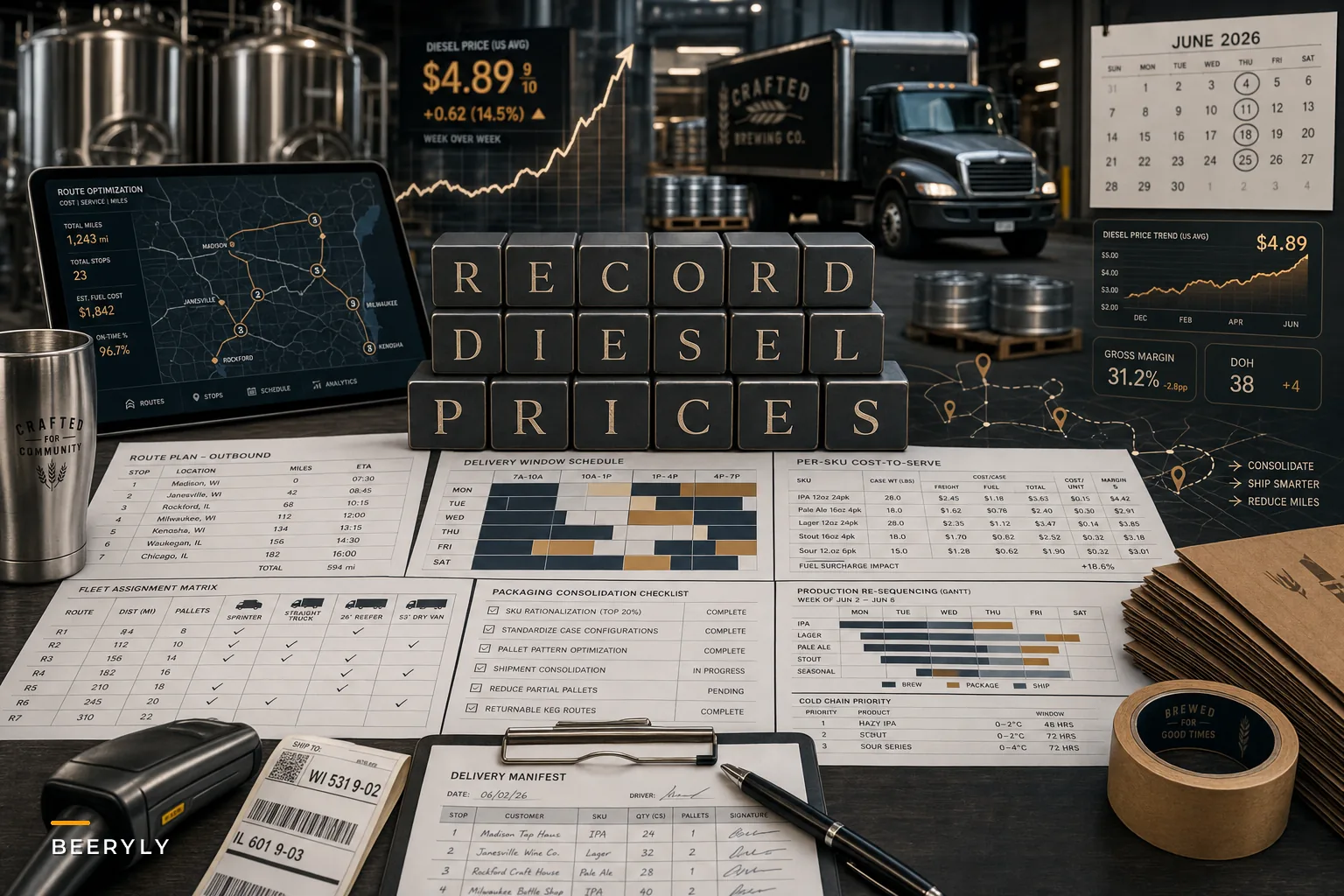

Diesel crossing $6/gal across much of the country this fall isn't just a bad line item on a carrier invoice. For most regional breweries, freight and last‑mile delivery already sit somewhere between the third and fifth biggest cost center after ingredients, labor and packaging. When fuel underneath that cost jumps 20–30% in a matter of weeks, it doesn't hit evenly. It hits your longest routes, your lightest drops, and your lowest‑margin SKUs hardest — which, annoyingly, tends to be the same handful of accounts you've been meaning to fix for two years and never got around to.
The spike itself is well documented. Bloomberg reported that diesel's record run is sidelining truckers and squeezing budgets as refining capacity tightens, and Reuters noted the knock‑on effect on freight and food prices as carriers reprice. That's the context. But reading about why diesel is expensive doesn't lower your cost‑to‑serve. What follows is the operational side — where the money actually leaks and what you can realistically change in the next few weeks.
Where the fuel increase actually lands (it's not where most owners look)
The instinct when fuel spikes is to stare at the surcharge line on carrier invoices and try to negotiate it down. That's the wrong starting point. The surcharge is a symptom. The real exposure is in your route and drop structure, and most breweries have never mapped it properly.
Fuel cost scales with miles and stops, but revenue per stop varies wildly. A self‑distribution van running a dense metro loop might hit 11 accounts in 40 miles. A second route might burn 130 miles to service four rural accounts that each take a few cases. When diesel was $4, that rural route was marginal. At $6+, it's underwater — you're paying to deliver beer.
| Route type | Miles/run | Stops | Cases delivered | Approx. fuel cost/run @ $6 | Fuel cost per case |
|---|---|---|---|---|---|
| Dense metro | ~40 | 11 | ~280 | ~$36 | ~$0.13 |
| Mixed suburban | ~85 | 7 | ~190 | ~$77 | ~$0.40 |
| Rural long‑haul | ~130 | 4 | ~95 | ~$118 | ~$1.24 |
That spread tells the whole story. The rural route is costing roughly ten times as much per case in fuel alone compared to the metro loop — and that's before you factor in driver hours, which are also longer per case. Most breweries track delivery cost as one lump number against total volume. Averaged out, it completely hides the routes that are quietly bleeding.
The deeper problem: fuel just exposed a delivery frequency habit nobody questioned
What this price spike really surfaces is that most self‑distributing breweries settled into a delivery cadence years ago — "we do the north side Tuesdays, south side Thursdays" — and never revisited it. Those schedules were built around convenience and keeping accounts happy, not around cost.
Take control of your brewery’s workflow.
Beeryly helps you schedule batches, track inventory, and monitor sales with ease.
- Production timeline management
- Inventory tracking & alerts
- Sales & distribution monitoring
No credit card required
The habit that quietly kills margin is high‑frequency, low‑volume drops. An account ordering six cases twice a week because a rep said yes to it in 2023 and it just became routine. At $4 diesel, two half‑empty runs to that account were annoying. At $6+, it's a measurable loss you're eating twice a week.
In practice this usually shows up as a cluster of accounts that each individually seem fine but collectively force an extra run or an extra 50 miles of backtracking. The fuel spike doesn't create that problem — it just makes it finally visible on the P&L. Which is actually useful, if you treat it as a prompt to fix the structure rather than just a temporary squeeze to ride out.
Delivery frequency is a pricing decision disguised as a service decision. Almost nobody treats it that way.
Consolidation: the single highest‑leverage move, and how to do it without losing accounts
Reducing drop frequency sounds like it'll anger accounts. Done bluntly, it will. Done with a minimum‑order threshold and some advance coordination, most accounts barely notice.
The core tactic: shift accounts from "whenever they order" to scheduled delivery windows with a minimum case count. If an account can't hit the minimum for their window, they roll to the next one. You frame it as a reliability improvement — fixed delivery days — not a cutback. Which is genuinely true, so it's not a hard sell.
A practical rollout:
-
Pull 8–12 weeks of order history by account. Flag every account whose average order falls below your break‑even case count for its route distance.
-
Set two tiers of delivery windows — metro accounts get twice weekly, anything beyond your distance threshold gets once weekly or biweekly.
-
Establish a minimum order per drop tied to route cost. For long routes this might be 15–20 cases; for metro drops, much lower.
-
Give accounts a short lead window to adjust their ordering patterns. Most will simply order a bit more, a bit less often. That's the outcome you want.
-
Batch the stragglers. Accounts that can't meet minimums get grouped onto a single consolidated route run less frequently, or moved to a distributor or third‑party if the math says so.
The mistake is announcing a blanket policy change to every account at once. You don't need to. The 20% of accounts driving your worst routes are where you focus. Leave your dense, profitable metro drops exactly as they are — there's no fuel problem there.
When consolidation makes sense
-
You self‑distribute or run a mixed fleet with real route flexibility
-
You have a long tail of small, scattered accounts
-
Your delivery cadence hasn't been reviewed in over a year
When it's a bad idea
-
Accounts are contractually tied to delivery frequency (check before you touch anything)
-
You're in a hyper‑competitive market where a distributor will happily take the account you deprioritize
-
The SKU is perishable enough that stretching frequency risks stale product on shelf — fresh hop and unpasteurized styles especially
Leave your dense, profitable metro drops exactly as they are — there's no fuel problem there.
Reworking run sizes and production cadence around slower, pricier freight
Fuel cost doesn't only hit outbound delivery. It flows backward into inbound freight on malt, cans, and anything you truck in. Reuters covered how states are scrambling to respond to fuel costs precisely because it ripples through every goods‑moving business. For a brewery that means two adjustments worth thinking through.
Outbound: if you're consolidating delivery frequency, production and packaging schedules need to match. There's no point stretching an account to biweekly delivery if you're still packaging that SKU in weekly batches — you lose the changeover savings and hold inventory longer than necessary. Align batch sizes to the new delivery rhythm so you package once for a longer window. Inbound: higher freight rewards fuller inbound loads. The mistake is over‑correcting into oversized buys that blow up working capital or risk spoilage on anything perishable. The balance is ordering in full‑pallet or full‑truck increments on shelf‑stable inputs — cans, bottles, dry malt — while keeping perishable and specialty items on tighter cycles.
Order history → Identify consolidation candidates → Set delivery windows → Align packaging batch sizes → Adjust inbound ingredient timing
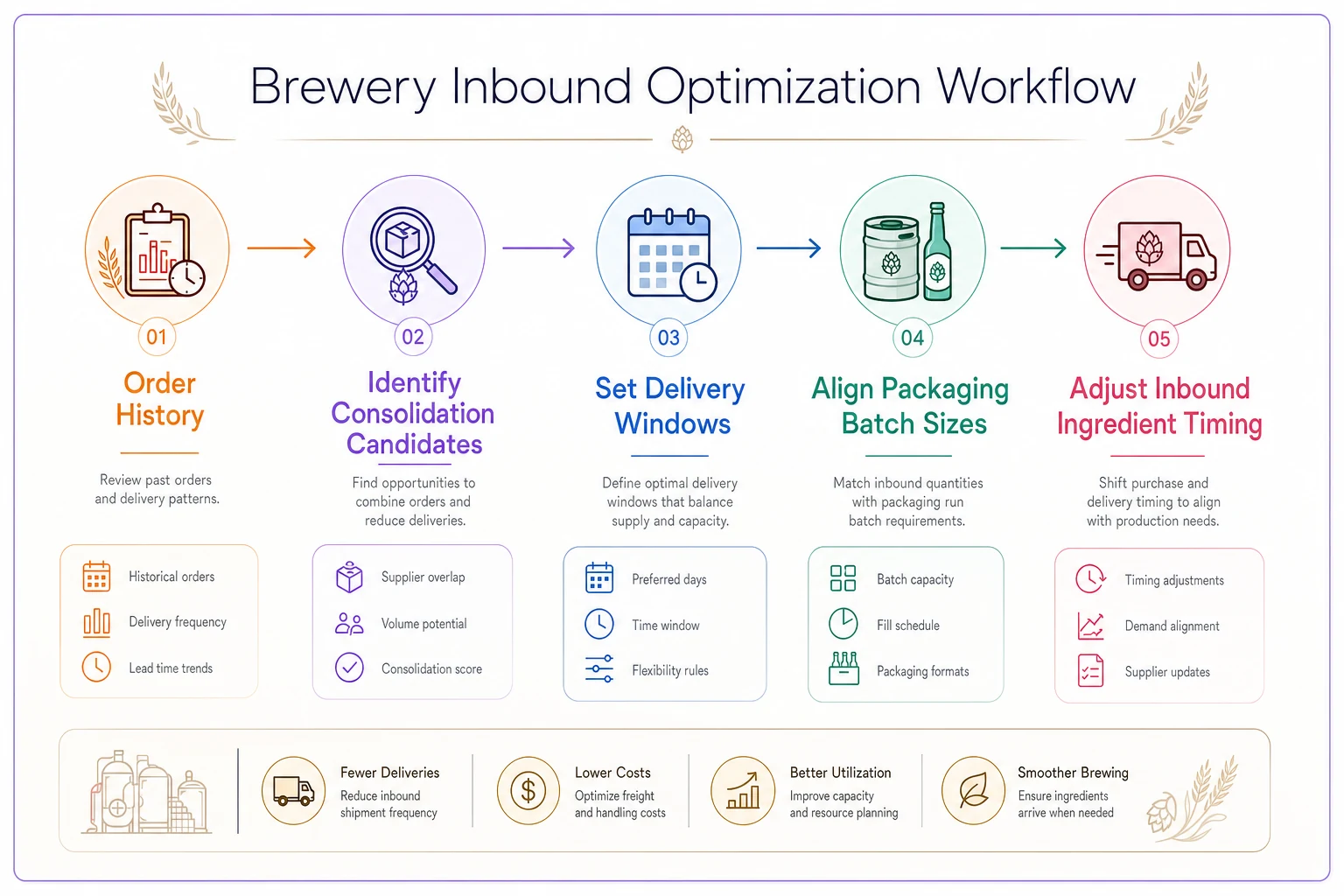
Change one link in that chain and the others have to move with it, or you just shift the cost somewhere else instead of removing it.
Per‑SKU cost‑to‑serve: the number that tells you what to cut
This is where fuel pressure forces a conversation breweries tend to avoid — some SKUs aren't worth shipping at the new freight cost. A low‑margin seasonal in heavy glass, going to distant accounts in small quantities, might have a fully loaded cost‑to‑serve that now exceeds its contribution margin.
You don't need a perfect model. Add fuel‑adjusted freight cost per case to each SKU's existing cost structure and sort the list. The SKUs at the bottom are candidates for:
-
Format change — move it from bottles to cans to cut weight and freight cost
-
Geographic limiting — sell it only within your low‑cost delivery radius
-
Minimum‑order gating — only ship it in combined orders with faster movers
-
Retirement — if it's chronically underwater, the fuel spike is probably just confirming what you already suspected
A quick checklist to run on any SKU you're unsure about:
-
[ ] What's its freight cost per case at $6 diesel on its actual routes, not your blended average?
-
[ ] What's its contribution margin after that freight cost?
-
[ ] How many of its accounts fall outside your dense delivery zone?
-
[ ] Could a lighter package format change the math enough to keep it viable?
-
[ ] If you dropped it, would you lose the account entirely or just that one line?
That last question matters more than people expect. Dropping a losing SKU is straightforward when the account buys five others from you. It's a completely different decision when it's the only thing they order.
A real scenario
A regional brewery doing around 9,000 BBL a year, self‑distributing with three trucks across a mix of metro and rural accounts, ran this exercise after fuel jumped. Their average delivery cost looked acceptable on paper. Route‑level attribution told a different story: two long rural routes were running at a fuel‑plus‑labor cost that wiped out the margin on roughly 30 accounts, most of them ordering well under a pallet per visit.
They didn't fire anyone or drop accounts. They moved those routes from weekly to biweekly with a 15‑case minimum, consolidated two overlapping runs into one, and shifted a heavy bottled seasonal to cans for the distant market. Nothing dramatic. Over the following quarter they saw a reduction of roughly $1.00–$1.20 per case on the worst routes, and kept all but two accounts — both of which were marginal anyway. The seasonal's freight cost fell enough that it went from a loss leader to actually contributing margin.
The point isn't the exact numbers. The fix was structural and nearly free — rescheduling and repackaging, not renegotiating surcharges.
Fitting this into mixed‑fleet decisions
Most of what's above comes down to assigning the right vehicle and the right frequency to the right cluster of accounts — which is fundamentally a mixed‑fleet problem. If you run a combination of your own vans, box trucks, and third‑party carriers, fuel pressure changes which tool wins for which route.
Short dense loops stay on your efficient vehicles. Long thin routes that just got punished by fuel are often exactly the ones to hand off or consolidate. The logic and templates for sorting that out are covered in detail in our breakdown of mixed‑fleet distribution heuristics and assignment templates, which pairs directly with the route‑cost thinking here.
Keeping all of this coordinated — order history, route cost, delivery windows, batch sizing — gets hard to manage on spreadsheets once you're past a handful of routes. Operational software that ties account order patterns to route cost and production scheduling earns its keep in exactly this situation. It keeps the chain of decisions connected so a change in delivery frequency flows into packaging and inbound planning automatically, instead of relying on someone to remember to update three separate sheets. The value isn't the software itself — it's that the attribution stays current when fuel moves again, instead of going stale the moment the situation changes.
The part that outlasts the price spike
Diesel will come back down eventually. As NPR laid out in its explainer on why diesel runs the U.S. economy, the fundamentals swing both ways. But the structural fixes you make now — route‑level cost attribution, delivery windows with minimums, batch sizes aligned to delivery cadence, per‑SKU freight visibility — keep working when fuel is cheap too. You just capture savings you were leaving on the table before.
Treat the spike as the forcing function it is. The breweries that come out of this stronger won't be the ones who found a cheaper carrier. They'll be the ones who finally looked at which routes and which SKUs were quietly losing money all along, and fixed the structure instead of waiting for the price to drop.
Treat the spike as the forcing function it is. The breweries that come out of this stronger won't be the ones who found a cheaper carrier. They'll be the ones who finally looked at which routes and which SKUs were quietly losing money all along, and fixed the structure instead of waiting for the price to drop.
Ready to elevate your brewery operations?
Join 500+ craft breweries using Beeryly to increase production efficiency, reduce waste, and grow sales.