

Your fermenter schedule looks clean. Each batch moves to bright tanks on time. Yet somehow you're always waiting for tanks to free up, watching beer sit in primary longer than it should while your next batch of wort has nowhere to go.
Tank bottlenecks in breweries happen when conditioning times overlap in ways that seem fine on paper but create cascading delays in practice. The problem isn't capacity—most 7-15 BBL breweries have enough tanks. The problem is sequencing.
Why tank scheduling breaks down during conditioning
Conditioning times vary way more than fermentation times. A standard IPA might condition for 3-5 days. A lager needs 14-21 days. Your imperial stout? Could be 28+ days. When you schedule based on fermentation alone, these varying conditioning periods stack up unpredictably.
The real killer happens around day 8-12 of your production cycle. Multiple batches converge on your bright tank capacity simultaneously. Your wheat beer finishes primary fermentation. Your pale ale needs to move. Your IPA is ready for dry hopping then transfer. Suddenly three beers need tank space at once.
Most breweries handle this by extending fermentation time—leaving beer on yeast an extra 3-4 days "just to be safe." But extended yeast contact changes your beer profile. Autolysis flavors creep in. Hop character fades. Your consistency suffers.
Short-conditioning alternatives that maintain quality
Not every beer needs two weeks in a bright tank. Here's what works for different styles without compromising quality:
Take control of your brewery’s workflow.
Beeryly helps you schedule batches, track inventory, and monitor sales with ease.
- Production timeline management
- Inventory tracking & alerts
- Sales & distribution monitoring
No credit card required
Forced carbonation with inline injection Works for: IPAs, pale ales, wheat beers Timeline: 24-48 hours vs 5-7 days natural Setup: Carbonation stone in bright tank or inline carbonator during transfer
Run CO2 at 30 PSI for 24 hours at 34°F, then drop to serving pressure. The key is maintaining tank temperature below 36°F during forced carb to prevent foaming and ensure proper CO2 absorption. Your dissolved oxygen stays below 50 ppb if you purge properly.
Krausening for natural carbonation Works for: Lagers, pilsners, traditional styles Timeline: 3-4 days vs 7-10 days standard Process: Add 10-15% actively fermenting wort during transfer
| Beer Style | Target CO2 Volumes | Krausen Addition (7 BBL batch) | Timeline |
|---|---|---|---|
| Wheat Beer | 2.3-2.5 | 0.6-0.7 BBL high-krausen wort | 3-4 days |
| IPA | 2.4-2.6 | 0.7-0.8 BBL high-krausen wort | 3-5 days |
| Lager | 2.5-2.8 | 0.8-0.9 BBL high-krausen wort | 4-6 days |
Calculate krausen addition based on target volumes. For a 7 BBL batch targeting 2.5 volumes CO2, you need roughly 0.7 BBL of high-krausen wort. This provides natural carbonation while the fresh yeast cleans up any fermentation byproducts.
Centrifuge or filter then force carb Works for: High-volume flagship beers Timeline: 4-6 hours vs 3-5 days cold crash and settle Investment: $15k-40k for small centrifuge
Run beer through centrifuge at 4,000-6,000 RPM, removing yeast and proteins instantly. Clarity matches 5-day cold conditioning. Then force carbonate in 24 hours. Total tank time drops from 7-10 days to under 48 hours.
When estimating krausen addition, calculate based on target CO2 and round up slightly to ensure consistent carbonation on bottling day.
Run CO2 or adjust processes conservatively at first to validate flavor outcomes before applying to full production.
Tank sequencing workflow for preventing bottlenecks
[Tank Sequencing Decision Flow] Beer Ready for Transfer → Check Available Tank Capacity → If Available: Transfer Immediately → If Unavailable: Apply Sequencing Rules → Rule 1: Stagger by Half Conditioning Time → Rule 2: Alternate Long/Short Styles → Rule 3: Tank Dedication by Timeline → Rule 4: Build Transition Buffers → Schedule Adjustment → Monitor for Future Conflicts
The core approach involves two changes: switching to short-conditioning methods for specific beer styles, and implementing hard sequencing rules that prevent convergence points.
Rule 1: Stagger same-style brews by half their conditioning time If your IPA conditions for 6 days, start your next IPA batch 3 days after the first, not 7 days. This creates a continuous flow rather than batch clusters. Your tank utilization improves by roughly 35% just from this change.
Rule 2: Alternate long and short conditioning beers Follow your 14-day lager with a 3-day wheat beer, not another lager. The short-conditioning beer clears tank space while the long-conditioning beer occupies its tank. Think Tetris—fitting different shaped blocks together efficiently.
Rule 3: Dedicate specific tanks to specific conditioning times
-
Tank 1 and 2
Short conditioning (under 5 days)
-
Tank 3 and 4
Medium conditioning (5-10 days)
-
Tank 5
Long conditioning (10+ days)
This prevents a long-conditioning beer from blocking a tank needed for quick turns. Small breweries using this system see 20-30% throughput gains without adding tanks.
Rule 4: Build buffer time only at transition points Instead of padding every transfer with 2-3 days "just in case," build one 48-hour buffer between your fermentation block and conditioning block. If something runs long, you have cushion. If everything runs on time, you can pull that next batch forward.
Visualize the decision flow to help operators follow the steps when a tank becomes unavailable.
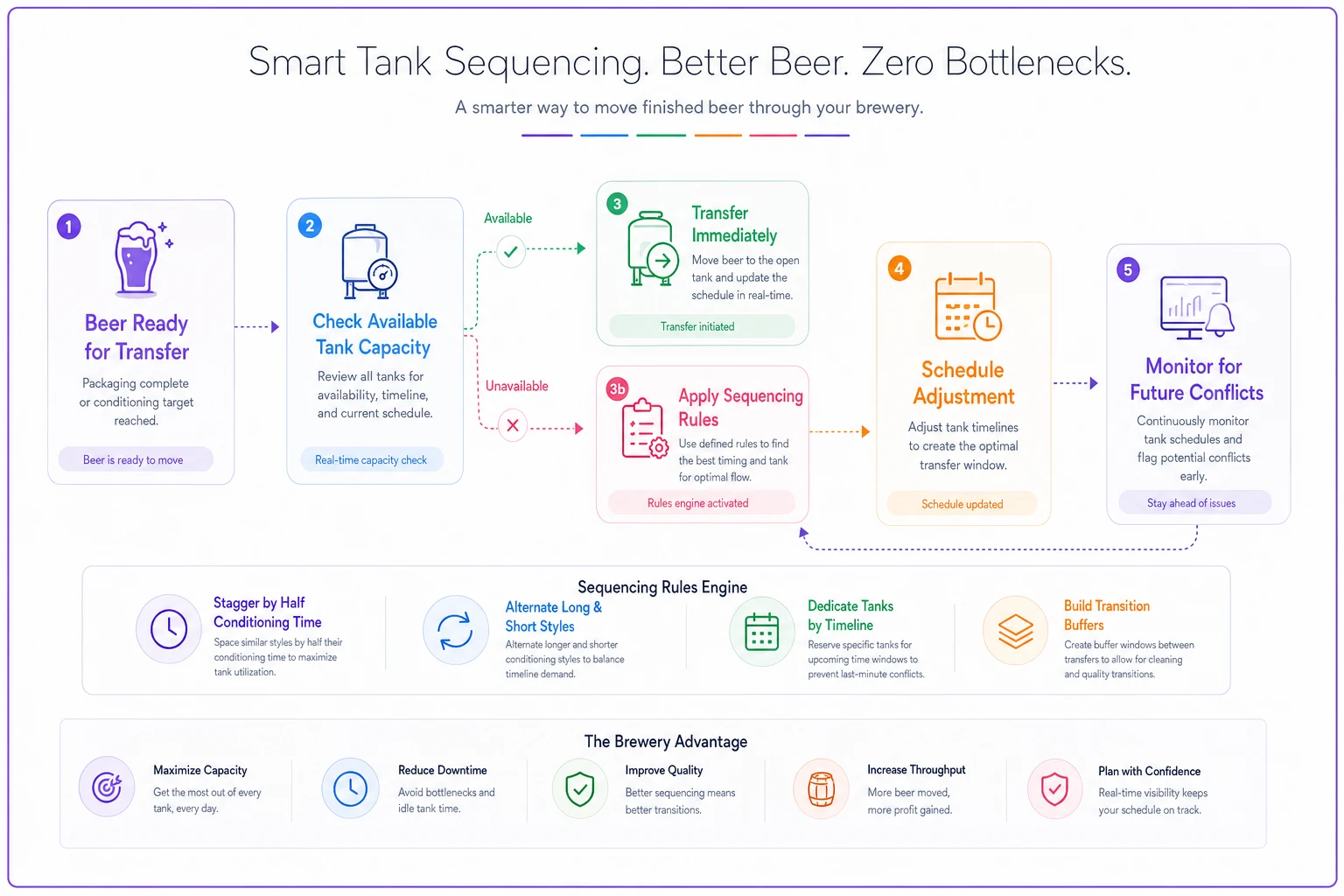
Use this flow as the basis for a checklist so decisions are consistent and predictable across all shifts.
Before and after: Regional brewery case examples
Before: Convergence chaos A 10 BBL brewery in Colorado ran this schedule:
-
Monday
Brew IPA (7 day ferment, 7 day condition)
-
Wednesday
Brew Stout (10 day ferment, 14 day condition)
-
Friday
Brew Wheat (5 day ferment, 4 day condition)
By day 12, all three beers needed bright tank space within 48 hours. They had four bright tanks but could only use two (others were serving). Result: The IPA sat on yeast an extra 4 days. The wheat developed unexpected esters. The stout schedule pushed into the next week's production.
Monthly output: 280 BBL with quality inconsistencies
After: Sequenced flow New schedule with sequencing rules:
-
Monday
Brew Wheat (5 day ferment, 2 day force carb)
-
Thursday
Brew IPA (7 day ferment, 4 day krausen condition)
-
Following Tuesday
Brew Stout (10 day ferment, 14 day condition)
The wheat clears by day 7, freeing space for the IPA. The IPA clears by day 15, creating room for the stout. No convergence. No extended yeast contact.
Monthly output: 385 BBL with consistent quality The 37% throughput gain came purely from sequencing and conditioning changes. No new tanks. No staff additions.
Decision tree for handling active bottlenecks
When you hit a tank bottleneck mid-cycle, here's your decision framework:
Is the blocking beer a flagship that needs consistency? → Yes: Move it on schedule, delay the waiting batch → No: Continue below
Can you force carbonate without changing the profile? → Yes: Transfer and force carb in 36 hours → No: Continue below
Is there a partial volume you can keg/can early? → Yes: Package 30-50% to free tank space → No: Extend the current fermentation by 48 hours maximum
For the delayed batch, can you cold crash harder (28°F vs 34°F) to accelerate settling? Add finings to clear faster? Adjust dry hop schedule to use tank time productively? Making deliberate choices rather than letting delays cascade through your schedule prevents the scrambling that kills efficiency.
Common sequencing mistakes to avoid
Scheduling all flagships together: Your three core beers might represent 70% of volume, but brewing them simultaneously creates massive bottlenecks. Stagger them throughout your schedule.
Ignoring seasonal patterns: Summer wheat beer demand might double, requiring different sequencing than winter. Build separate sequence templates for peak seasons.
Assuming faster is always better: Rushing conditioning to free tanks often backfires. Off-flavors from incomplete conditioning create quality issues that damage reputation more than delayed production.
Planning at 100% capacity: Tank scheduling needs 20% slack for cleaning, maintenance, and unexpected delays. Plan at 80% capacity maximum.
One brewery discovered their "5-day IPA conditioning" actually averaged 6.2 days because they always started weekend transfers on Monday morning instead of Sunday. Those extra 36 hours per batch created monthly bottlenecks they couldn't figure out.
Measuring improvement
Track these metrics before and after implementing sequencing rules:
-
Tank utilization rate
(Days beer in tank) / (Total tank days available) - Target: 75-85% - Below 70%: You have excess capacity or poor sequencing - Above 90%: You're running too tight, risking quality issues
-
Average tank residence time by style
- Wheat/Wit: 7-9 days total - IPA/Pale: 10-14 days total - Lager: 21-35 days total - Stout/Porter: 14-21 days total
-
Bottleneck frequency
Number of times per month a batch waits for tank space - Target: Less than 2 per month - Current average for 10 BBL breweries: 5-7 per month
-
Extended fermentation events
Times you leave beer on yeast longer than planned - Target: Zero for flagships, less than 15% for seasonals
When a regional brewery in Vermont applied these sequencing rules, their tank utilization went from 68% to 82%. More importantly, their "beer waiting for tanks" incidents dropped from 6 per month to 1. Five fewer batches sitting on yeast too long, developing unwanted flavors.
Setting up preventive scheduling systems
A simple spreadsheet with color coding prevents most bottlenecks. Map each beer's total tank time (fermentation + conditioning) as colored blocks. When blocks overlap, you've found a future bottleneck.
But manual scheduling breaks down around 15-20 batches per month. The complexity grows exponentially with volume. A 7 BBL brewery managing 8 batches monthly can use manual methods. At 20+ batches, the interactions between different conditioning times become impossible to track mentally.
Modern brewery management platforms use AI automation to spot bottleneck patterns weeks in advance. They suggest schedule adjustments, track actual vs planned timings, and learn your specific conditioning variations. The automation handles what humans struggle with: remembering that your wheat beer actually takes 6 days not 5 when ambient temperature drops below 65°F. Or that your IPA dry hop extends timeline by 36 hours during double dry hop variants.
AI-powered operational software tracks your actual conditioning times (not theoretical ones), factors in your packaging schedule, and suggests optimal sequencing. It alerts you to future bottlenecks while you still have time to adjust. For example, the software might notice that scheduling your coffee stout on November 3rd will create a tank collision with your winter warmer on November 18th. It suggests moving the coffee stout to October 31st, preventing the issue entirely.
The operational efficiency gained from avoiding just two tank bottlenecks monthly typically saves 15-20 hours of scrambling and replanning. Time you can spend on recipe development, quality control, or sales instead. These platforms also learn from your actual results. If your wheat beer consistently takes 6 days instead of 5 during winter months, the system adjusts future schedules automatically.
Your next steps
Tank bottlenecks aren't usually a capacity problem—they're a sequencing problem. Start by mapping your current tank schedule visually. Look for convergence points where multiple beers need tank space simultaneously.
Then implement one change at a time. Try forced carbonation on your next IPA. Stagger your flagship production by half the conditioning time. Dedicate specific tanks to specific beer categories.
Most breweries see throughput improvements within 3-4 weeks of implementing proper sequencing. The beer quality improves too, since you're not leaving anything on yeast longer than necessary or rushing conditioning to free space.
The goal isn't maximum speed—it's consistent flow. When beer moves through your brewery predictably, everything else falls into place. Labor scheduling becomes easier. Raw material ordering stabilizes. Cash flow improves from more consistent packaging schedules.
Tank bottlenecks feel like an inevitable part of brewing, but they're not. With the right sequencing rules and conditioning alternatives, you can improve throughput 25-40% using your existing equipment.
Ready to elevate your brewery operations?
Join 500+ craft breweries using Beeryly to increase production efficiency, reduce waste, and grow sales.